Prints & drawings
Six views of the Franciscan missions of California
F. Mela Medina · Palma del Río (Córdoba), Spain · c. 1950
Six oil paintings by F. Mela Medina, commissioned c. 1950 by Félix Moreno Ardanuy for the former Franciscan monastery of Palma del Río; the only set of California mission views painted in Spain
FM-0088
€ 50.000
Key Properties
Edition: Unique set of six original paintings, each signed "F. Mela Medina fecit"
Language: Spanish (painted titles and captions)
Format: Oil on linen, six canvases of c. 80 x 100 cm each, landscape format
Binding: Uniformly framed; painted title, caption in red and coat of arms in the lower part of each canvas
Collation & Technical Description
The six paintings, in the order of foundation of the missions:
1. Misión Franciscana San Diego de Alcalá (founded 1769). Caption: first Franciscan mission, founded by Fray Junípero Serra on 16 July 1769, site of the first olive orchard of California; attacked and burned by the Indians in 1775, when Fray Luis Jaume of Mallorca was killed. The mission is shown from the south, with the espadaña front and the bell tower as it stood between the rebuilding of 1813 and the collapse of the tower around 1860.
2. Misión Franciscana de San Carlos de Borromeo de Río Carmelo (founded 1770; the caption gives 1776). Caption: founded by Serra at the same time and place as Governor Gaspar de Portolá founded the Royal Presidio of Monterey, with Lieutenant Pedro Fages and the Catalan volunteers; Serra died and was buried here. The stone church (1793 to 1797) is shown with the steep roof of the 1884 reconstruction.
3. Misión Franciscana San Francisco de Asís, también llamada Misión Dolores (founded 1776). Caption: founded on 3 October 1776 by Frays Francisco Palóu and Pedro Benito Cambón after the discovery of the route between Sonora and Monterey. The church of 1782 to 1791 is shown with Indians dancing after mass, as described by Kotzebue in 1816.
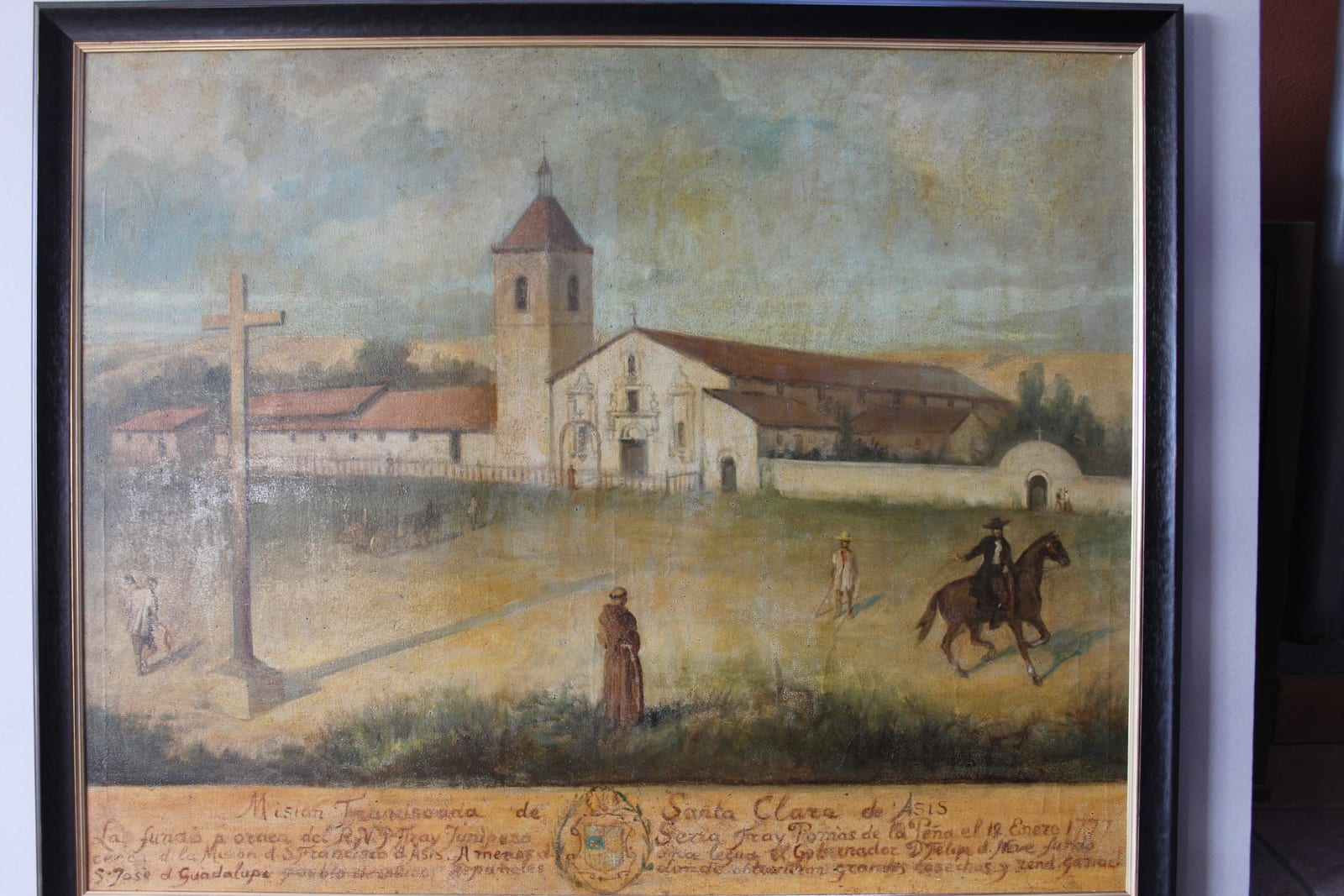
4. Misión Franciscana de Santa Clara de Asís (founded 1777). Caption: founded on 12 January 1777 by Fray Tomás de la Peña on Serra's orders, less than a league from the Spanish pueblo of San José de Guadalupe founded by Governor Felipe de Neve. The composition follows the well-known painting of the mission before the Gold Rush by Andrew P. Hill (formerly California Historical Society, now Stanford).
5. Misión Franciscana Santa Bárbara, llamada la Reina de las Misiones (founded 1786; the caption gives 1783). Caption: founded by Fray Fermín de Lasuén thirteen years later than planned because of the opposition of Governor Neve; damaged by several earthquakes; remarkable for its hydraulic works. Shown from the west, with the monastery wing, the twin-towered stone church (finished 1820) and the Moorish fountain of 1808 in the foreground.
6. Santa Buenaventura (founded 1782; the caption gives 1788). Caption: founded by Serra in person, assisted by Fray Pedro Cambón, at the head of the Santa Barbara channel; visited by George Vancouver. Shown from the mountains to the east, looking towards the sea, a viewpoint otherwise known only from a photograph of 1875.
The captions are the painter's own text and contain small errors of date and name, which are recorded here as part of the object. The buildings are shown as they stood between about 1815 and 1835, with romantic staffage of Franciscans, Indians, Spanish and English settlers. Only Santa Clara is a direct copy after an earlier picture; the others are free compositions after nineteenth-century sketches and photographs (Robinson 1829, the army sketches of the 1850s, Miller 1857, and later photographs).
Condition
Professional work, competent in proportion, light and shadow and the building-up of colour. Some age cracks in the paint layer, without loss; varnish yellowed. Frames uniform, with minor wear. Otherwise in fine, untouched condition.
References & Bibliography
Diócesis de Córdoba, 500 aniversario de la fundación del convento de San Francisco de Palma del Río (2018). F. Palóu, Relación histórica de la vida y apostólicas tareas del venerable padre fray Junípero Serra (Mexico 1787). Z. Engelhardt, The Missions and Missionaries of California (San Francisco 1908 to 1915). H. Miller, Account of a Tour of the California Missions, 1856 (San Francisco 1952). D. Krell (ed.), The California Missions: A Pictorial History (Menlo Park 1964, and later editions). For the Franciscan Province of Los Ángeles and its convents: Universidad de Sevilla, Grupo GIESRA, La Orden Tercera y la Provincia de los Ángeles. Andrew P. Hill's Mission Santa Clara is discussed in the literature on the artist and the mission.
Description
A complete set of six views of the earliest missions of Alta California, including the first (San Diego), the headquarters and burial place of Junípero Serra (Carmel) and the last mission he founded in person (San Buenaventura), painted in Spain by a local Andalusian painter and inscribed in Spanish with the Franciscan account of each foundation. The paintings were commissioned for the former Franciscan monastery of San Francisco in Palma del Río, a house of the Franciscan Province of Los Ángeles founded in the early sixteenth century. After the Mendizábal disentailment of the 1830s the friars were forced to leave and the complex was broken up and sold: the church remained with the clergy, while the cloister and residential quarters passed into private hands. In 1870 the Moreno de la Cova family became the owners of the monastery. They converted part of it into a hospedería, a guesthouse for travellers, and have maintained, restored and managed the property continuously across the generations since; it is still a place of lodging today, the Hotel Monasterio de San Francisco.
The Moreno de la Cova are one of the historic landowning families of Andalusia, rooted for generations in Palma del Río and the Guadalquivir valley and known for large-scale agriculture, for the breeding of fighting bulls (the Saltillo line) and for their part in the politics of the region. Félix Moreno Ardanuy, who commissioned the paintings, was the central figure of the family in the first half of the twentieth century, managing an estate of some 25,000 acres around Palma del Río. His son Félix Moreno de la Cova (1911 to 1999), born in Palma del Río, was an agricultural engineer who modernised the family's estates and later served as mayor of Seville; he married Carmen Maestre y Lasso de la Vega. The following generations have kept the monastery and the Palacio de los Leones at Lora del Río in the family: Enrique Moreno de la Cova Maestre, cattle breeder, businessman and company director, married Cristina Ybarra y Sáinz de la Maza, daughter of the fifth Count of Ybarra, and his son Enrique Moreno de la Cova y Ybarra married Victoria López-Quesada y Borbón-Dos Sicilias, goddaughter of King Felipe VI of Spain. The paintings thus come from a house that has been in one family's hands for more than 150 years, and from the generation that gave the family its modern shape.
Local and historical tradition holds that Fray Junípero Serra himself lodged at the monastery in 1749, on his way from Mallorca through Andalusia to Cádiz to embark for New Spain: Palma del Río lies roughly halfway between Córdoba and Seville, and its Franciscan house was the natural resting place for friars travelling that road. The same tradition records other travellers, among them Christopher Columbus, as guests of the house, and holds that friars of the community followed Serra to California and sent back the first orange seeds. The paintings were commissioned by Félix Moreno Ardanuy (1880 to 1960) to give that memory a place on the monastery's walls.
Each canvas combines a view, a title and a caption of several lines in red, and a coat of arms, so that the six read as a painted chronicle of the missions rather than as six separate pictures. The painter, F. Mela Medina, is otherwise unrecorded; the signature "fecit" on each canvas and the uniform framing show that the set was conceived and delivered as one commission.
Historical Significance
Views of the California missions are a Californian genre: from the army sketches and Henry Miller's tour of the 1850s, through Edward Deakin, Henry Chapman Ford and Andrew P. Hill, to the mission revival of the twentieth century, the missions were painted in California, for Californians, and mostly in a mood of picturesque decay. The present set reverses the direction. It was painted in Andalusia, for Spanish Franciscans, in the years around the bicentenary of Serra's sailing for America (1749) and the Spanish revival of interest in the missionary past, and it shows the missions not as ruins but as living Franciscan houses, with the friars, the Indians and the settlers in front of them. The Spanish captions preserve the Franciscan memory of the foundations, including the martyrdom of Luis Jaume of Mallorca at San Diego and the death and burial of Serra at Carmel. We know of no other painted set of the California missions made in Spain. For an institution in California it is the view from the other shore; for one in Spain it is a document of how mid-twentieth-century Andalusia remembered its share in the founding of California.
Provenance
Commissioned c. 1950 by Félix Moreno Ardanuy (1880 to 1960), grandfather of the present owner, for the family's former Franciscan monastery of San Francisco at Palma del Río (Córdoba), where by local tradition Junípero Serra lodged in 1749, and kept there ever since; acquired by Frederik Muller Rare Books directly from his grandson, 2008.