Voyages & Discovery
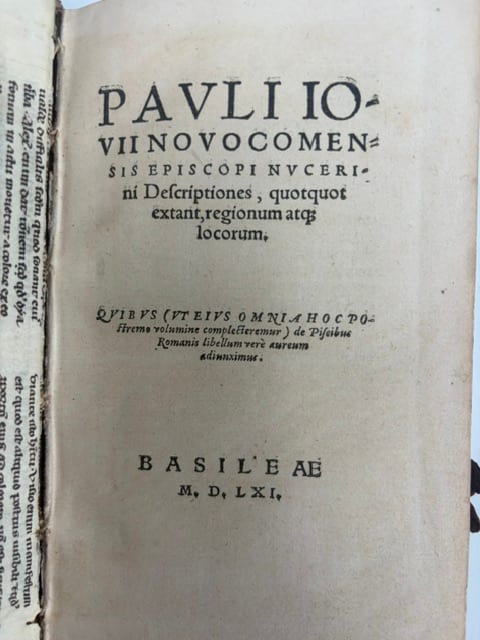
Descriptiones, quotquot extant, regionum atque locorum
GIOVIO, Paolo (Paulus Jovius) · Basel · Heinrich Petri and Pietro Perna · 1561
First collected edition of Giovio's geographical works, including the Moschovia, the first detailed Western account of Russia (Basel, 1561).
FM-0119
€ 4.200
Key Properties
Author: Paolo Giovio (Paulus Jovius, 1483-1552)
Title: Pauli Iovii Descriptiones, quotquot extant, regionum atque locorum
Place and printer: Basel, Heinrich Petri and Pietro Perna
Date: 1561
Format: 8vo
Edition: First collected edition of Giovio’s geographical works
Binding: Contemporary blind-tooled full leather over wooden boards
Provenance: Waldemar Schwalbe, silhouette bookplate dated 1937
Collation & Technical Description
8vo. [16], 239, [1]; 180, [10] pp. Two parts in one volume, the second part containing the Moschovia.
Condition
Contemporary blind-tooled full leather over wooden boards, spine with raised bands, brass catch plates preserved, lacking the clasps. Covers stamped in panels with fleur-de-lis tools and figured rolls, initials stamped on the upper cover. Extremities worn, head and tail of spine chipped. Pastedowns and endleaves of rubricated fifteenth-century liturgical binder’s waste. Internally crisp; a few early ink marks on the Moschovia divisional title.
References & Bibliography
VD16 G 2058; USTC 602783; Alden/Landis 561/16; Graesse III, 490.
Description
First collected edition of the geographical writings of Paolo Giovio, bishop of Nocera and historian to the Medici popes, printed at Basel by Heinrich Petri and Pietro Perna. The volume unites his descriptions of Britain, Scotland, Ireland and the Orkneys, his celebrated account of Muscovy, the description of Lake Como, and the treatise on Roman fish.
The centrepiece is the Moschovia, first published in Rome in 1525 as the Libellus de legatione Basilii Magni Principis Moscoviae. Giovio composed it from his conversations with Dmitry Gerasimov, the envoy sent by Grand Duke Vasily III to Pope Clement VII, and it stands among the very first detailed accounts of Russia to reach the European reading public, a generation before Herberstein. Giovio describes the religion, court ceremonial, trade in furs and sables, manners and geography of Muscovy, and famously corrects Strabo and Ptolemy by declaring that the fabled Riphean Mountains do not exist. The original 1525 account was accompanied by the earliest European map of Muscovy, drawn from Gerasimov's information and today known in only two copies.
The edition was seen through the press by the Basel humanist Johannes Herold, whose dedication to Servatius Irenaeus, abbot of Bellelay, opens the volume. The Descriptio Britanniae closes with genealogical tables of the English kings, and the Moschovia carries its own divisional title, likewise dated Basileae M.D.LXI.
This copy survives in its first binding: contemporary blind-tooled leather over wooden boards, the covers stamped in panels with fleur-de-lis tools and figured rolls, with initials stamped on the upper cover. The pastedowns and endleaves are made up of rubricated leaves from a fifteenth-century liturgical book, used as binder’s waste, a charming witness to the Basel bindery of the day.
Historical Significance
The foundation text of Western knowledge of Russia. Giovio's report, based on the firsthand testimony of a Muscovite envoy, shaped the European image of Russia throughout the sixteenth century and fed directly into the cartography of Muscovy from Battista Agnese onwards. Its rejection of the Riphean Mountains marks an early triumph of contemporary observation over classical authority.
Provenance
From the library of Waldemar Schwalbe, with his silhouette bookplate dated 1937 on the front endleaf. A few early ink marks and an old pencil number attest to earlier owners.