Voyages & Discovery
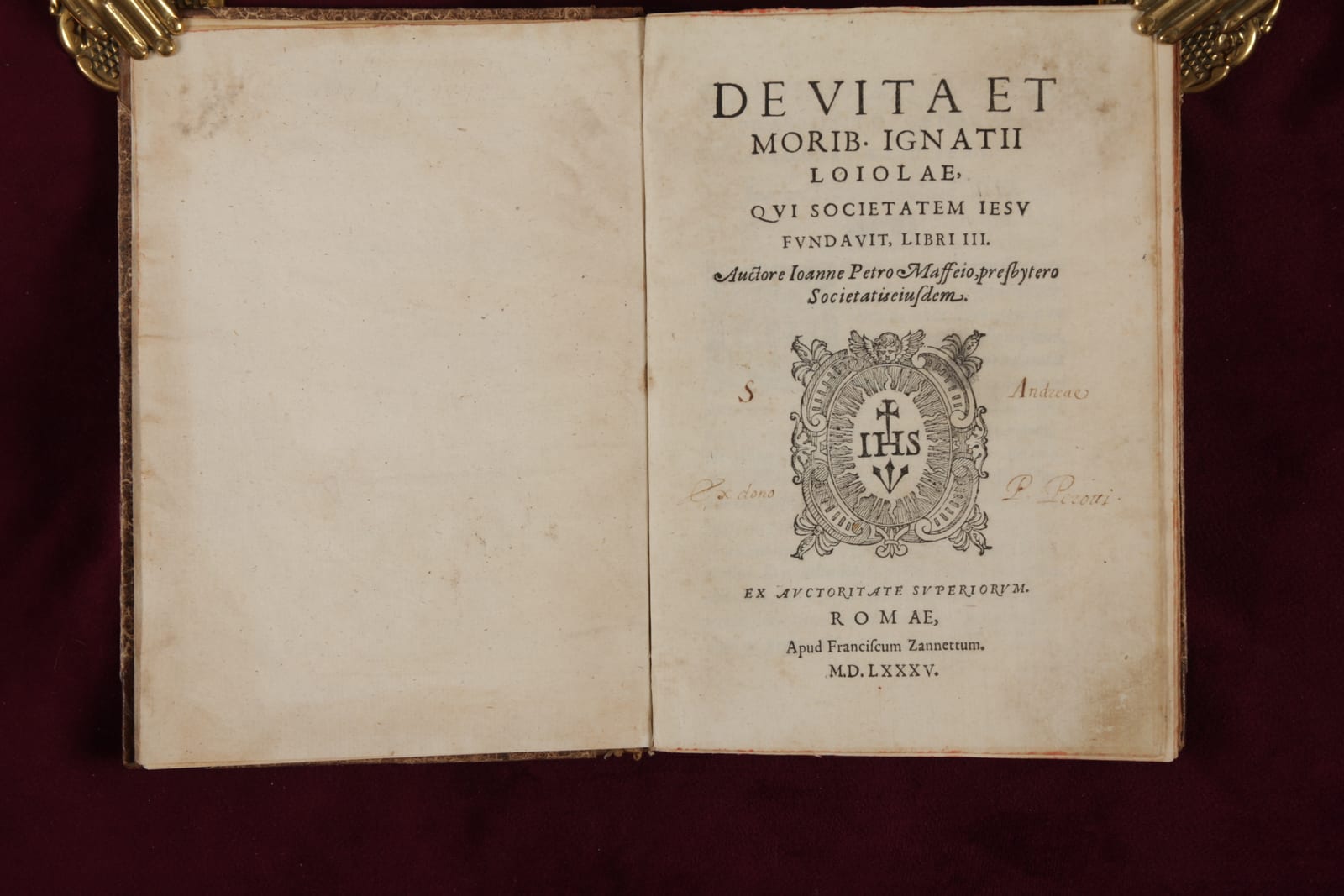
De vita et moribus Ignatii Loiolae libri III
Giovanni Pietro Maffei, S.J. · Rome · Francesco Zanetti · 1585
The first edition of the Jesuit life of Ignatius of Loyola, written at the order's own request by the finest Latinist it had
FM-0122
US$ 2.200
Key Properties
Edition: First edition
Language: Latin
Format: Quarto
Binding: Eighteenth-century quarter calf with marbled paper over boards; the lettering piece on the spine wanting
Collation & Technical Description
Quarto. 2 unnumbered leaves; 200 pp.; 6 unnumbered leaves.
Title-page with the printed device of the Society of Jesus.
Condition
A complete copy on strong paper, slightly thumbed. Bound in eighteenth-century quarter calf with marbled paper over boards; the lettering piece on the spine is missing.
References & Bibliography
De Backer-Sommervogel V, 296. Palau 146.954. Quaritch, Jesuits, no. 132.
Description
The first edition of the life of Ignatius of Loyola by Giovanni Pietro Maffei, and the version of the story that the Society of Jesus wished to have told. Maffei (Bergamo 1536, Tivoli 1603) entered the Society in 1565, taught rhetoric at the Collegio Romano, and was the best Latin stylist the order had. The book was long asked of him by Everard Mercurian, the general of the Society, and Quaritch's judgement is the usual one: the author is a skilled Latinist.
The work is in three books. The first is the life of Ignatius himself, from the Basque nobleman wounded at Pamplona to the founder in Rome. The second is the making of the Society of Jesus. The third sets out the rules of the order.
Ignatius of Loyola was born at the castle of Loyola in Azpeitia, in Guipuzcoa, in 1491, and died at Rome in 1556. He had already been written up: Pedro de Ribadeneira, who had known him personally, published his Vita at Naples in 1572. Maffei's book is the second life, and the more polished; the two were the most discussed biographies of their day, and between them they fixed the image of Ignatius for the centuries that followed.
Maffei went on to write the earliest history of the Jesuit missions in Asia. He spent five years in Portugal, from 1579 to 1584, gathering material on the Portuguese seaborne empire in the East at the invitation of Cardinal Henry of Aviz, and the result, the Historiarum Indicarum libri XVI, appeared at Florence from the Giunti press in 1588, with an Italian translation the following year. It is the work by which he is best known to collectors of voyages, and this life of Ignatius is its immediate predecessor.
Historical Significance
The two Jesuit lives of Ignatius, Ribadeneira's of 1572 and Maffei's of 1585, are the foundation of everything later written about him, and they were produced while men who had known him were still alive. Maffei wrote at the order's request and with its archive open to him, which makes the book an official account, and its silences are as informative as its statements.
It also belongs with Maffei's Indian histories rather than apart from them. The same author, the same patrons and the same purpose lie behind both: to set down, in Latin good enough to be read across Europe, what the Society and the Portuguese crown had done in the world. For a collection built on the voyages of discovery, this is the book in which the missionary half of that enterprise gets its founder.
Provenance
Manuscript dedication in brown ink on the title, partly illegible, in the form 'al estimado padre ... in obsequio di stima'; further inscriptions 'ex dono P. Perotti' and 'S. Andreae', the latter pointing to a house of the Society.