Science
Astronomicae Tabulae (the Alphonsine Tables)
Alphonsus X, King of Castile and Leon · Paris · Christian Wechel · 1553
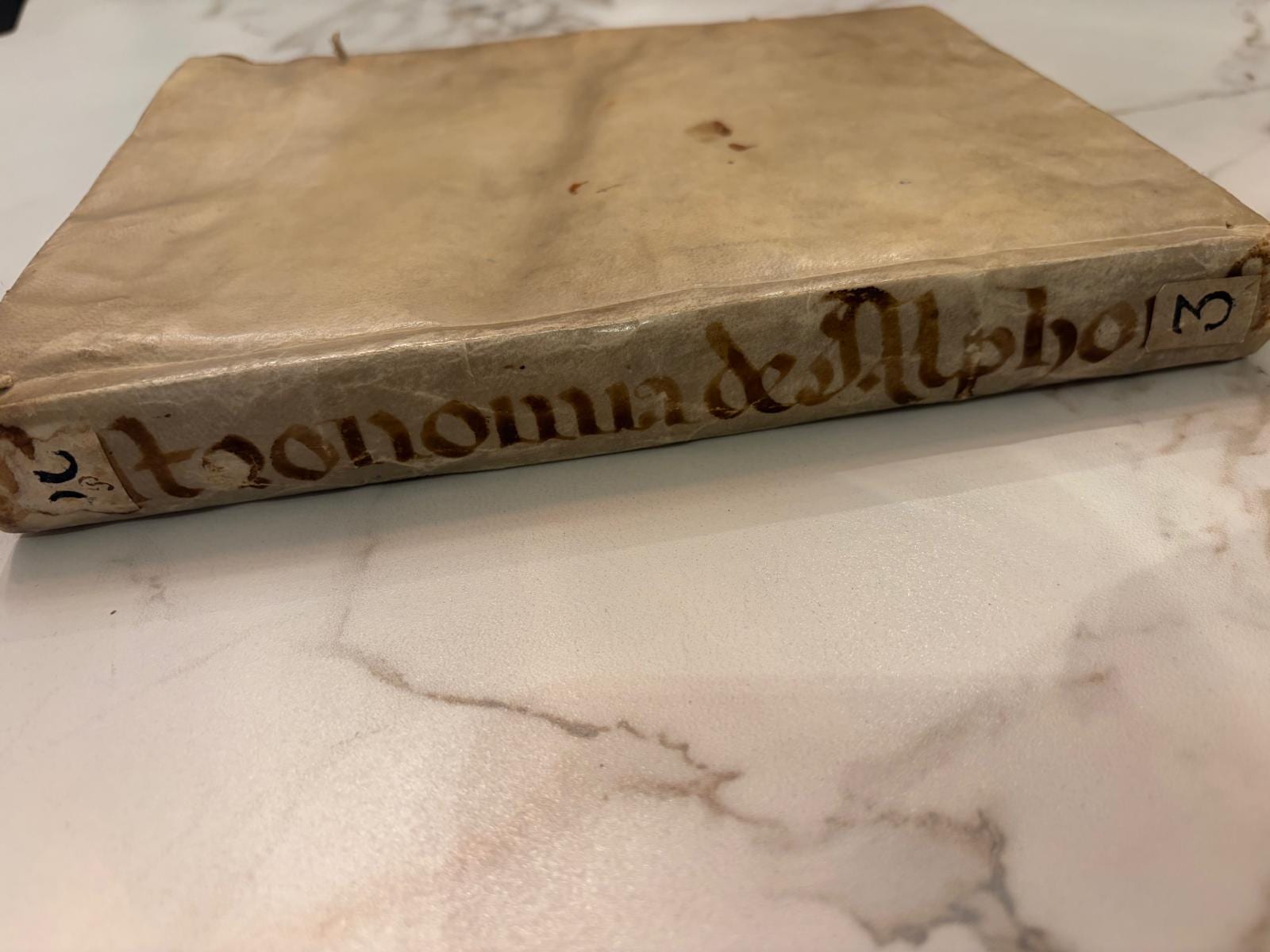
The Alphonsine Tables in their final printed edition, Paris 1553, only ten years after Copernicus's De revolutionibus; complete, in an old limp vellum binding with Wechel's Pegasus devices.
FM-0177
€ 3.000
Key Properties
Author: Alphonsus X, King of Castile and Leon
Title: Divi Alphonsi Romanorum et Hispaniarum Regis, Astronomicae Tabulae in propriam integritatem restitutae
Editor: Paschasius Hamellius; with the dedication by Luca Gaurico to Cardinal Pompeo Colonna
Imprint: Paris, ex officina Christiani Wecheli, sub Pegaso, in vico Bellovacensi, 1553
Edition: Second Wechel edition, the last of the Renaissance editions of the Alphonsine Tables (a final edition appeared at Madrid in 1641)
Format: Quarto
Collation: [8], 274, [2] pages
Illustration: Woodcut initials and printer's devices, including Wechel's large Pegasus device on the title page and repeated at the end; numerous astronomical and chronological tables throughout
Binding: Old limp vellum, early manuscript lettering to the spine
Collation & Technical Description
Quarto. [8], 274, [2] pages. Woodcut initials and printer's devices, including Wechel's large Pegasus device on the title page and repeated at the end. Numerous astronomical and chronological tables throughout. Old limp vellum binding, with early manuscript lettering to the spine and a later small numbered paper label.
Condition
Complete according to the pagination checked in the present copy. A generally well-preserved example with broad margins and strong impressions of the tables and woodcut devices. Scattered foxing and brown spotting throughout, more noticeable in some margins and in the preliminary and terminal leaves. Some creasing and wear to the vellum binding and endpapers, consistent with age and use. No substantial loss affecting the printed text.
References & Bibliography
Cf. the Wechel edition of 1545 (same title and setting, edited by Paschasius Hamellius); this 1553 issue recorded a.o. in the Bibliotheque nationale de France and HathiTrust.
Description
The Alphonsine Tables are among the most influential astronomical calculating tables of the medieval and Renaissance periods. Originating in the intellectual circle of Alfonso X of Castile in the thirteenth century and transmitted through successive European editions, they supplied astronomers with the numerical means of calculating the positions and motions of the Sun, Moon, planets and fixed stars.
The preliminary matter includes the dedication by the celebrated Italian astronomer and astrologer Luca Gaurico (1476-1558) to Cardinal Pompeo Colonna, in which Gaurico describes his work on the Alphonsine material, including the addition and clarification of problems, canons, propositions and tables. The edition itself was prepared by Paschasius Hamellius (Pasquier Hamel), and its contents show the book functioning as a practical computational instrument: methods and tables for the motions of the planets and fixed stars, the true position of the Moon and other planets, planetary latitudes, solar ingress, conjunctions, eclipses, stellar longitude and latitude, chronological eras, geographical longitudes and latitudes, and the conversion of different systems of time. Of particular interest is the Conficiendarum ephemeridum compendium, a compendium for the construction of ephemerides, illustrating the close relationship between these calculating tables and the printed ephemerides used by Renaissance astronomers.
Historical Significance
This Paris edition appeared only ten years after the publication of Copernicus's De revolutionibus orbium coelestium (1543), at a moment when traditional Ptolemaic computational astronomy remained in active use despite the emergence of the heliocentric model. It was also the last time the Alphonsine Tables were printed: after 1553 they were superseded by tables built on the new astronomy. The volume is therefore a particularly tangible document of astronomical practice during the transitional decades of the sixteenth century, uniting Alfonso X, the Renaissance editorial tradition of Gaurico and Hamellius, and the Paris press of Christian Wechel in the age of Copernicus.
Provenance
An engraved armorial bookplate is pasted to the rear pastedown, displaying two crowned coats of arms with accompanying mottoes; the former owner represented by these arms has not yet been securely identified.