Science
Traité d'horlogiographie, contenant plusieurs manieres de construire, sur toutes surfaces, toutes sortes de lignes horaires, & autres cercles de la sphere
SAINTE-MARIE-MAGDELEINE, Dom Pierre de · Paris · Antoine Dezallier · 1680
The Feuillant monk's standard French manual of sundials, the 'new edition, corrected and augmented' of 1680, with 73 engraved plates of dials on every kind of surface, instruments, a nocturnal, the hand used as a dial, tide tables and the cutting of polyhedra; in contemporary calf.
FM-0210
€ 550
Key Properties
Edition: 'Nouvelle edition, corrigée & augmentée de plusieurs propositions & figures', Paris, Antoine Dezallier, rue Saint-Jacques, à la Couronne d'or, 1680, with royal privilege; the work first published in 1641 and reprinted many times to 1701.
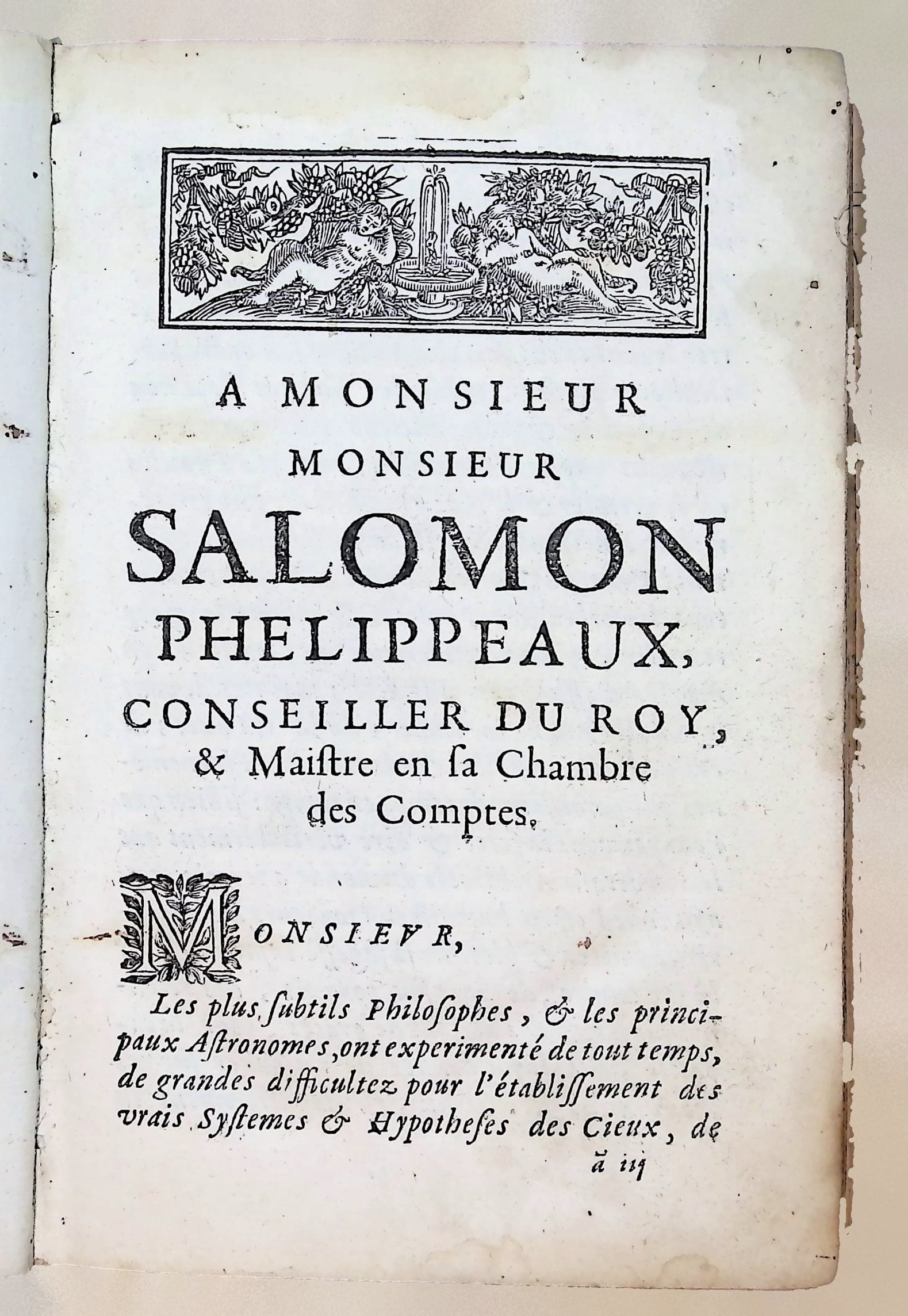
Author: Dom Pierre de Sainte-Marie-Magdeleine of Abbeville, a monk of the Congregation of the Feuillants (reformed Cistercians); dedicated to Salomon Phelypeaux, conseiller du roi and maître in the Chambre des Comptes.
Illustration: 73 engraved plates of dials, instruments and geometrical constructions, several folding, with figures numbered in Roman numerals (this copy without the frontispiece; five of the plates lacking a half).
Contents: sundials on plane, inclined, declining and curved surfaces; portable and universal dials; instruments for the same practice; telling the hours at night by the Great and Little Bear and by the hand; the hour of the tides; the cutting in stone or wood of the regular solids and other polyhedra by the cube and the cylinder; a table of the sun's declination for every degree of the signs.
Format: octavo, 312 pages plus preliminaries.
Binding: contemporary mottled brown calf, spine with raised bands, gilt ornaments and gilt title, speckled edges.
References: Houzeau and Lancaster 11455; Sotheran II, 14635.
Collation & Technical Description
8vo. [7] preliminary leaves (title, dedication to Salomon Phelypeaux, preface, privilege), 312 pages, 73 engraved plates (several folding); the frontispiece and the front and rear free endpapers lacking. Woodcut headpieces, tailpieces and initials. Contemporary mottled brown calf, spine in compartments with raised bands, gilt ornaments and gilt lettering, speckled edges.
Condition
A used working copy in its first binding. Binding rubbed and scuffed, the mottled calf worn through in places on the boards, headcaps missing, joints cracked but holding, corners worn; the spine gilding still bright. Internally browned in places, a few leaves with worn or frayed edges and minor marginal tears, some early manuscript notes; old ownership inscriptions on the title crossed through in ink. Lacking the frontispiece and the front and rear free endpapers; five plates lacking a half, plate 73 with a hole in the centre and plate 74 torn across; the other plates complete and clear.
References & Bibliography
Houzeau and Lancaster, Bibliographie générale de l'astronomie, 11455. Sotheran, Bibliotheca Chemico-Mathematica, II, 14635. Lalande, Bibliographie astronomique, s.a. 1641 and 1680.
Description
The most popular French handbook of dialling of the seventeenth century, in the enlarged edition published by Antoine Dezallier in 1680. Its author, Dom Pierre de Sainte-Marie-Magdeleine, a native of Abbeville and a monk of the Feuillants, the austere reformed Cistercians of the rue Saint-Honoré, first published his Traité d'horlogiographie in 1641, and it was reprinted, corrected and enlarged for sixty years: the present 'nouvelle edition, corrigée et augmentée de plusieurs propositions et figures' is the fullest form of the text, and the last but one before Dezallier's final reissue of 1701. It is dedicated to Salomon Phelypeaux, master in the Chambre des Comptes.
The book is a complete practical course in gnomonics. It begins with the sphere, the sun's motion and the table of solar declinations for every degree of the zodiac, and then teaches how to lay out the hour lines on every surface a sundial can be made on: horizontal, vertical, declining and inclining planes, cylinders, cones and spheres, the polyhedral and 'universal' dials of the Renaissance tradition, and the small portable dials that travellers carried. A second part describes the instruments for the same practice, the quadrant, the gnomonic rule and the declinator, and explains how to tell the hour at night from the Great and Little Bear with a nocturnal, or with nothing more than the outstretched hand, whose fingers and lines are engraved on one of the plates. There follow the hour of the tides, calculated from the age of the moon, and, as a closing tour de force, the method of cutting the regular solids and other polyhedra in stone or wood 'by the cube and by the cylinder', so that a mason could make the many-sided dials the book describes.
The 73 engraved plates, several of them folding, show the dials, the constructions and the instruments, among them the polyhedral dial with sun and moon faces, the pedestal dials, the nocturnal and the hand. This copy, in its contemporary calf, has been used as such books were meant to be: it carries early manuscript notes, and the old owners' inscriptions on the title have been crossed through. It lacks the frontispiece and five of the plates have lost a half.
Historical Significance
Gnomonics, the science of sundials, was in the seventeenth century a serious branch of applied astronomy and the everyday means of setting clocks and watches, and the Traité d'horlogiographie was the book from which generations of French craftsmen, surveyors, teachers and gentlemen learned it. It stands beside the works of Clavius, Bettini and Kircher for its scope but was written in the vernacular and for the practical man, which explains its many editions. Its chapters on telling the time at night by the stars and on the hour of the tides connect it directly with navigation, and its instructions for cutting polyhedra with the stone-cutting geometry of the age.
Provenance
Old ownership inscriptions on the title, crossed through.