Science
Annotationi sopra la lettione della Spera del Sacro Bosco. Doue si dichiarano tutti e principii mathematici & naturali, che in quella si possan' desiderare
MAURO FIORENTINO (Fra Mauro, c. 1493-1556); after Johannes de SACROBOSCO · Florence · Lorenzo Torrentino · 1550
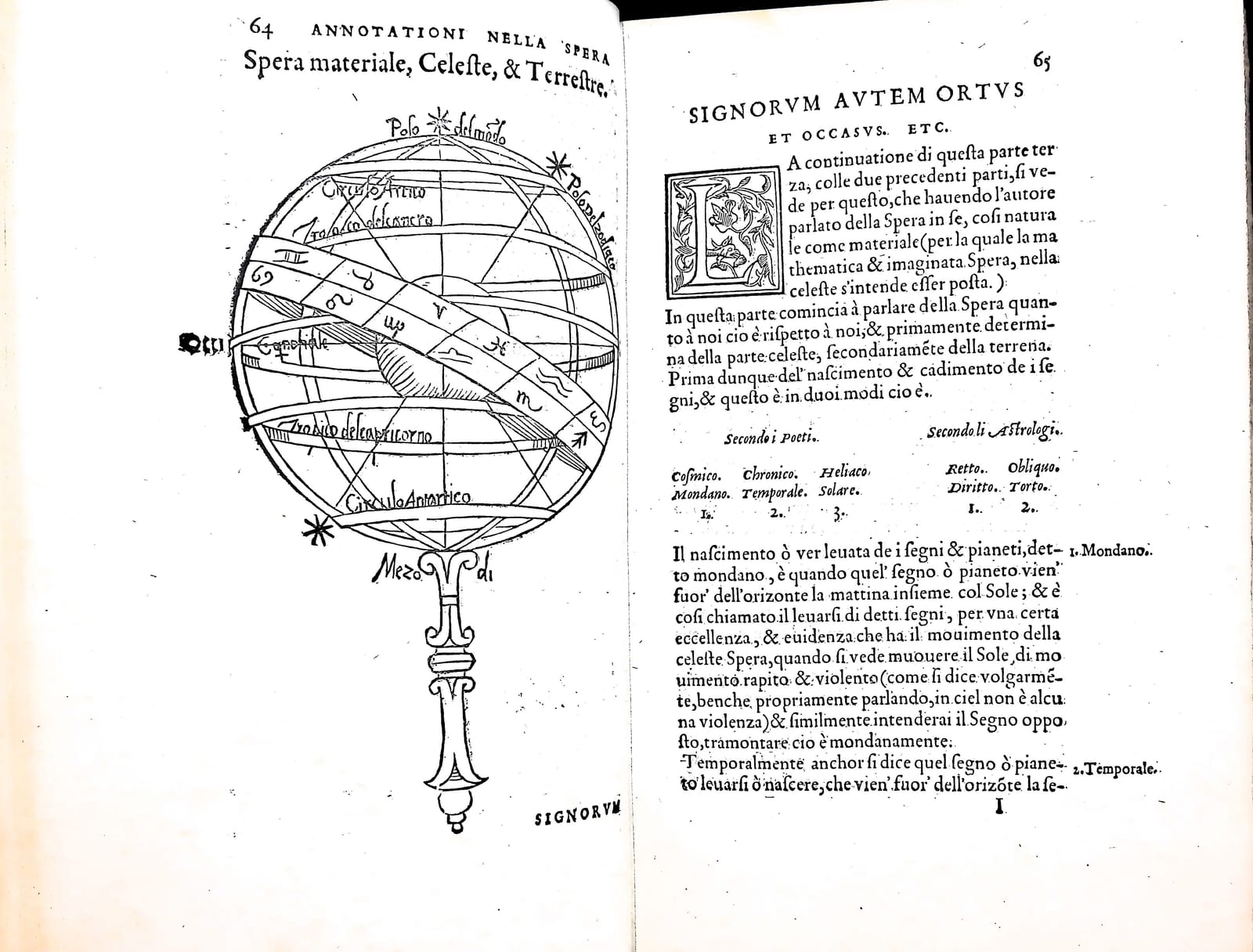
Sacrobosco's Sphere in Italian, with a word-for-word translation, a 'theological' and a 'Platonic' sphere, and a new instrument for drawing up the twelve astrological houses, by the Florentine Servite friar Mauro; dedicated to Duke Cosimo I and printed by the ducal printer Torrentino.
FM-0220
€ 3.250
Key Properties
Italian vernacular commentary on Sacrobosco's De sphaera, with a literal ('ad verbum') translation
Dedicated to Cosimo de' Medici, Duke of Florence
Printed by Lorenzo Torrentino, the Netherlandish-born ducal printer of Florence
Title woodcut of the geocentric cosmos within the twelve celestial houses
108 woodcuts in the text, including a hand used as a sundial
Complete
Two early manuscript annotations in Italian, c. 1560-1590
A book placed on the Spanish Index of 1583 and the Roman Indices of 1590 and 1593
Contemporary vellum
Collation & Technical Description
4to (215 x 148 mm). 219, [1] pp. Complete. Title with large woodcut of the geocentric cosmos within the twelve celestial houses; 108 woodcuts in the text, depicting globes, stars, planets, scientific instruments, diagrams and projections, among them a figure showing how to tell the time of day with the hand and its shadow; ornamental initials. Colophon dated Florence, 6 March 1550. With two early manuscript annotations in Italian, apparently in the same sixteenth-century hand, commenting on Mauro's natural-philosophical arguments concerning the elements and the faculty of imagination, one including an internal cross-reference. The hand may plausibly be dated to the second half of the sixteenth century, perhaps c. 1560-1590.
Condition
Contemporary full vellum, with stains, signs of use and creases; the four small holes for the ties remain, the ties themselves are lacking; binding sound. Slight damp staining in the blank margins of a few leaves.
References & Bibliography
Riccardi, Biblioteca matematica italiana, I.2, col. 138.
Thorndike, The Sphere of Sacrobosco and its Commentators (Chicago, 1949), for the commentary tradition.
Sander, 'Johannes de Sacrobosco und die Sphaera-Tradition in der katholischen Zensur der Frühen Neuzeit', NTM 26 (2018), pp. 437-474.
Description
Fra Mauro of Florence, a friar of the Servite order at the Santissima Annunziata, taught Latin, Greek and Hebrew and wrote on theology, cosmography and music. On the title page he styles himself Theosebo, Phonasco and Philopanareto: god-fearing, trainer of the voice, lover of every virtue.
In 1537 he had published in Venice one of the first Italian translations of Sacrobosco's Sphere, a free rendering with added treatises on cosmography, navigation, altimetry and stereometry. The present book of 1550 is a new work rather than a reissue: a continuous commentary on the Sphere, followed by a new and literal translation 'ad verbum', a Christian 'theological sphere', a 'Platonic sphere' with mathematical and theological reflections, and Mauro's own invention, an instrument for constructing the twelve celestial houses of a horoscope at once, without tables or calculation. Among the 108 woodcuts is a hand held up against the sun, to read the hour from its shadow. The great woodcut on the title shows the instrument's purpose: the earth at the centre of the elemental and celestial spheres, set within the twelve houses of life, friends, enemies, riches, religion and death.
The book is dedicated to Cosimo de' Medici, Duke of Florence, and was printed by Lorenzo Torrentino, the printer Cosimo had brought to Florence in 1546. Torrentino was a Netherlander, born Laurens van den Bleeck, and in this same year 1550 his press also issued the first edition of Vasari's Lives of the artists. The volume closes with a sonnet in praise of Mauro by Pietro Orsilago of Pisa, who lectured at the Accademia Fiorentina, and with a list of works Mauro promised to publish next, among them an arithmetic with algebra and a treatise on practical and theoretical music, plain and figured.
The book did not stay innocent for long. Mauro's excursions into theology, on the Trinity, the Incarnation, the Eucharist and the immortality of the soul, made it suspect to the censors: it was placed on the Spanish Index of Cardinal Quiroga in 1583 and on the Roman Indices of Sixtus V in 1590 and Clement VIII in 1593, before disappearing again from the definitive Clementine Index of 1596. The two early annotations in this copy, in an Italian hand of perhaps c. 1560-1590, comment on Mauro's natural-philosophical arguments about the elements and the faculty of imagination, and so appear to date from roughly the years in which the work came under inquisitorial scrutiny.
Historical Significance
Sacrobosco's De sphaera, written in Paris around 1230, was the standard university introduction to the cosmos for four centuries. Mauro's Annotationi belongs to the moment when that Latin schoolbook was carried into the vernacular for readers outside the universities: physicians, navigators and educated laymen. Mauro makes the case himself, citing Hippocrates and Galen to the effect that a physician without astrology is blind.
It sits naturally beside the Latin university tradition of the same text, [[FM-0112|Ciruelo's Alcala commentary of 1526]], and beside the practical astronomy of [[FM-0075|Apian and Gemma Frisius]] and the [[FM-0071|ephemerides of Stoffler]].