Illustrated Books
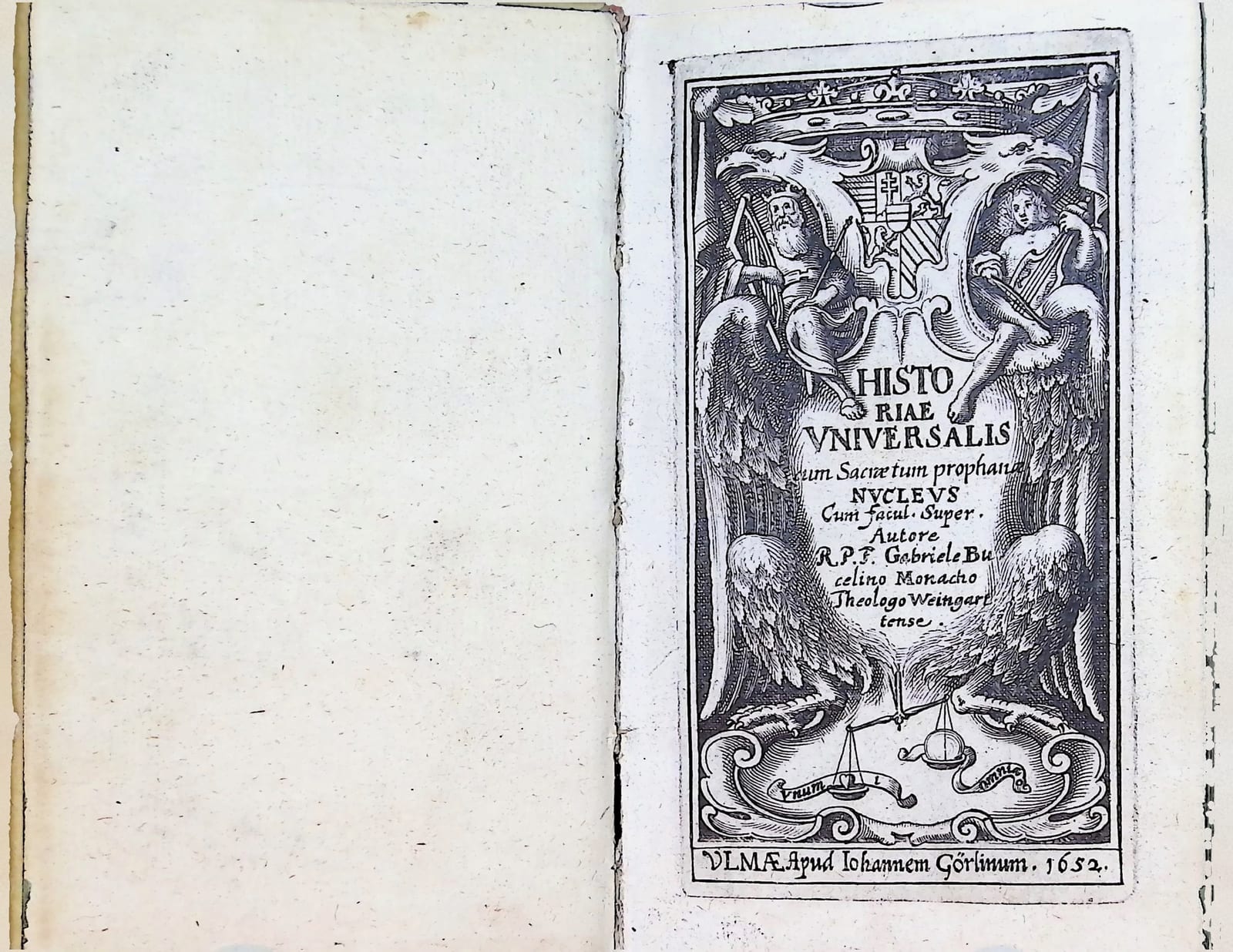
Nucleus insigni lectionis variae fructu locuples. Historiae cum sacrae, tum profanae cognitione compendiosissima atque utilissima praegnans
Gabriel Bucelin · Ulm · Johann Görlin · 1652
Gabriel Bucelin's pocket compendium of sacred and profane history, Ulm 1652: engraved title, calendars and tables, a series of the popes with woodcut arms, and small woodcut maps of the countries of Europe, each facing a short Latin description.
FM-0276
€ 895
All prices include VAT. Import duties outside the EU are not included.
Free insured shipping. The price shown is the price you pay.
Key Properties
Edition: Ulm, Johann Görlin, 1652; engraved title and printed titles dated 1652
Language: Latin
Format: small pocket volume in vellum, edges stained green
Illustrations: engraved title with arms; woodcut plate of the arms of the Habsburg lands; woodcut papal arms; calendar and chronological tables; woodcut maps of European countries, among them Bavaria, the Upper Palatinate, Bohemia, Austria, Swabia, Lake Constance, Switzerland, Hungary, the Low Countries, England, Italy, Spain and Saxony
Second part: Summorum urbis orbisque pontificum, nec non imperatorum ... successio, with its own title, Ulm 1652
Collation & Technical Description
Not collated leaf by leaf. The copy contains: the engraved title (Historiae universalis cum sacrae tum prophanae nucleus, Ulm 1652); the printed title; the woodcut plate of arms and the dedication to Ferdinand IV, signed P. F. Gabriel Bucelinus; the preface; the calendar section with its tables; the Sacrae historiae universae nucleus, running to the year 1652; the second part with its own title, Summorum urbis orbisque pontificum ... successio (Ulm 1652), with the series of popes and their woodcut arms; and the section of woodcut maps of the European countries, ending with Spain and the words 'Deus Benedictus'.
Condition
Vellum, the covers somewhat soiled and stained; edges stained green. Foxing and browning to the paper, as usual for paper of this date, with some spotting. Old ink shelfmark 'D.XI.G.137' at the head of a cover; old ink and pencil numbers on the front free endpaper.
References & Bibliography
VD17 (Verzeichnis der im deutschen Sprachraum erschienenen Drucke des 17. Jahrhunderts), for the Ulm 1652 edition.
Allgemeine Deutsche Biographie, s.v. Bucelin, Gabriel.
Description
Gabriel Bucelin (1599 to 1681), Benedictine monk of Weingarten in Swabia, was one of the most prolific historians and genealogists of seventeenth-century Germany. This small book was meant as he describes it in the preface: an epitome and 'kernel' of his larger works, to be carried and consulted daily, so that the reader would always have at hand material for learned conversation.
The preface sets out the contents. First come the tables that serve the calendar and the course of sun and moon, then the Roman calendar set against the Greek and the Syriac, so that the differences between the Western and Eastern churches in keeping the feasts may be seen. Then follow an astronomical calendar after Ptolemy, a Hebrew calendar for the reading of Scripture, and a historical calendar giving for each day of the year the events that fell on it. The core of the book is a year-by-year history, sacred and profane, from the creation of the world to Bucelin's own day, ending with the year 1652, in which the English Commonwealth, the peace negotiations in the Empire and the Venetian war against the Turks in Candia and Dalmatia are still news.
The second part, with its own title, gives the succession of the popes, emperors, electors and other princes, the popes each shown with their arms in a small woodcut shield. It closes with a short description of the countries of Europe, each country given a page of Latin text and, facing it, a small woodcut map: Bavaria, the Upper Palatinate, Saxony, Bohemia, Austria, Swabia, Lake Constance, Switzerland, Hungary, the Low Countries, England with part of Ireland, Italy and Spain. The texts are lively: Hungary is the most fertile of all kingdoms, where eighty thousand partridges were once offered for sale in a single day at Buda; the Low Countries have no beggars and no wine; England has the golden fleece of its wool, but suffers from plague almost every fourth year.
The book is dedicated to the young Ferdinand IV, King of Hungary and Bohemia, eldest son of Emperor Ferdinand III, with a woodcut of the arms of the Habsburg lands rising from a crowned helm.
Historical Significance
A characteristic Catholic reference book of the years just after the Peace of Westphalia, combining chronology, calendar, genealogy and geography in a volume small enough to carry.
Provenance
Old library shelfmark 'D.XI.G.137' on the cover and the ink note 'Histor. N. ... 62' on the free endpaper; the former owner has not been identified.