Science
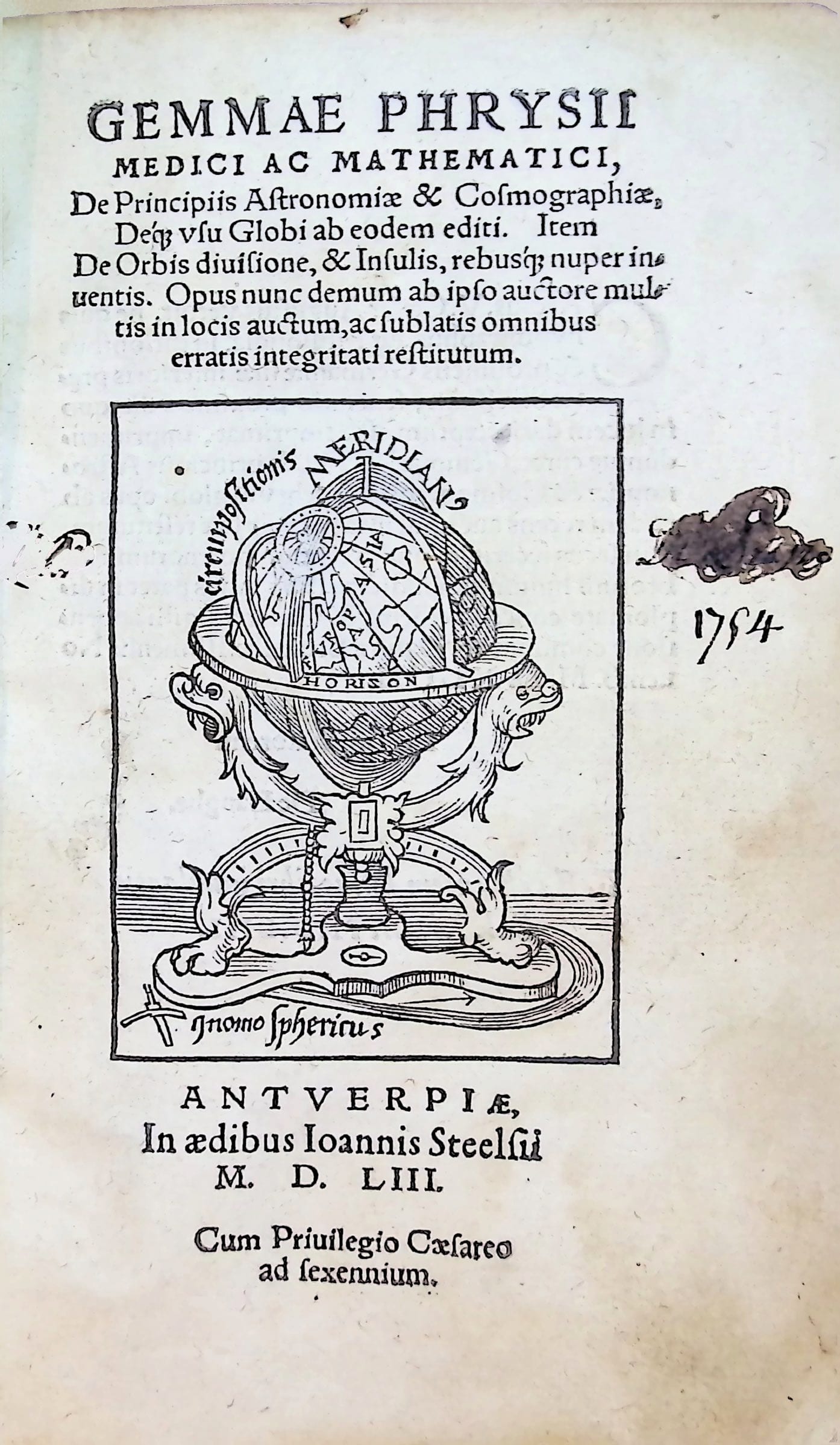
De Principiis Astronomiae & Cosmographiae. Bound with: Usus annuli astronomici; Ioannis Schoneri de usu globi astriferi opusculum; Typus globi astriferi
GEMMA FRISIUS, Reinerus · Antwerp · Joannes Steelsius · 1553 (bound with three parts of 1548)
Gemma Frisius's guide to astronomy, cosmography and the use of the globe, in the corrected and enlarged edition of 1553 with the world map on the title and the description of America, bound with three astronomical tracts of 1548, in contemporary limp vellum.
FM-0292
€ 3.950
All prices include VAT. Import duties outside the EU are not included.
Free insured shipping. The price shown is the price you pay.
Key Properties
Edition: Corrected and enlarged edition, with the author's preface dated 1553
Contents: Four parts in one volume
Format: Octavo, 165 x 105 mm
Collation: Pp. 185, [47]; bound with leaves [1], 74-87, [1]; [1], 90-93, [1]; [1], 95-119, [1] (according to the seller's description)
Illustration: Woodcut world map on the title, full-page woodcut astrolabe, woodcuts in the text, Steels's device
Binding: Contemporary limp vellum
Collation & Technical Description
I: pp. 185, [47]. II: Usus annuli astronomici, 1548, leaves [1], 74-87, [1]. III: Schöner, De usu globi astriferi opusculum, [1548], leaves [1], 90-93, [1]. IV: Typus globi astriferi, [1548], leaves [1], 95-119, [1] (according to the seller's description).
Condition
Contemporary limp vellum. Italic and roman type, woodcut world map on the first title, Steels's device on the last leaves, full-page woodcut astrolabe, woodcut illustrations and pictorial initials. Illegible manuscript inscription on the title. Traces of use and light damp-staining in the margin of some leaves.
References & Bibliography
Sabin 26846 and 62588 (1548 edition).
Description
Gemma Frisius (1508-1555), the physician and mathematician of Leuven who taught Mercator, first published his revision of Peter Apian's Cosmographia in 1529, and wrote alongside it this handbook on the principles of astronomy and cosmography and the use of the globe. It explains the spheres and circles of the heavens, how to find one's position on the earth, and gives a description of the world including the islands and lands recently discovered; the final section, from p. 179, is devoted to America. The title is dominated by a small woodcut world map.
This is the corrected and enlarged edition printed by Joannes Steelsius in Antwerp, with Gemma's preface dated 1553. It contains Gemma's proposal that longitude could be found by carrying a clock and comparing local time with the time at a known place, the principle on which the marine chronometer was eventually to solve the longitude problem more than two centuries later.
Bound with it are three tracts from the Steelsius edition of 1548, each with a woodcut astrolabe on the title: Gemma's account of the astronomical ring, Johannes Schöner's short treatise on the celestial globe, and the Typus globi astriferi.
Historical Significance
A key text of Renaissance cosmography from the circle of Gemma Frisius and Mercator, containing the first explicit proposal to determine longitude with a clock, together with an early printed description of America.
Provenance
Illegible early manuscript inscription on the title.