Books
Strategematum libri octo
POLYAENUS (2nd century AD); MAASVICIUS, Pancratius (editor) · Leiden · Jean du Vivier & Jordaan Luchtmans · 1690
Polyaenus's Stratagems of War in parallel Greek and Latin, Leiden 1690, with Casaubon's Greek text, in a contemporary binding with extensive contemporary manuscript notes on the endpapers
FM-0307
€ 750
All prices include VAT. Import duties outside the EU are not included.
Free insured shipping. The price shown is the price you pay.
Key Properties
Edition: parallel Greek and Latin text, edited by Pancratius Maasvicius; Greek text and notes of Isaac Casaubon, Latin translation by Justus Vulteius
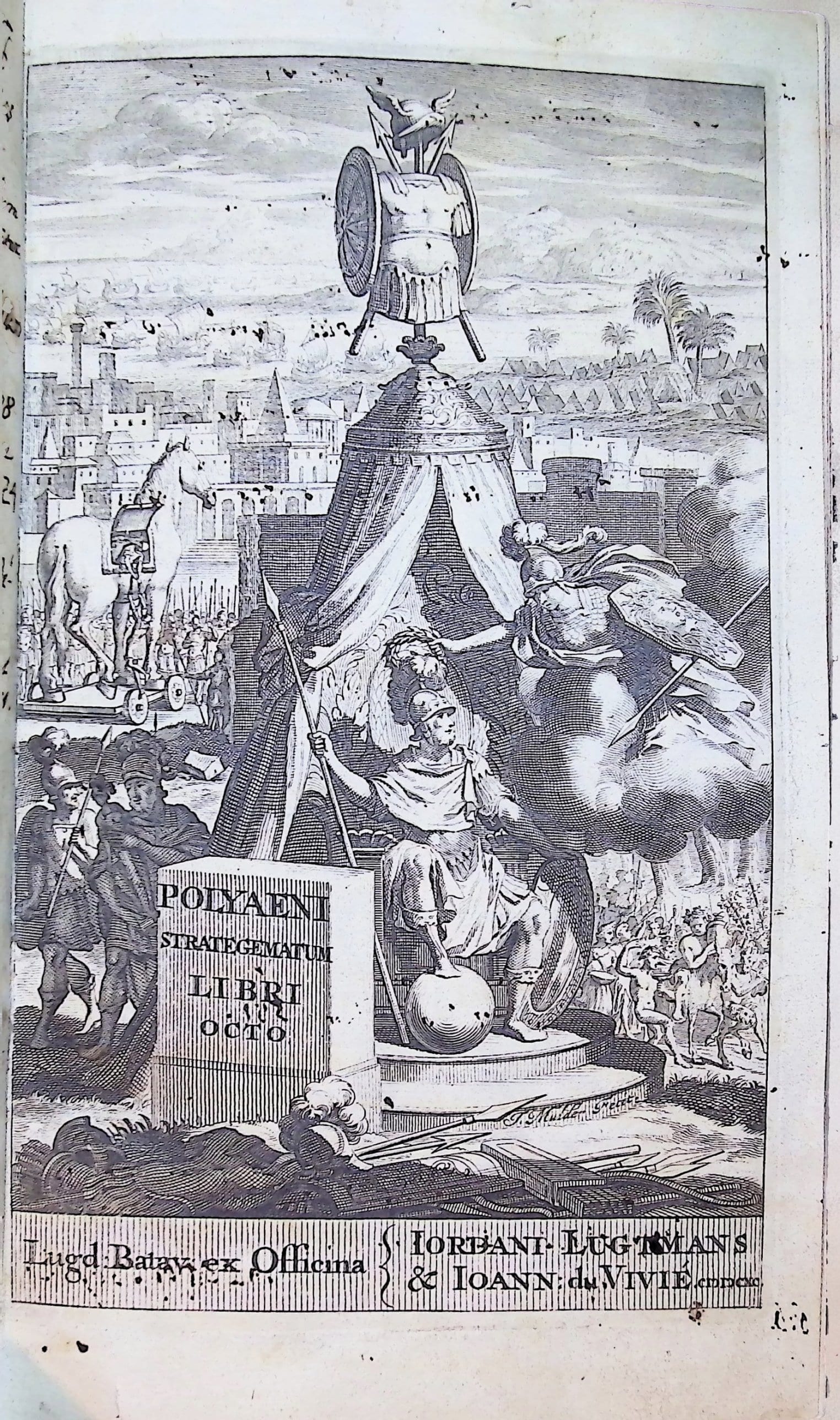
Illustration: additional engraved title-page signed by J. Mulder; woodcut printer's device on the title
Format: thick octavo
Binding: contemporary calf-backed boards covered with speckled paper, calf corners
Annotations: extensive early manuscript notes in Greek and Latin on the opening and closing endpapers (glossary keyed to the page numbers, corrections and critical remarks)
Provenance: early ownership inscription on the title-page; later library labels
Condition
Contemporary calf-backed speckled paper boards with calf corners, rubbed; spine worn, with loss at the head. Extensive contemporary manuscript notes in Greek and Latin on the opening and closing endpapers. Early ownership inscription and a faint stamp on the title-page; shelf labels on the front cover and the rear endpaper.
References & Bibliography
Schweiger, Handbuch der classischen Bibliographie I (Griechen), s.v. Polyaenus.
Dibdin, An Introduction to the Knowledge of Rare and Valuable Editions of the Greek and Latin Classics, s.v. Polyaenus.
STCN 118791400.
Description
Polyaenus, a Macedonian rhetorician and advocate working in Rome, compiled his Strategemata around 162 AD and dedicated the eight books to the emperors Marcus Aurelius and Lucius Verus as they went to war with Parthia. The work gathers several hundred ruses and stratagems from Greek, Roman and Eastern history and legend, from the gods and heroes of myth to Alexander, Hannibal and Caesar, and also includes stratagems attributed to women. It was read and excerpted by Byzantine military writers and became, after its rediscovery in the Renaissance, a standard source for the study of ancient warfare and political cunning.
The Greek text was first published by Isaac Casaubon in 1589. This Leiden edition was prepared by Pancratius Maasvicius, who printed Casaubon's Greek text facing the Latin translation of Justus Vulteius and added Casaubon's notes together with his own. Maasvicius dedicated it to the burgomasters and regents of Delft. The engraved title by Jan Mulder shows a commander enthroned before a tent crowned with a trophy of arms, with the Trojan horse, the greatest stratagem of all, being drawn towards a besieged city behind him. The book was issued by Jean du Vivier together with Jordaan Luchtmans, whose Leiden firm, founded in 1683, is the direct ancestor of the publishing house Brill.
This copy was read closely by an early owner, who filled the opening and closing endpapers with manuscript notes in Greek and Latin: a running glossary of difficult Greek words keyed to the page numbers of this edition, with a few German glosses, corrections to the Latin translation, and critical remarks on the text, for example on stratagems that are rather crimes than ruses of war, and on Polyaenus's confusion of the Gauls under Brennus who took Rome with those who plundered Delphi.
Historical Significance
The principal ancient collection of military stratagems after Frontinus, in a scholarly Leiden edition of the Dutch Golden Age, from the early years of the Luchtmans firm (later Brill).
Provenance
Early ownership inscription on the title-page (not identified). Later library shelf labels "Hadt. O." on the front cover and rear endpaper, the cover label also lettered "Görög" (Hungarian: Greek).