Books
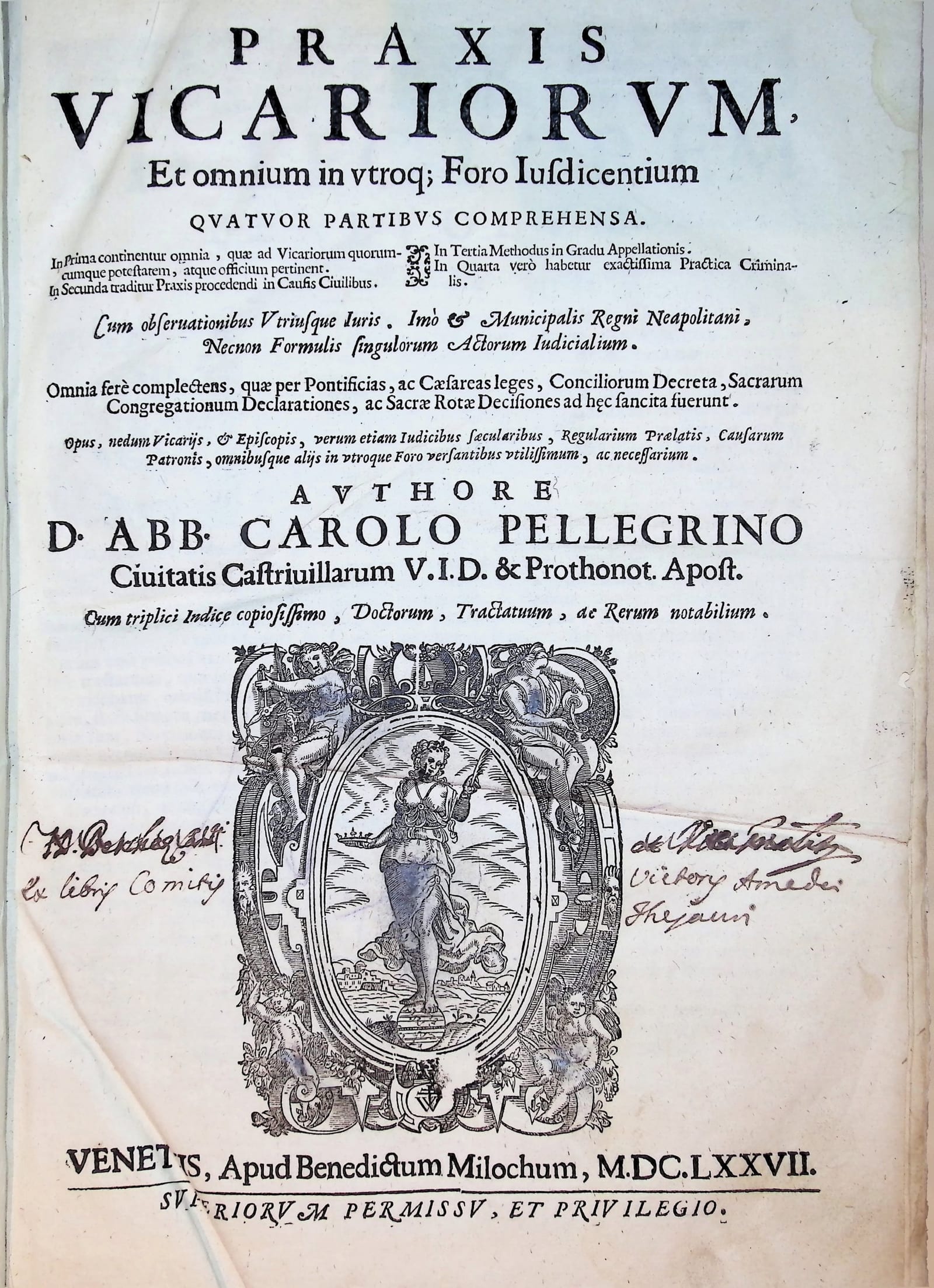
Praxis Vicariorum, et omnium in utroque foro iusdicentium, quatuor partibus comprehensa
PELLEGRINO, Carlo (17th century) · Venice · Benedetto Milocco · 1677
Carlo Pellegrino's handbook for episcopal vicars and judges in church and secular courts, Venice 1677, covering civil, appellate and criminal procedure with the laws and customs of the Kingdom of Naples, in contemporary vellum
FM-0315
€ 850
All prices include VAT. Import duties outside the EU are not included.
Free insured shipping. The price shown is the price you pay.
Key Properties
Edition: Venice, Benedetto Milocco, 1677
Contents: four parts: (I) the office and powers of vicars; (II) civil procedure; (III) appeals; (IV) criminal practice, with formularies of judicial acts
Collation: pp. [12], 474, [34] (according to the seller's description)
Illustration: large printer's device with the figure of Justice on the title; woodcut initials and headpieces
Format: folio, c. 32 x 22 cm (seller)
Binding: contemporary vellum, raised bands, manuscript title on the spine (seller)
Provenance: early manuscript ownership inscription on the title, partly struck through
Language: Latin
Condition
Contemporary vellum over raised bands, manuscript title on the spine (according to the seller). The seller describes the copy as in very good condition. The photographs show creasing to the half-title, title and preface leaf, and some staining to the title woodcut. Early manuscript ownership inscription on the title, partly struck through.
Description
Carlo Pellegrino, an abbot from Castrovillari in Calabria, doctor of both laws and apostolic protonotary, wrote this book out of his own experience as a vicar. In the preface to the reader he explains that he had served several times as a bishop's vicar and began by keeping private notes for his own conscience and memory, following his father's advice not to leave everything to the court clerks. Colleagues who saw the notes urged him to publish them for the benefit of judges, and above all of beginners who were raised to office by the favour of the powerful without knowing courts, canons or laws.
The result is a practical manual in four parts. The first sets out what a bishop should look for when choosing his vicar general: a qualified man of good life, a cleric, a doctor of law, preferably not a native of the diocese, citing the example of Saint Charles Borromeo and the decisions of the Roman congregations. The second part deals with civil procedure, the third with appeals and the fourth with criminal practice. Throughout, Pellegrino gives the actual formulas of judicial acts, so that a vicar could draw up a summons, a sentence of excommunication or an interdict from the book itself.
What makes the work distinctive is that it joins canon and Roman law to the law and custom of the Kingdom of Naples. Pellegrino cites the royal pragmatics, the decisions of the Sacro Regio Consiglio and Neapolitan jurists such as Afflitto and Franchis next to the Roman Rota. As he says in the preface, the book was meant not only for church judges but for secular judges and the superiors of religious orders as well. The criminal part, with its treatment of inquisitorial procedure and the use of torture, gives a direct view of how justice was administered in southern Italy in the seventeenth century.
This Venetian edition was printed by Benedetto Milocco in 1677.
Historical Significance
A working manual for church and secular judges in the Kingdom of Naples, giving the formulas and procedures actually used in seventeenth-century courts, including criminal and inquisitorial practice.
Provenance
Early manuscript ownership inscription on the title, reading in part "ex libris Comitis ... Victorij Amedei ...", partly struck through.