Books
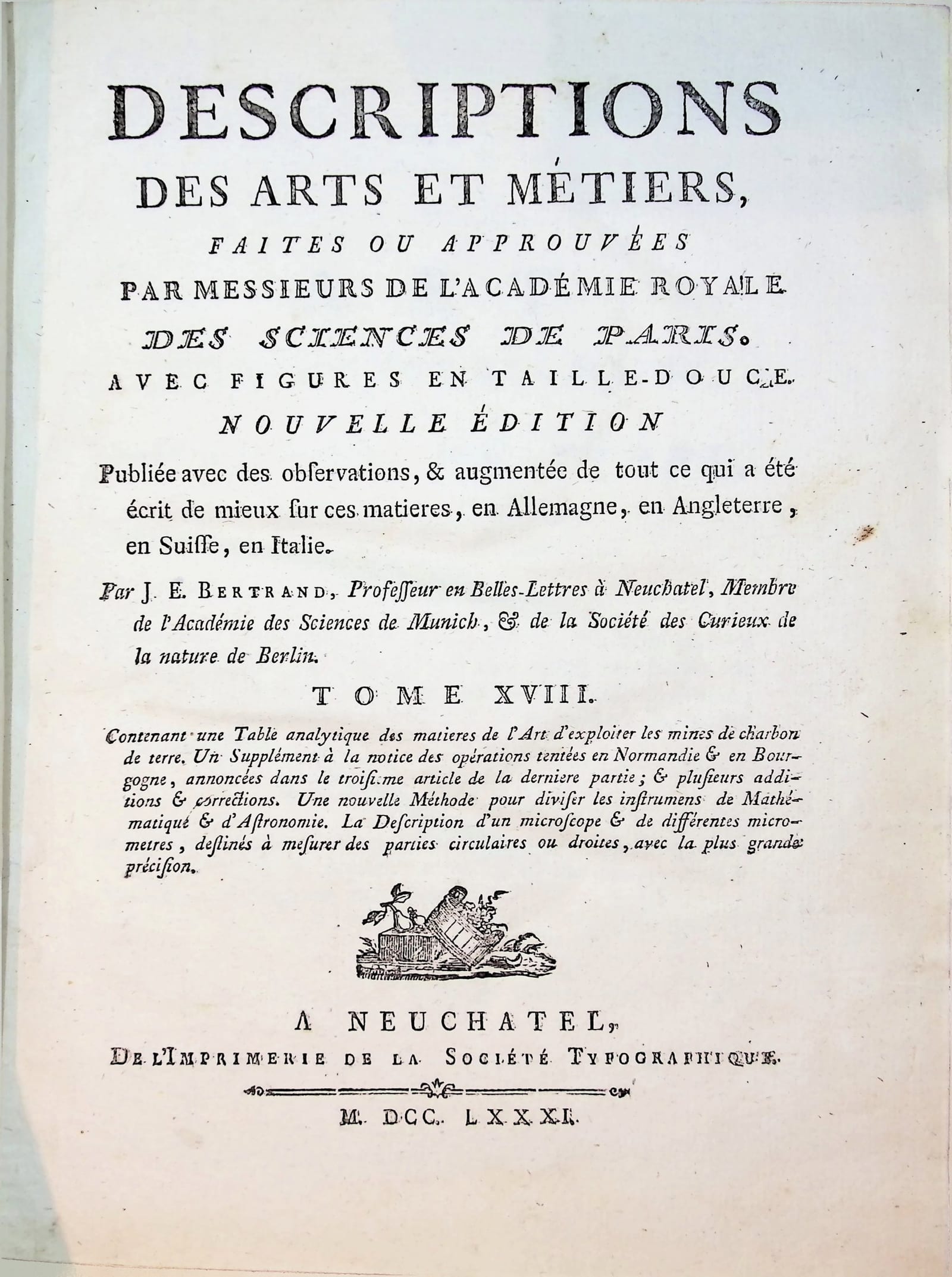
Descriptions des arts et métiers, faites ou approuvées par Messieurs de l'Académie Royale des Sciences de Paris. Nouvelle édition. Tome XVIII
BERTRAND, Jean-Élie (editor); CHAULNES, Michel-Ferdinand d'Albert d'Ailly, duc de; MORAND, Jean-François-Clément · Neuchâtel · Imprimerie de la Société Typographique · 1781
Volume XVIII of the Neuchâtel edition of the Paris Academy's Descriptions des arts et métiers, with the duc de Chaulnes's new method for dividing mathematical and astronomical instruments and his description of a microscope and micrometers, with 13 engraved plates by Sellier, in contemporary calf
FM-0316
€ 650
All prices include VAT. Import duties outside the EU are not included.
Free insured shipping. The price shown is the price you pay.
Key Properties
Edition: Neuchâtel, Société Typographique, 1781, "nouvelle édition" edited by J.E. Bertrand
Contents: Morand, table analytique to the Art d'exploiter les mines de charbon de terre, with supplement on operations in Normandy and Burgundy, a supplement to the alphabetical catalogue of coals and minerals, additions and corrections; duc de Chaulnes, Nouvelle méthode pour diviser les instrumens de mathématique et d'astronomie; Description d'un microscope et de différens micromètres
Collation: 476 pp., with 13 engraved plates (VIII + V) by Sellier (according to the seller's description)
Format: quarto, c. 25 x 19 cm (seller)
Binding: contemporary full calf, spine and edges gilt, marbled endpapers, ribbon marker (seller)
Language: French
Condition
Contemporary full calf, gilt spine and board edges, marbled endpapers, ribbon marker (according to the seller). The seller describes the paper and plates as very clean with wide margins. The photographs show the covers rubbed and scuffed, with wear at the foot of the spine and a scraped area at the lower edge of the front board, and a pale stain in the upper outer corner of the plates.
References & Bibliography
Cole, A.H. and Watts, G.B., The Handicrafts of France as recorded in the Descriptions des Arts et Métiers 1761-1788 (Boston, 1952), for the series and its Neuchâtel edition.
Description
Between 1761 and 1788 the Académie Royale des Sciences in Paris published its Descriptions des arts et métiers, a long series of folio treatises in which members of the Academy set out, trade by trade, how things were actually made. Soon after the series began, the Société Typographique de Neuchâtel undertook a reprint in the handier quarto format, edited by Jean-Élie Bertrand, professor of belles-lettres at Neuchâtel. As the title states, this "nouvelle édition" was augmented with observations and with the best that had been written on the same subjects in Germany, England, Switzerland and Italy.
This eighteenth volume, printed in 1781, combines two very different subjects. The first part completes the physician Jean-François-Clément Morand's great treatise on coal mining, L'Art d'exploiter les mines de charbon de terre, with an analytical table of contents for its second part, which dealt with extraction, trade and the uses of coal, chiefly at Liège, in England and in France. It includes a dictionary of mining terms in several languages, with words used in England, Holland, Germany, Liège, Saxony, Sweden and Scotland, a supplement on the attempts to open coal mines in Normandy and Burgundy, and additions and corrections.
The second part is of real importance for the history of scientific instruments. It contains the two works of the duc de Chaulnes, first published by the Academy in 1768: his Nouvelle méthode pour diviser les instrumens de mathématique et d'astronomie and his description of a microscope and of micrometers for measuring circular and straight divisions with the greatest precision. In his introduction Chaulnes explains why: the accuracy of a divided scale had until then depended on the eye and hand of the craftsman, which no human skill could make equal to the precision of a mechanical movement combined with the magnification of optical instruments. His dividing engine, with a microscope fixed over the work, is shown in the five plates of the Nouvelle division des instrumens engraved by Sellier, and was one of the first attempts to take the dividing of instruments out of the hands of the individual artist.
Historical Significance
Contains the duc de Chaulnes's method of dividing mathematical and astronomical instruments with a microscope-mounted engine, an early step towards mechanical precision in instrument making, together with the closing parts of Morand's treatise on coal mining.