Cartography
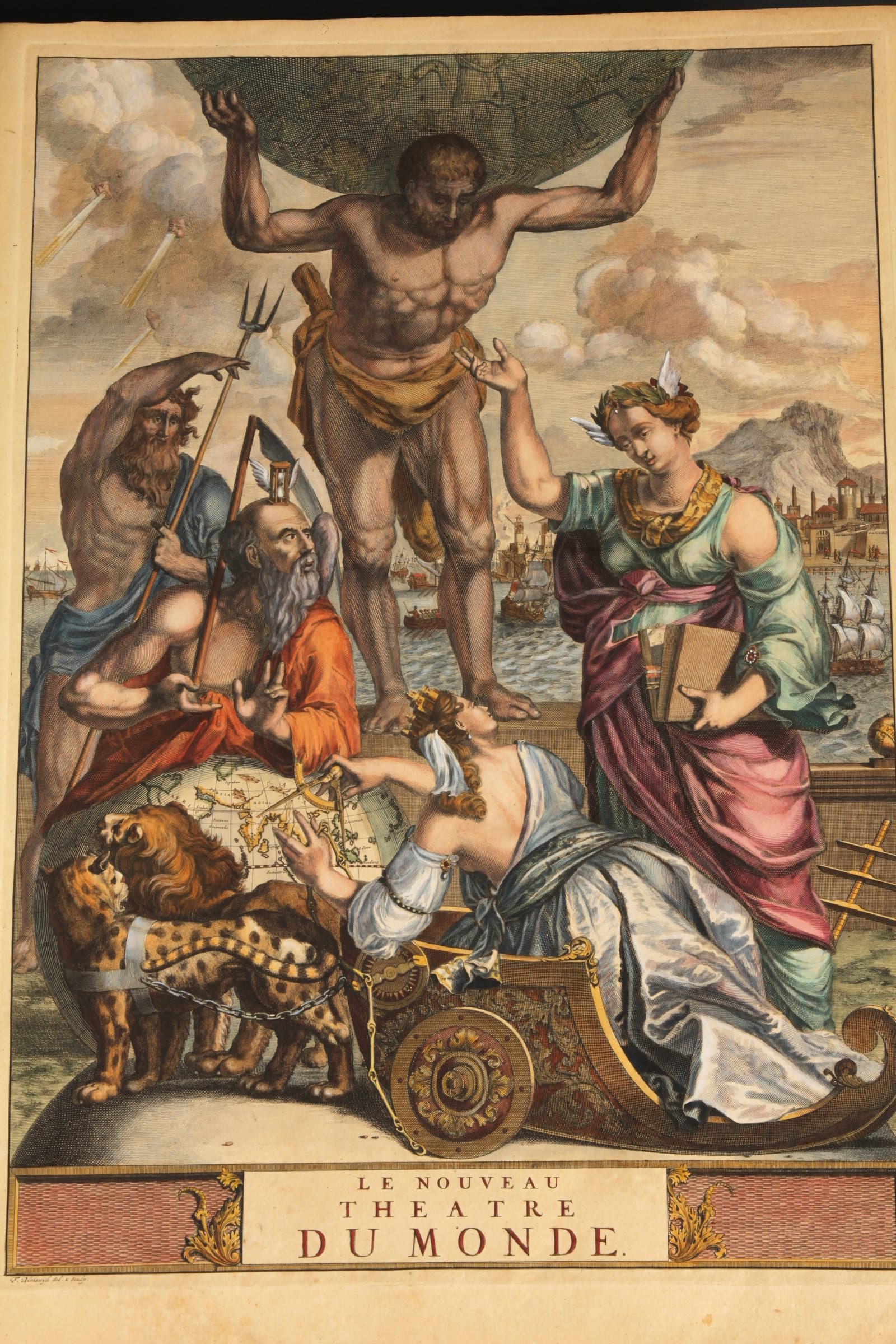
Le nouveau Theatre du Monde ou la Geographie Royale
Pieter van der Aa (text by Gueudeville and Ferrarius) · Leiden · Pieter van der Aa · 1713
Pieter van der Aa, a sumptuous grand-folio world atlas, richly engraved and finely coloured
FM-0036
Price on request
Key Properties
Format: Grand folio, 56 x 43 cm
Binding: Half vellum and marbled paper over boards
Colour: Continent maps, Italy, engraved title-page, vignettes and initials in later colour, heightened in gold
Maps: 2 folding world maps, 4 continent maps and Italy in colour; 88 maps in black and white on 44 sheets
Language: French
Collation & Technical Description
Grand folio, 56 x 43 cm. Letter title-page in red and black and an engraved title-page, followed by 3 unnumbered leaves (dedication), 1 unnumbered leaf (preface) and 1 unnumbered leaf (index), then 66 and 76 leaves of text on broadsheet (landscape) paper, interleaved with the maps. With 2 double-page folding world maps (50 x 65 cm), 4 double-page continent maps and 1 double-page country map of Italy, all in colour, and a further 88 maps in black and white on 44 sheets covering the whole world and especially the Netherlands and Europe. The engraved title-page, seven double-page maps and all vignettes and historiated initials are in superb later colour, modestly heightened in gold.
Condition
Excellent. Strong paper that sounds loudly when handled. A few leaves with modest waterstaining. Two of the single-page map sheets show a small tear and old restoration; all other maps are fine, with deep impressions on strong paper. Apparently rebound in the nineteenth century, using a fifteenth-century manuscript on vellum for the spine and marbled paper over boards.
References & Bibliography
Koeman, Atlantes Neerlandici, Aa 6. Hoftijzer (1999).
Description
A magnificent world atlas by the Leiden publisher and engraver Pieter van der Aa. Its text gives a geographical, political and historical description of all the regions and countries of the world, written by Nicolas Gueudeville for Europe and by Ferrarius for the other continents.
The atlas is rare and celebrated for its sensational engravings. Beyond the engraved title-page, the two world maps and the maps of the continents and Italy, even the small maps each carry a scene relating to the country depicted. Van der Aa was one of the finest Dutch engravers of his day (Hoftijzer, 1999), and this shows in the detail of the maps, the richness of the cartouches, and the engraved initials and vignettes.
Van der Aa (1659 to 1733) was among the most prolific publishers of the Dutch Golden Age, and in 1715 he was appointed head printer to the city of Leiden and its university. He was famous for acquiring and reworking engraved plates from earlier publishers, often adding large decorative borders, which gives his atlases their exceptionally rich and ornamental character. This same body of atlas material culminated in his monumental Galerie Agreable du Monde (Leiden, 1728), issued in sixty-six volumes with more than three thousand plates, of which only about one hundred copies are said to have been printed, one of the largest illustrated works ever produced. As a curious footnote to his fame, the orchid genus Aa is said to have been named after him by the botanist Heinrich Gustav Reichenbach, in connection with his printing of Paul Hermann's Paradisus Batavus, although this explanation is disputed.
Historical Significance
The atlas appears only rarely on the market. In the present century only three copies are recorded at auction: one coloured, one in black and white, and a third in black and white with serious condition problems. A black and white copy lacking the large maps has since been offered on the open market. The present copy, with its world and continent maps in fine colour and heightened in gold, is a notably rich example.
Provenance
Available on request.