Voyages & Discovery
Weltbuch, with Schmidel on the Rio de la Plata and von Staden on Brazil
Sebastian Franck (with Ulrich Schmidel and Hans von Staden) · Frankfurt · Georg Lechler for Sigmund Feierabend · 1567
1567 edition of Franck's Weltbuch, with the first printed report on the founding of Buenos Aires (Schmidel) and von Staden's Brazilian captivity; extremely rare Americana
FM-0067
Price on request
Key Properties
Format: Folio, book block 31.5 x 19.5 cm, three parts in one volume
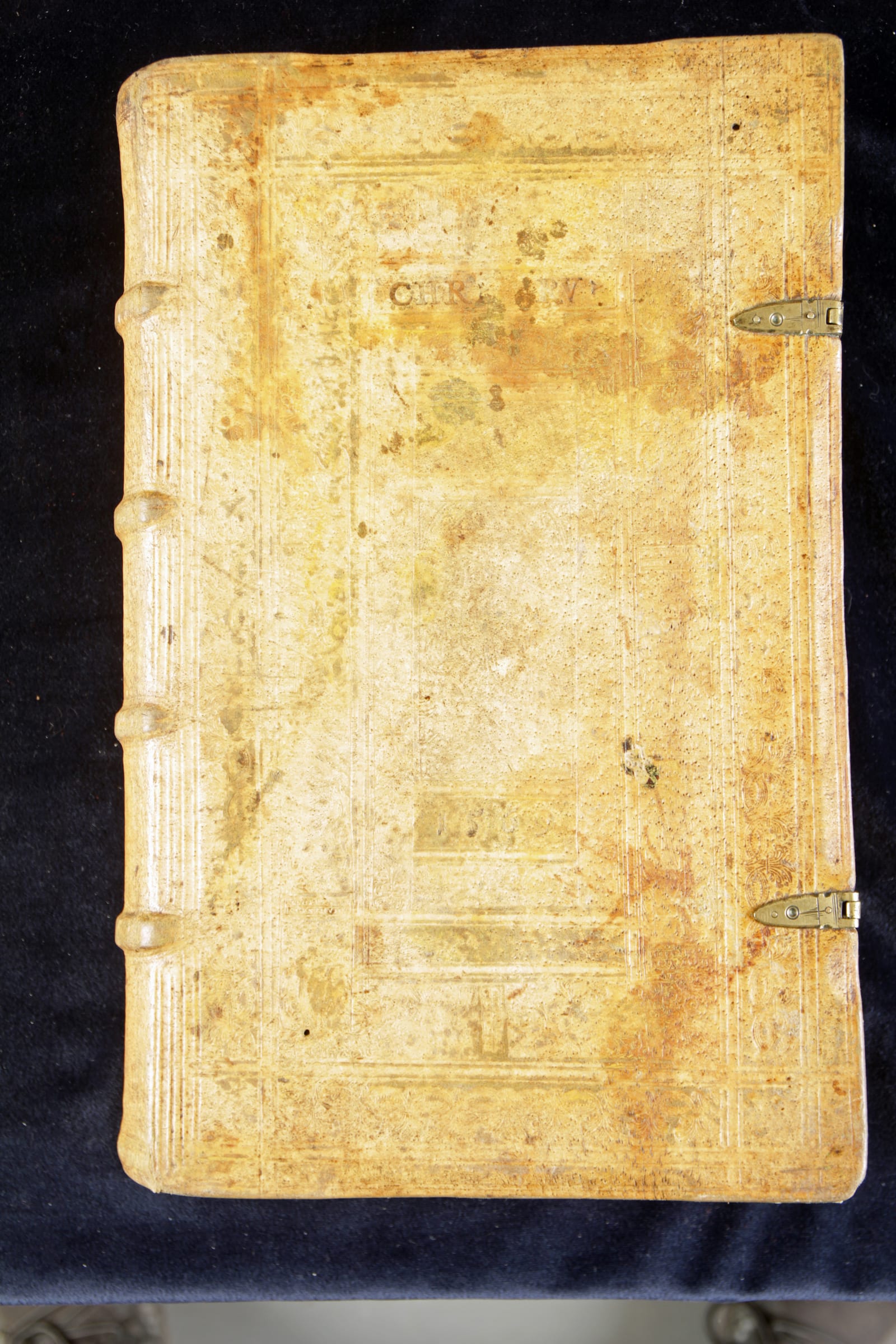
Binding: Contemporary blindstamped pigskin over wooden boards with brass clasps, dated 1569 and signed with a monogram
Language: German
Contents: Franck's Weltbuch, with Schmidel's Rio de la Plata and von Staden's Brazil
References: Alden 567/16; Bosch 27; Borba de Moraes I, 60
Collation & Technical Description
Folio, book block 31.5 x 19.5 cm. Three parts in one volume. 6 unnumbered leaves; 242 leaves; 8 unnumbered leaves (Register); 6 unnumbered leaves, the last an authentic blank; 110 leaves; 59 leaves and 1 unnumbered leaf (the colophon). Franck's Weltbuch complete and in its original state.
Condition
Complete, in a contemporary binding of blindstamped pigskin over wooden boards, decorated with a portrait and ornamental borders and fitted with contemporary brass clasps. The binding is dated 1569 and signed with a monogram (CHV / RV), and the title has been burned into the book block (Weltbuch Franc). The binding is shaved. Minor paper repairs to the title leaf; the front free endpaper has been renewed.
References & Bibliography
Alden and Landis, 567/16. Bosch, 27. Borba de Moraes, I, 60. Dominguez, The Conquest of the River Plate (Hakluyt Society, 1891). Duffy and others, The Return of Hans Staden (Johns Hopkins, 2012). Sanz, La fundacion de Buenos Aires (Madrid, 1958).
Description
A landmark and extremely rare Americana. This is the 1567 Frankfurt edition, printed by Lechler for the publisher Sigmund Feierabend, of Sebastian Franck's Weltbuch, here in three parts in one volume. It contains the first printed report of the earliest years of Argentina, including the founding of Buenos Aires, together with Hans von Staden's account of his time on the Rio de la Plata and his later captivity in Brazil. Sebastian Franck (1499 to 1542) was a well known German intellectual and the author of some fourteen books. His Weltbuch, a cosmography first published in 1534, includes a substantial section on the Americas. As Franck died in 1542, the later parts of this collection were assembled by others, and the whole is also known as the Feierabend Sammlung. The second part is a compilation of travel accounts, and the third contains a translation of Apollonius on Peru and the voyages of the French to Florida. The second part gives the first publication of Ulrich Schmidel's account of his nineteen years in the Rio de la Plata. Schmidel (1510 to 1580) was a German soldier who joined Pedro de Mendoza's expedition to settle the region. Mendoza founded Puerto Nuestra Senora Santa Maria del Buen Aire in January 1536, and a party sent upriver founded Asuncion; the settlers who remained on the Plata starved and were driven out, abandoning the settlement in 1541. Schmidel stayed in the region until 1552 and returned to Germany in 1554. His account, covering the governorships of Mendoza and Alvar Nunez Cabeza de Vaca and the role of Domingo Martinez de Irala, was first printed here in 1567. The collection also contains Hans Staden's celebrated account of his captivity among the Tupi in the region of present-day Sao Paulo, first published at Marburg in 1557. Staden's text was written up by Johann Dryander, a professor at the University of Marburg and a follower of Martin Luther. Both the Schmidel and the Staden narratives carry a Protestant, anti-Catholic signature, as would the later editions later issued by De Bry and Hulsius. The Schmidel first edition is of the greatest rarity. Over the last forty years only two copies have been traced at auction. Only four copies have been located in public libraries: one at the Boston Athenaeum, two at the John Carter Brown Library, one at the New York Public Library, and one at a Catholic university in Minnesota. Both accounts have become landmarks in their own right. Hans Staden's narrative, first published at Marburg in 1557 with fifty-six woodcuts, is the earliest European eyewitness description of the Tupinamba and a foundational text for the European image of Brazil, as well as a touchstone in the long scholarly debate over cannibalism. Its reliability is not undisputed: the anthropologist William Arens argued that Staden embellished or invented its more sensational scenes, while most scholars continue to regard it as an important ethnohistorical source. Ulrich Schmidel's report, one of very few eyewitness sources for the conquest of the Rio de la Plata, records the first founding of Buenos Aires in 1536 and of Asuncion in 1537; from this 1567 printing onward it was repeatedly reissued and translated into five languages, and it became a foundational text for Argentina's national history.