Science
Ephemerides (Almanach) for the years 1516 to 1531, second part
Johann Stoffler · Venice · Petrus Liechtenstein · 1504
Rare Venetian ephemeris of 1504, the second part (1516 to 1531), continuing the ephemerides of Regiomontanus
FM-0071
€ 25.000
Key Properties
Format: Quarto
Binding: Recased in seventeenth-century vellum over boards
Collation: 224 leaves
Colophon: Woodcut printer's device of Liechtenstein, printed in black and red
Language: Latin
Reference: Houzeau, 14471
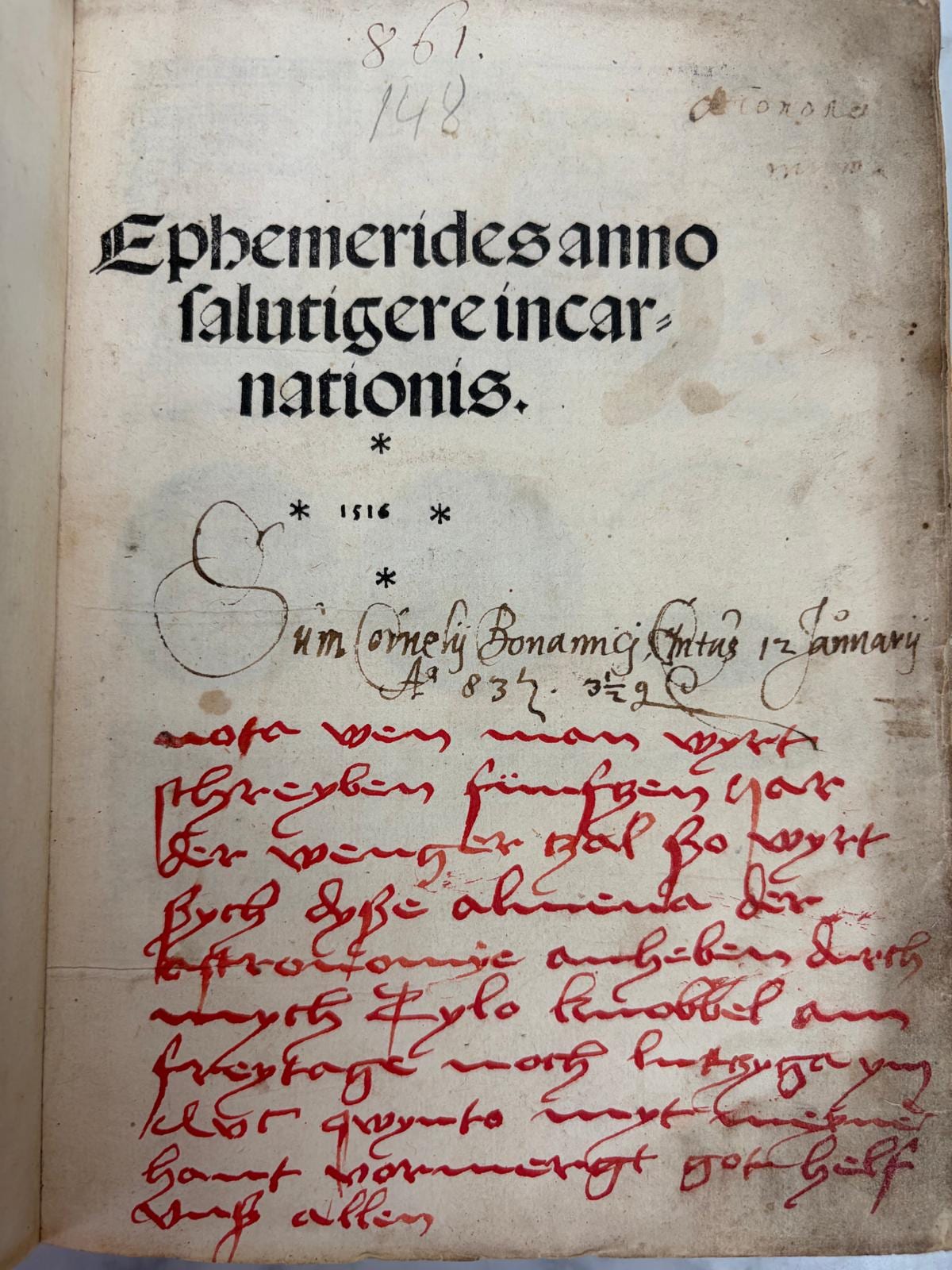
Provenance: Ownership inscription of Cornelius Freundt (1535 to 1591), cantor and composer at Zwickau; early annotation on the title page, close to the time of publication
Collation & Technical Description
Quarto, 224 leaves, recased in seventeenth-century vellum over boards. The second of two parts (the first covering 1505 to 1516). A collection of annual predictions of the positions of the sun, moon and stars for each day, each month occupying a double-page opening, with a title-page and a final blank. Woodcut colophon of Liechtenstein printed in black and red.
Condition
A fine copy on strong paper, in original condition apart from one leaf (N2) with a torn-off piece. Recased in seventeenth-century vellum over boards.
References & Bibliography
Houzeau, 14471.
Description
A rare Venetian ephemeris by the German mathematician and astronomer Johann Stoffler, printed at Venice by Petrus Liechtenstein and dated 4 January 1504. This is the second of the two parts, covering the years 1516 to 1531, giving the predicted daily positions of the sun, moon and stars, with one double-page opening for each month.
Stoffler produced his ephemerides to continue those of Regiomontanus, covering the years from 1499 to 1531. His first collection (Ulm, 1499) is extremely rare, and this second edition (Venice, 1504) is equally so. No copy has appeared at auction in the past twenty-five years; WorldCat locates only one other copy of this second part and two copies of the first part, of which only two of the three are complete.
Johann Stoffler (1452 to 1531) held the chair of mathematics and astronomy at the University of Tubingen, where his pupils included Philipp Melanchthon and Sebastian Munster, the very scholar who a few years later edited the Solinus and Mela geographies. Stoffler's almanacs are also remembered for an unintended consequence: their notice of a rare conjunction of all the then known planets in Pisces in February 1524 was seized upon across Europe as the sign of a coming universal flood, setting off widespread panic, with people reportedly building arks on the Rhine. Stoffler himself had made no such prophecy and publicly denied ever having predicted a flood.
Provenance
The volume contains an autograph ownership inscription by the Zwickau cantor and composer Cornelius Freundt (1535 to 1591). The attribution has been established through comparison with authenticated manuscript material from his later years preserved in a German institutional collection. A separate, substantially earlier annotation on the title page appears to date from close to the time of publication and is written in an East Central German dialect associated with the Saale and Elbe region, adding a further layer to the volume's early history and use.