Science
Cosmographicus liber Petri Apiani, restitutus per Gemmam Phrysium (with) Gemma Frisius, Libellus de locorum describendorum ratione
Peter Apian and Gemma Frisius · Antwerp · Johannes Grapheus for Arnold Birckman · 1533
Third edition of Apian's Cosmographia revised by Gemma Frisius, with the first edition of Frisius's treatise containing the earliest printed account of triangulation; four volvelles, complete
FM-0075
Price on request
Key Properties
Format: Small quarto, two works in one volume
Binding: Contemporary limp vellum
Collation: 56 and 10 leaves
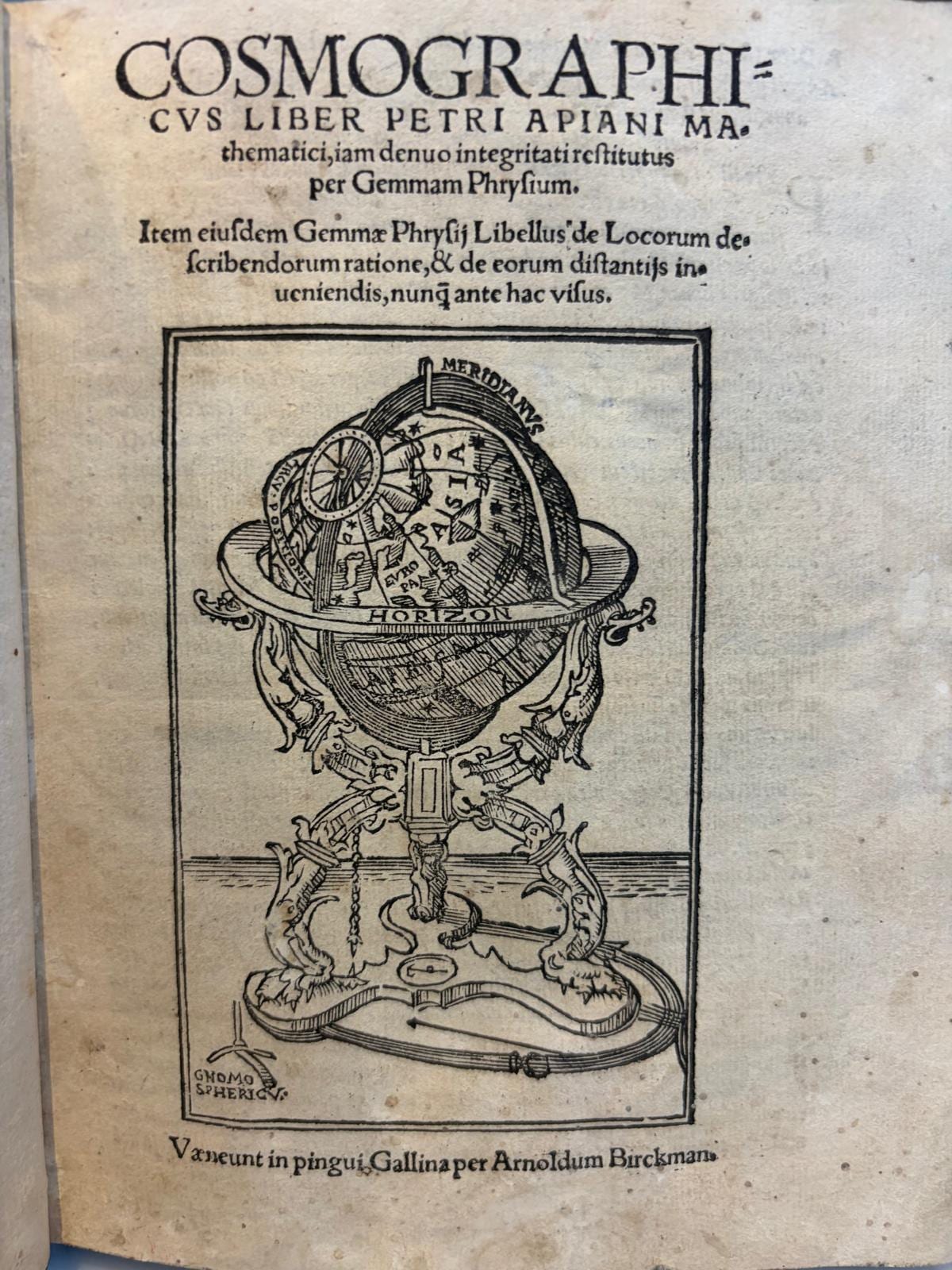
Illustration: Woodcut globe on the title, numerous text woodcuts, four with moving parts (volvelles)
Language: Latin
References: Van Ortroy 8; Harrisse 179; Sabin 1742; JCB I, 106; Honeyman 102; Coppens (2008) Frisius 1
Collation & Technical Description
Small quarto, two works in one volume. 56 and 10 leaves. Title-page with a woodcut globe, and a colophon with Birckman's woodcut device. Numerous woodcut text illustrations, four of them with moving parts (volvelles, at C1, C4, H4 and O1). Complete. Bound in contemporary limp vellum.
Condition
A nice copy in its original condition, in the contemporary limp vellum binding, with a restored tear to the vellum. Some gatherings are slightly loosening from the spine but are not detached.
References & Bibliography
Van Ortroy, 8. Harrisse, 179. Sabin, 1742. John Carter Brown, I, 106. Honeyman collection, 102. Coppens, Frisius bibliography (2008), 1.
Description
The third edition of Peter Apian's celebrated Cosmographia, revised and enlarged by Gemma Frisius, printed at Antwerp by Johannes Grapheus for Arnold Birckman in February 1533. Apian's Cosmographicus liber was one of the most successful textbooks of astronomy and geography of the sixteenth century, and its early editions are now rare.
Bound with it as a second work is the first edition of Gemma Frisius's Libellus de locorum describendorum ratione, his short treatise on the plotting of places, which contains the first printed account of the principle of triangulation, the method that would underpin land surveying and map-making for centuries. Frisius's contribution was both innovative and important, and it appears here in print for the first time.
The volume is illustrated with numerous woodcuts, including a globe on the title-page and Birckman's device at the colophon, and four of the diagrams are fitted with moving parts (volvelles), which let the reader make astronomical and geographical calculations by hand. The copy is complete.
Gemma Frisius, who revised this Cosmographia, was one of the most inventive minds of his age. In 1530 he had been the first to describe how longitude might be found by carrying an accurate clock: since the Earth turns fifteen degrees every hour, comparing the time kept from the port of departure with the local time gives the difference in longitude. This was the very principle of the marine chronometer, though the clocks of the day were far too crude to realise it, and a workable solution had to wait some two centuries. From his workshop at Leuven Frisius also taught the young Gerardus Mercator, and together with the engraver Gaspar van der Heyden they made Leuven a leading centre for the making of globes, maps and astronomical instruments.