Illustrated Books
Los desastres de la guerra
Francisco de Goya y Lucientes (1746-1828) · Madrid · Real Academia de Bellas Artes de San Fernando · 1892
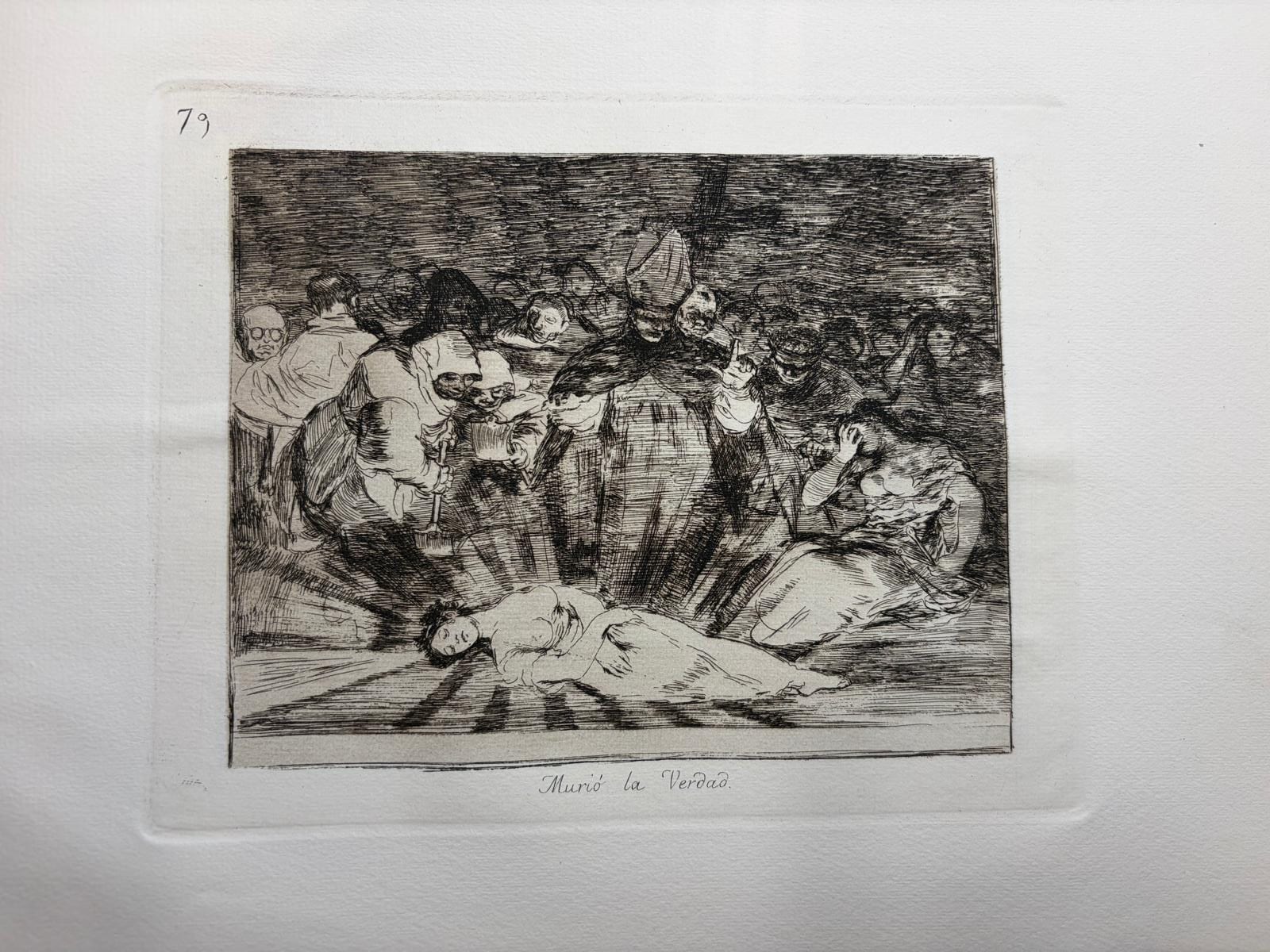
Goya's Los desastres de la guerra: the complete set of 80 etchings, second edition, one of only 100 copies (Madrid, 1892).
FM-0081
Price on request
Key Properties
Edition: Second edition, one of 100 copies (first edition 1863, 500 copies)
Language: Spanish
Format: Oblong folio, sheets c. 23.5 x 33 cm
Binding: Contemporary full calf
Medium: Etching with aquatint, drypoint and burin
Paper: Laid paper without watermark, as issued
Collation & Technical Description
Title page and introduction (2 leaves), followed by the complete series of 80 numbered plates, executed in etching with aquatint, drypoint and burin, printed on laid paper without watermark. Complete.
Condition
An unmanipulated, unwashed copy. Occasional slight spotting, mainly to the versos. The impressions are of excellent quality throughout.
References & Bibliography
Harris, Goya: Engravings and Lithographs, I, pp. 139 ff.; II, p. 174 (Harris 121-200).
Description
Second edition of the Desastres, printed in 1892 for the Real Academia de Bellas Artes de San Fernando in an edition of only 100 copies, against 500 for the first edition of 1863. It was issued on laid paper without watermark, which readily distinguishes it from the first edition. Harris judged the second edition 'generally well printed on suitable paper', while dismissing every later edition as 'very inferior or inferior to the second edition'. The 1892 printing is therefore the finest edition of the Desastres obtainable after the first, and, in only a fifth of that edition's number, considerably rarer.
Historical Significance
The Desastres de la guerra is one of the most impressive documents against war ever made. Etched by the ageing Goya between 1810 and 1820, the 80 plates form an eloquent denouncement of war and hunger: the scenes depict the horrors of the French (Napoleonic) invasion of Spain (1808-1814) and the ensuing famine of Madrid (1811-1812), witnessed by the artist at first hand. In 1808 Goya had travelled to Zaragoza at the invitation of General Palafox to see the ruins of the besieged city with his own eyes, and the series insists on this eyewitness authority: several of Goya's manuscript captions read as testimony, most famously plate 44, 'Yo lo vi' (I saw it).
The subject was far too dangerous to publish under the restored Bourbon regime, and the series remained unprinted in Goya's lifetime. The only contemporary set is the proof album Goya prepared for his friend Juan Agustin Cean Bermudez (now in the British Museum), on which he inscribed his own title: 'Fatales consequencias de la sangrienta guerra en Espana con Buonaparte. Y otros caprichos enfaticos' (Fatal consequences of Spain's bloody war with Bonaparte, and other emphatic caprices). The familiar title Los desastres de la guerra was only devised for the Academia's posthumous first edition. The copperplates were preserved by Goya's son Javier (d. 1854) and were acquired by the Academia in 1862, which brought out the first edition in 1863, thirty-five years after the artist's death in 1828. The original coppers survive to this day in the Calcografia Nacional in Madrid.
With the Caprichos, the series is debatedly Goya's most famous graphic work, and its influence on the imagery of war, from Manet to Picasso and the photojournalism of the twentieth century, can hardly be overstated.
Provenance
Available on request.