Voyages & Discovery
Narrative of a Five Years' Expedition against the Revolted Negroes of Surinam, in Guiana, on the Wild Coast of South America
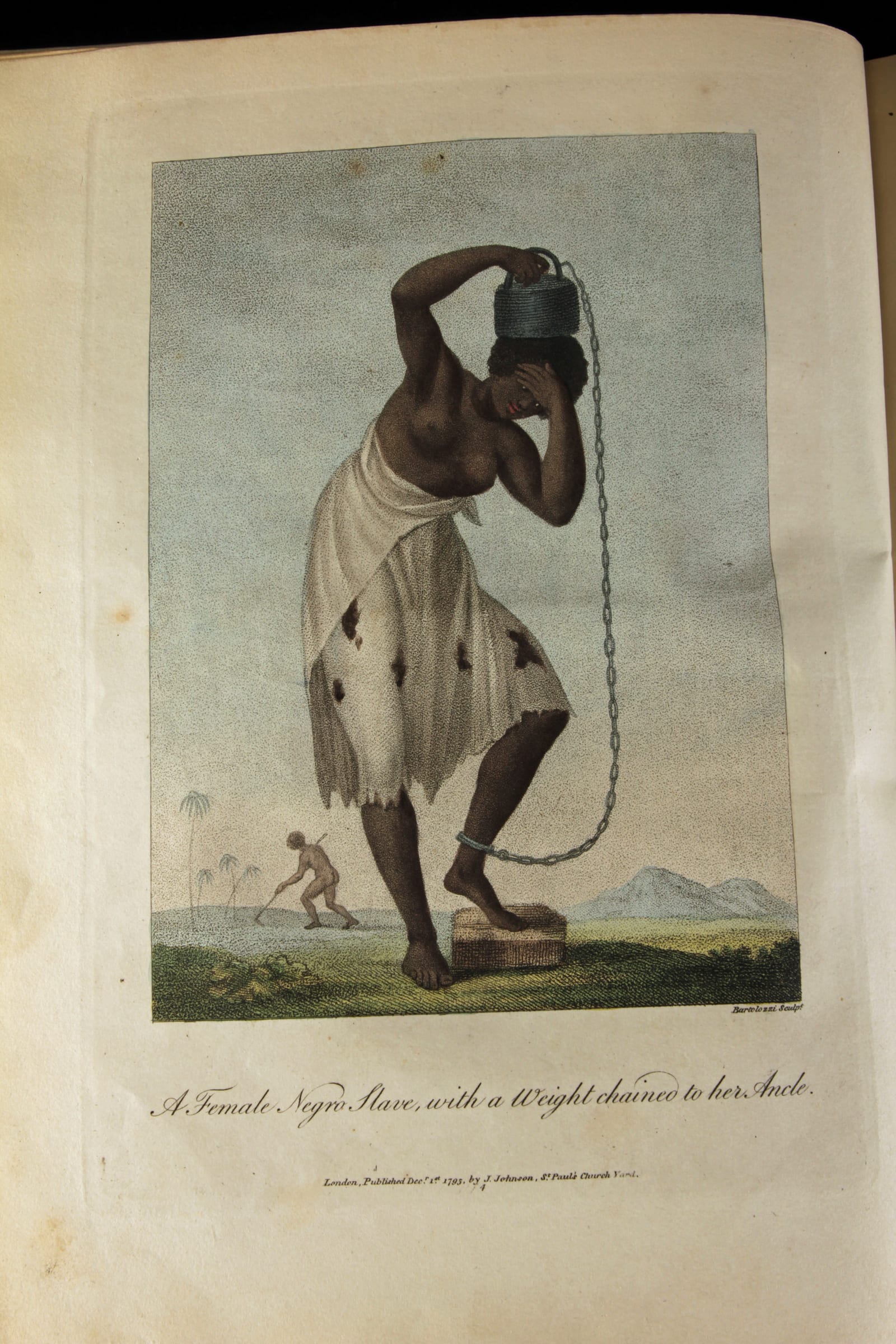
John Gabriel Stedman; the plates after his own drawings, engraved by William Blake, Francesco Bartolozzi and others · London · J. Johnson and Th. Payne · 1806
The second edition of the great abolitionist narrative of Suriname, a large paper copy with 77 aquatint plates and 3 folding maps in contemporary colour
FM-0083
€ 18.000
Key Properties
Edition: Second edition, first published in 1796
Language: English
Format: Two volumes in one, quarto; a large paper copy, the bookblock 29.5 x 23 cm
Binding: Blindstamped vellum over heavy bevelled boards
Illustration: 77 plates in aquatint and 3 engraved folding maps, all in attractive contemporary colour; both title-pages with an engraved vignette
Colouring: Contemporary hand colouring, deeply applied
Collation & Technical Description
Two volumes bound in one, quarto.
Volume one: 11 leaves including the frontispiece and title-page; 423 pp.; 1 leaf; 4 pp.
Volume two: second title-page; 4 leaves; 419 pp.; 5 pp.
Both title-pages with an engraved vignette. 77 plates in aquatint and 3 engraved folding maps, all after Stedman's own drawings made on the spot.
Condition
A large paper copy, the bookblock measuring 29.5 x 23 cm, in blindstamped vellum over heavy bevelled boards. The plates in deep contemporary colour.
References & Bibliography
Sabin 91075. Abbey, Travel, 719. Bentley, Blake Books, 499 B.
Description
One of the most important abolitionist documents of the eighteenth century, and among the most vivid eyewitness accounts of any slave society. Stedman was an officer of the Scots Brigade in Dutch service who volunteered in 1772 for an expedition to Suriname, then a Dutch colony, and stayed five years. He came back with a manuscript, a portfolio of drawings, and a settled horror at what he had seen.
The Dutch had sent the expedition against the maroons, the communities formed far upriver by people who had escaped the plantations and who were hunted, brought back and punished with a cruelty that Stedman recorded in detail because he could not bring himself to leave it out. Suriname was the most extreme slave society in the Americas. Stedman reckoned the enslaved population at twenty five times the size of the white one, against ten to one in Jamaica, and the plantations consumed lives at a rate that required constant replacement from the Atlantic trade.
The book is also the record of his relationship with Joanna, a young enslaved woman whose mother offered her to him within days of his arrival, and with whom he had a son. He tried to buy her freedom and failed, and when he sailed for Europe she would not come. Nothing in that account can be separated from the fact that she was owned property and he was an officer of the force that kept her so, and Stedman's own text does not pretend otherwise. It is that refusal to look away, from the whippings and the hangings and from his own position in the system, that gave the book its force in the abolition debate.
Stedman was a gifted and curious man, and the Narrative is far more than a polemic. He observed, drew and described the plants, birds, fish and animals of Suriname with the eye of a naturalist, and the plates carry that work as much as they carry the scenes of punishment. Sixteen of the engravings are by William Blake, and they are among the most powerful images he ever made for another man's book. Francesco Bartolozzi and others engraved the rest.
Historical Significance
First published in London in 1796 and translated into six languages, the Narrative reached the whole of literate Europe at exactly the moment the abolition campaigns were gathering force, and Blake's plates travelled further still, cut loose from the book and reprinted for two centuries as the defining images of plantation slavery. Richard and Sally Price, who restored Stedman's original manuscript in 1988, call the narrative one of the richest and most vivid accounts ever written of a flourishing slave society.
That restoration also revealed how much the published book differs from what Stedman wrote. His 1790 manuscript was heavily edited before it reached print, its politics softened and its prose smoothed, to his own loud objection. The book collectors have always known, and the book that did the work in the world, is the printed one.
A large paper copy with the plates in contemporary colour is the form in which the book is most wanted. The aquatints were designed to be coloured, and a deeply coloured set transforms both the natural history and the scenes of punishment, which lose none of their brutality for being beautiful objects.