Early Printing
Liber Chronicarum (the Nuremberg Chronicle): the Creation of the World, the seven opening leaves in contemporary colour
SCHEDEL, Hartmann · Nuremberg · Anton Koberger · 12 July 1493
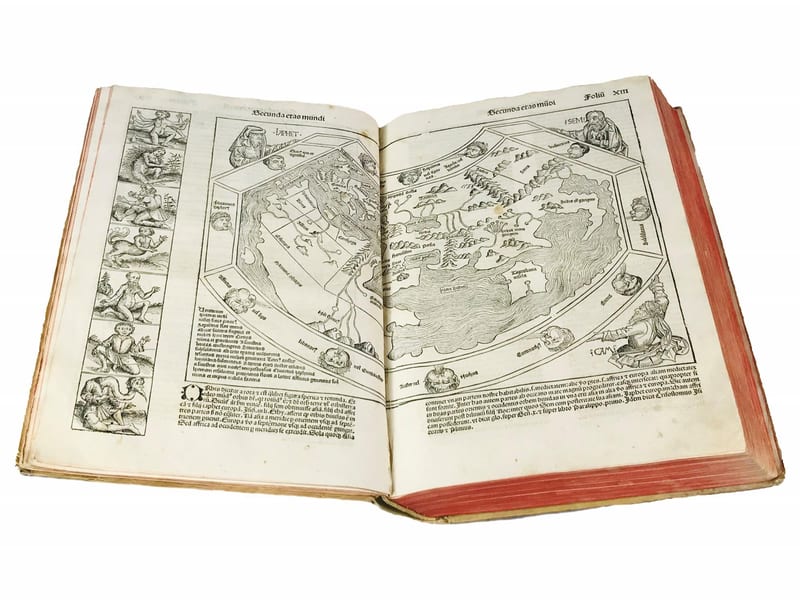
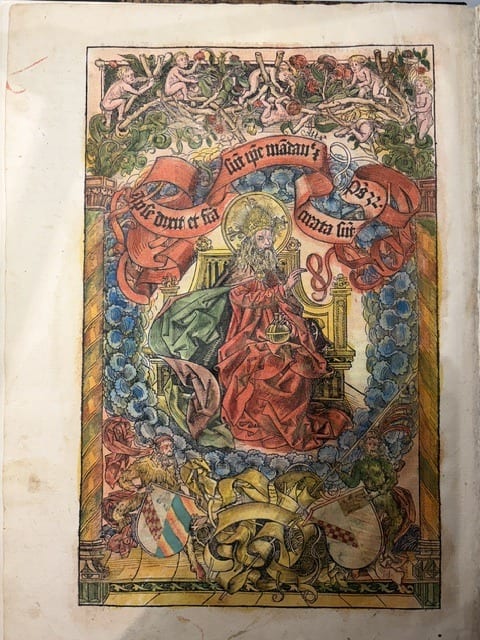
The first seven leaves of the Latin Nuremberg Chronicle, the Creation of the World, with God enthroned, the seven half-page woodcuts of the days of Creation, the Creation of Eve and the Expulsion from Paradise, all in contemporary full colour and with extensive early Italian marginal notes drawn from Foresti's Supplementum Chronicarum, bound as a book in imperial folio
FM-0094
€ 22.000
Key Properties
Edition: First, Latin edition, Nuremberg, Anton Koberger, 12 July 1493 (Hain 14508; Goff S 307; Sabin 77523; Church 7)
Language: Latin
Format: Imperial folio, the leaves 46.2 x 31.2 cm; seven leaves, fourteen pages
Illustration: one full-page woodcut (God enthroned, with the arms of the original owners), seven half-page woodcuts (the heavens filled with angels and the six days of Creation), three three-quarter-page woodcuts (the spheres of the universe, the Creation of Eve, the Expulsion from Paradise); all in contemporary full colour; a large painted initial
Annotations: extensive early manuscript notes in Italian, first half to middle of the sixteenth century, drawn from Foresti da Bergamo's Supplementum Chronicarum
Binding: Modern quarter goatskin with matching paper sides and an engraved title label, the contemporary free endpapers preserved
Collation & Technical Description
The seven opening text leaves of the Latin Chronicle, the account of the Creation of the World, bound as a book. The first page with a large painted initial and the full-page woodcut of God the Father enthroned, with the coat of arms of the original owners painted beneath; then the seven half-page woodcuts of the heavens filled with angels and the six days of Creation, the three-quarter-page woodcut of the universe with the spheres of the planets and the fixed stars, the Creation of Eve and the Expulsion of Adam and Eve from Paradise. All the woodcuts in contemporary full colour. Extensive early marginal annotations in Italian throughout, in a learned sixteenth-century hand, with the reader's own reference to his source, Croniche di fra Filippo da Bergamo.
Condition
Leaves of full imperial folio size, the margins uncut, in fresh contemporary colour, with the early Italian manuscript notes in the margins. Bound in modern quarter goatskin. Full condition report on request.
References & Bibliography
Hain 14508. Goff S 307. Sabin 77523. Church 7. Wilson, The Making of the Nuremberg Chronicle (Amsterdam 1976). Die Graphiksammlung des Humanisten Hartmann Schedel (Munich 1990). Panofsky, The Life and Art of Albrecht Dürer (Princeton 1948).
Description
The Nuremberg Chronicle of Hartmann Schedel, printed by Anton Koberger on 12 July 1493, is the most richly illustrated book of the fifteenth century and one of the best designed: a history of the world from the Creation to the year of printing, with more than 1,800 woodcut impressions from the workshop of Michael Wolgemut and Wilhelm Pleydenwurff, in whose shop the young Albrecht Dürer had just completed his apprenticeship when the blocks were being cut. The present volume contains the opening of the book, the seven leaves of the Creation of the World, in the form in which a fifteenth-century reader saw them: in full contemporary colour, on uncut leaves of the great imperial folio, and annotated in the margins by an early owner whose arms are painted beneath the first woodcut.
The Creation is the most famous sequence in the Chronicle. It opens with the full-page woodcut of God the Father enthroned, followed by the seven half-page cuts in which the work of the six days is shown as a growing circle of the cosmos, from the empty sphere filled with angels to the finished universe of earth, sea, planets and stars; then the three-quarter-page diagram of the spheres, the Creation of Eve from the side of Adam and the Expulsion from Paradise. Coloured examples of these leaves, with margins of the original size, are the exception: most surviving copies were cut down by nineteenth-century binders, and the great majority of the Latin edition was sold uncoloured.
Nuremberg in 1493 was one of the largest and most cultivated cities of the Empire, with some 50,000 inhabitants. Schedel, a physician trained at Padua, was one of its leading humanists and the owner of a celebrated library and print collection from which much of the Chronicle was compiled; Koberger ran the largest printing house in Europe; the astronomer Regiomontanus had worked in the city from 1471 until he was called to Rome; and Martin Behaim, whose family house stood in the same street as Schedel's and Koberger's, completed his terrestrial globe, the oldest surviving, in the very year the Chronicle appeared. The book is the product of that circle.
Why these seven leaves matter. They are not a gathering of loose plates but a self-contained book: the opening of the Chronicle from the prologue, through the seven days of Creation, the spheres, Adam and Eve and the Expulsion, to the four rivers of Paradise on the last verso, so that the text runs complete from the first page to the last. They carry the two woodcuts that every collector of the Chronicle wants: the full-page God the Father enthroned, and the great image of the seventh day, the finished universe with the earth at its centre, the spheres of the planets and the fixed stars, the choirs of angels and the four winds at the corners, the definitive printed picture of the pre-Copernican cosmos, published exactly fifty years before Copernicus's De revolutionibus of 1543. The two shields at the foot of the God the Father woodcut, left blank by the block-cutter for the arms of the purchaser, have here been filled with the painted arms of the first owners, which makes the volume a candidate for identification and gives it a provenance from the year of printing. The colouring is contemporary and of the Nuremberg type, applied when the book was new; the Latin edition was sold for the most part uncoloured, and coloured leaves of this quality are far scarcer than plain ones. The leaves are of the full imperial folio size, 46.2 by 31.2 cm, where most surviving copies were cut down by later binders. And the margins carry the extensive Italian notes of an early sixteenth-century scholar, evidence that the book was read as closely as it was looked at.
The annotations. The manuscript notes in the margins of these leaves are not the casual jottings of a reader but a piece of scholarship. They are in Italian, and their author names his source himself: Croniche di fra Filippo da Bergamo, that is the Supplementum Chronicarum of the Augustinian Jacopo Filippo Foresti da Bergamo, the other great world chronicle of the age, which had appeared in an Italian vernacular edition at Venice in 1491, two years before Schedel's book. Beside Schedel's account of the Creation the annotator sets passages taken from Foresti: Moise homo santo e Teologo eccellente, for instance, is a phrase that recurs almost word for word in Foresti, and we have compared the notes with the Italian Foresti editions of 1508, 1524 and 1540, in which the same passages occur. He does not simply copy: he selects, abridges and places Foresti's material against the corresponding passages of Schedel. The columns of figures in his hand appear to relate to Foresti's chronological system, which sets the different eras of the world side by side, and another note deals with the traditional reckoning that the world was to last six thousand years. The whole points to a deliberate comparison of the two systems of biblical and universal chronology. On palaeographical grounds the hand belongs to the first half or the middle of the sixteenth century; the writer has not yet been identified, but he was an Italian-speaking, learned reader with an interest in theology and chronology. What makes the volume remarkable is therefore not only that it was annotated early, but how it was used: a sixteenth-century reader laid the two great world chronicles of the 1490s, Foresti in Italian and Schedel in Latin, side by side and worked their texts and their chronologies into one another.
We also hold a complete copy of the Latin edition (FM-0021).
Historical Significance
The Creation woodcuts of the Nuremberg Chronicle are the image of the medieval cosmos at the moment of its dissolution: printed in the year after Columbus's first voyage and in the year of Behaim's globe, in the city where Regiomontanus had laid the foundations of modern astronomy. For the collector of the age of discovery they are the starting point, the world as Europe pictured it before the discoveries redrew it.
Provenance
Early owners' arms painted beneath the first woodcut; extensive Italian marginal annotations of the first half or middle of the sixteenth century, drawn from Foresti's Supplementum Chronicarum; further provenance available on request.