Voyages & Discovery
LIBER CHRONICARUM
Hartmann Schedel (1440–1514) · Nuremberg · Anton Koberger, for Sebald Schreyer and Sebastian Kammermaister · 12 July 1493
The Nuremberg Chronicle
FM-0021
Price on request
Key Properties
Edition: First Latin edition
Language: Latin
Binding: Stiff vellum, label with title on flat spine, endpapers renewed
Collation & Technical Description
Leaves 325: [20, title and Tabula], 300 numbered I–CCXCIX–[1], [5 De Sarmacia Regione]. Two colophons: on leaf 266r (4 June 1493) and on leaf 300v (Anton Koberger, Nuremberg, 12 July 1493). Leaves CCLIX–CCLXI blank, reserved for manuscript annotations by the reader as indicated on leaf CCLVIIIv. Last blank leaf not present.
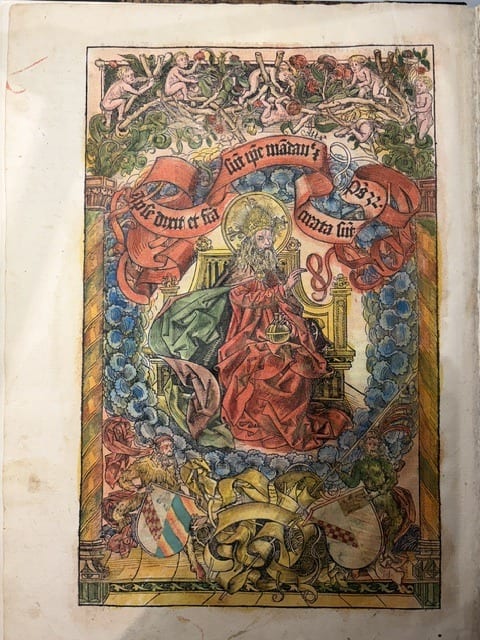
Over 1,800 woodcut illustrations of varying sizes printed from 645 woodblocks, from the workshop of Michael Wolgemut and Wilhelm Pleydenwurff. The young Albrecht Dürer, who was apprenticed to Wolgemut from 1486 to 1489, is believed to have contributed to the designs. Koberger also reused nineteen woodcuts from his earlier Postillae (1481).
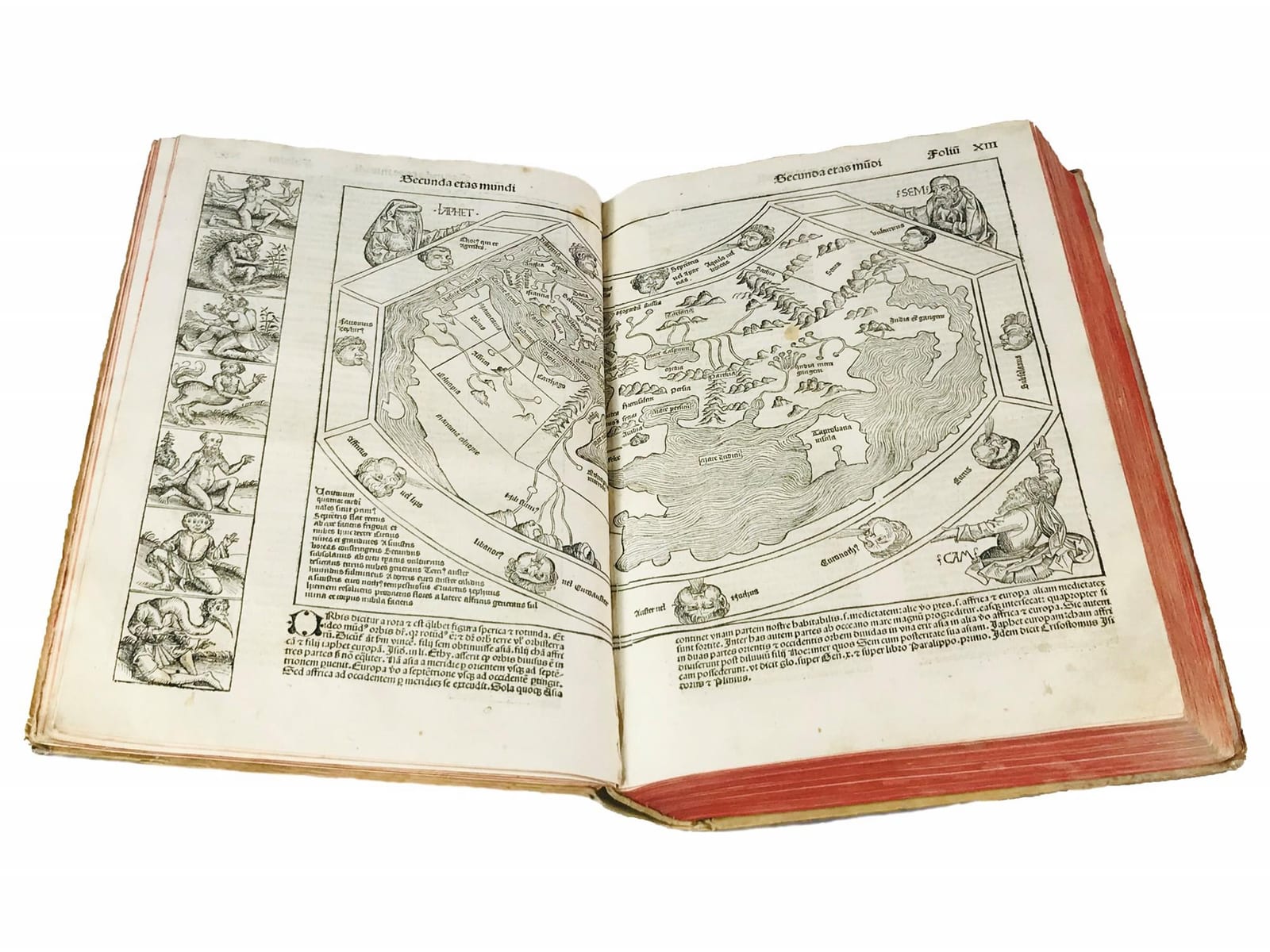
The illustrations include 29 double-page city views, a large plate of coats of arms (leaves CLXXXIII–CLXXXIIII), a globe (leaf XIII), and numerous portraits of saints, emperors, kings and biblical figures. Two important double-page maps are present: a world map based on Pomponius Mela's Cosmographia (Shirley 19) and a map of northern and central Europe by Hieronymus Münzer, engraved by Nicolas Khyrpffs.
Condition
Bound in later full vellum over boards, with a more recent red leather title-label pasted to the spine. In its contemporary structure and easily opened; printed in dark black ink on strong, thick paper, the leaves measuring approximately 42.5 × 28.5 cm. The three blank leaves in the body of the book (folios 259–261) are printed with their numbers and headlines and are thus the originals; the final blank leaf (the last leaf of the book) is not present. Endpapers renewed.
This copy retains, on leaf 169 verso, the famous portrait of "Pope Joan" (Joannes Septimus), a leaf that has been removed or defaced in many copies.
Condition, few leaves slightly browned, folio 26, a slight tear at the foot; leaf 74, a small hole in the woodcut of Pavia; leaf 75, a small lack to the upper right corner; leaf 169, reinforcement to the inner edge; leaf 175, a small hole in the text; folios 183–185, a small hole; leaf 184, a small cut; folio 196, a small hole; a small restoration to the lower margin of leaf 206; folio 271, a small hole; folio 279, some creasing to the foot; the map of Europe with traces of dampstain to its central part; reinforcements to some of the initial leaves; and the last five folios (Sarmatia, regiones Europae) with staining, some holes, edging and traces of humidity.
References & Bibliography
Hain-Copinger *14508.
BMC II, 437.
BSB-Ink. S-195.
Bodleian Incunables: S-108.
Goff S-307.
ISTC is00307000.
Brunet I, 1860.
Shirley 19 (world map).
Campbell, The Earliest Printed Maps, 1472–1500 (1987).
Adrian Wilson, The Making of the Nuremberg Chronicle (1976).
Description
The Liber Chronicarum, universally known as the Nuremberg Chronicle, is one of the supreme achievements of fifteenth-century printing and one of the most lavishly illustrated books of any era. Published on 12 July 1493 by Anton Koberger, the godfather of Albrecht Dürer and the most prolific printer north of the Alps, it represents the culmination of the German incunabulum tradition: a monumental synthesis of text, image and design on a scale that would not be surpassed for generations.
Hartmann Schedel, a Nuremberg physician, humanist and bibliophile, compiled the work as a universal history from Creation to his own time, structured according to the six ages of the world with a seventh reserved for the anticipated end of days. Biblical and classical history run in parallel with the founding and growth of cities, the lives of saints and scholars, and the great events of recent memory, including the invention of printing at Mainz and the Portuguese exploration of the African coast.
The Chronicle is remarkable for what it includes at the very edge of contemporary knowledge. A passage on folio 290v has been read as a reference to a possible voyage to America in 1483, seven years before Columbus. The world map, derived from Ptolemy via Pomponius Mela's 1482 Cosmographia, is one of only three fifteenth-century maps to incorporate Portuguese knowledge of the Gulf of Guinea, making it, according to Campbell, the first modern map of that region to appear in print.
THE ILLUSTRATIONS
The 1,800 woodcut illustrations were produced in the workshop of Michael Wolgemut and his stepson Wilhelm Pleydenwurff, the leading painters of Nuremberg. Wolgemut had been the master of the young Albrecht Dürer during his apprenticeship from 1486 to 1489, and scholars have long debated which, if any, of the woodcut designs can be attributed to the teenage Dürer's hand.
The double-page city views are among the finest topographical images of the fifteenth century. Many depict recognisable cityscapes drawn from life, Nuremberg, Florence, Venice, Rome, Constantinople, while others serve as generic representations adapted by changing the captions. This practice of reusing woodblocks with modified titles was standard in the period and reduces the total number of unique blocks to 645, even as the total number of printed images exceeds 1,800.
The portrait of Pope Joan (Joannes Septimus) on leaf 169v is among the most controversial images in the book. According to medieval legend, a woman disguised as a man rose through the Church hierarchy to become Pope in the ninth century. The portrait was considered so scandalous that it was removed or defaced in many surviving copies. Its preservation in the present copy is a mark of the book's integrity.
The making of the Chronicle has been reconstructed in detail by Adrian Wilson in The Making of the Nuremberg Chronicle (1976), which traces the project through its surviving layout drawings, the "exemplars", and shows how closely text, woodcut and page design were planned together. The illustrations issued from the Nuremberg workshop of Michael Wolgemut and his stepson Wilhelm Pleydenwurff, the foremost painter-designers of the city, the same shop in which the young Albrecht Dürer had recently served his apprenticeship. With characteristic economy the blocks were re-used across the book: the 53 woodcuts of cities and countries do duty for 101 different places, and the 96 blocks of emperors, kings and popes are used 598 times, an average of six times each. The whole undertaking was financed by two Nuremberg merchants, Sebald Schreyer (1446–1503) and Sebastian Kammermeister (1446–1520), who commissioned the work in 1491 and bore its considerable cost, while the German translation was entrusted to Georg Alt, a clerk of the city treasury.
Of the book David Bland wrote (A History of Book Illustration, p. 55): "In fact this is a marvellous book, a landmark in the history of illustration. It cannot fail to impress by sheer size and by the quality of its cuts. They take up almost as much space as the text with which they are integrated in a remarkable way. Most of the small blocks are let into the type at the inner or outer edge of the page, while sometimes the branches of the genealogical tables run right in among the type in a way that had probably never been seen before and is certainly seldom seen today. The usual cut extending across the page to the same width as the type is in a minority and full-page cuts are very rare."
As in the finest incunabula, spaces were left throughout the text for initials and headings to be supplied by hand after printing, in the manner of a manuscript. In the present copy these blanks have been beautifully completed by an early owner, whose accomplished hand-lettering, together with his contemporary notes in the margins, gives the volume the character of a book genuinely read, rubricated and studied rather than merely printed.
The Chronicle was both a publishing sensation and a considerable commercial gamble: an estimated 1,400–1,500 copies of the Latin edition and some 700–1,000 of the German were printed in 1493. Of these, only around 400 Latin and 300 German copies are thought to survive today, and complete copies in fine condition, with the hand-lettering supplied and early ownership evident as here, are decidedly uncommon.
A characteristic and forward-looking feature of the Chronicle is the group of leaves (folios 259–261) that Schedel left printed with their numbers and headlines but otherwise blank in the body of the work: they were provided expressly so that the owner might continue the history by entering the events of his own and later times. In the present copy these original blank leaves are present.
A note on the market: copies of the Schedel in Latin come up surprisingly often, one or more most years, and prices vary accordingly, though good copies command the price of an important illustrated incunable. Good examples are nonetheless rare: the best are those in contemporary binding, full size, and composed of the original leaves only. What comes to the market frequently is a composite copy, often cut short, as shown by narrow margins at the top. Ours is in a slightly later than contemporary binding, but full size, printed on healthy paper, and complete without help.
Historical Significance
The Nuremberg Chronicle holds a singular position in the history of the printed book. Published just four decades after Gutenberg's invention, it demonstrates how completely the new technology of movable type had been assimilated into the most ambitious intellectual projects of its age. No fifteenth-century book, with the possible exception of the Gutenberg Bible itself, is more widely recognised or more eagerly collected.
As a product of Nuremberg humanism, the Chronicle reflects the city's unique position at the intersection of medieval scholasticism and Renaissance empiricism. Schedel attempted to join together biblical and secular history, running the founding of cities in parallel with the biblical narrative. The result is a panoramic view of the known world as understood by a learned European on the eve of the great voyages of discovery, a world still centred on the Mediterranean, still framed by classical and biblical authority, but already beginning to absorb the new geographical knowledge arriving from Portugal and Spain.
The two maps in the Chronicle are of particular cartographic importance. The world map (Shirley 19) is among the earliest printed maps to incorporate Portuguese discoveries along the West African coast, recording knowledge of the Gulf of Guinea that dates from around 1470. The map of Europe by Hieronymus Münzer, engraved by Nicolas Khyrpffs, is one of the most detailed large-scale maps of the continent produced in the fifteenth century.
The production of the Chronicle was itself a landmark in the history of publishing. The contract between Koberger, Schreyer and Kammermaister, which survives in the Nuremberg archives, documents the financial and organisational arrangements in unusual detail, providing one of the most complete records of a major fifteenth-century publishing venture. Adrian Wilson's study The Making of the Nuremberg Chronicle (1976) remains the standard account of this remarkable enterprise.
Provenance
Available on request.