Science
Margarita Philosophica Nova
Gregor Reisch · Strasbourg · Johann Gruninger · 1512
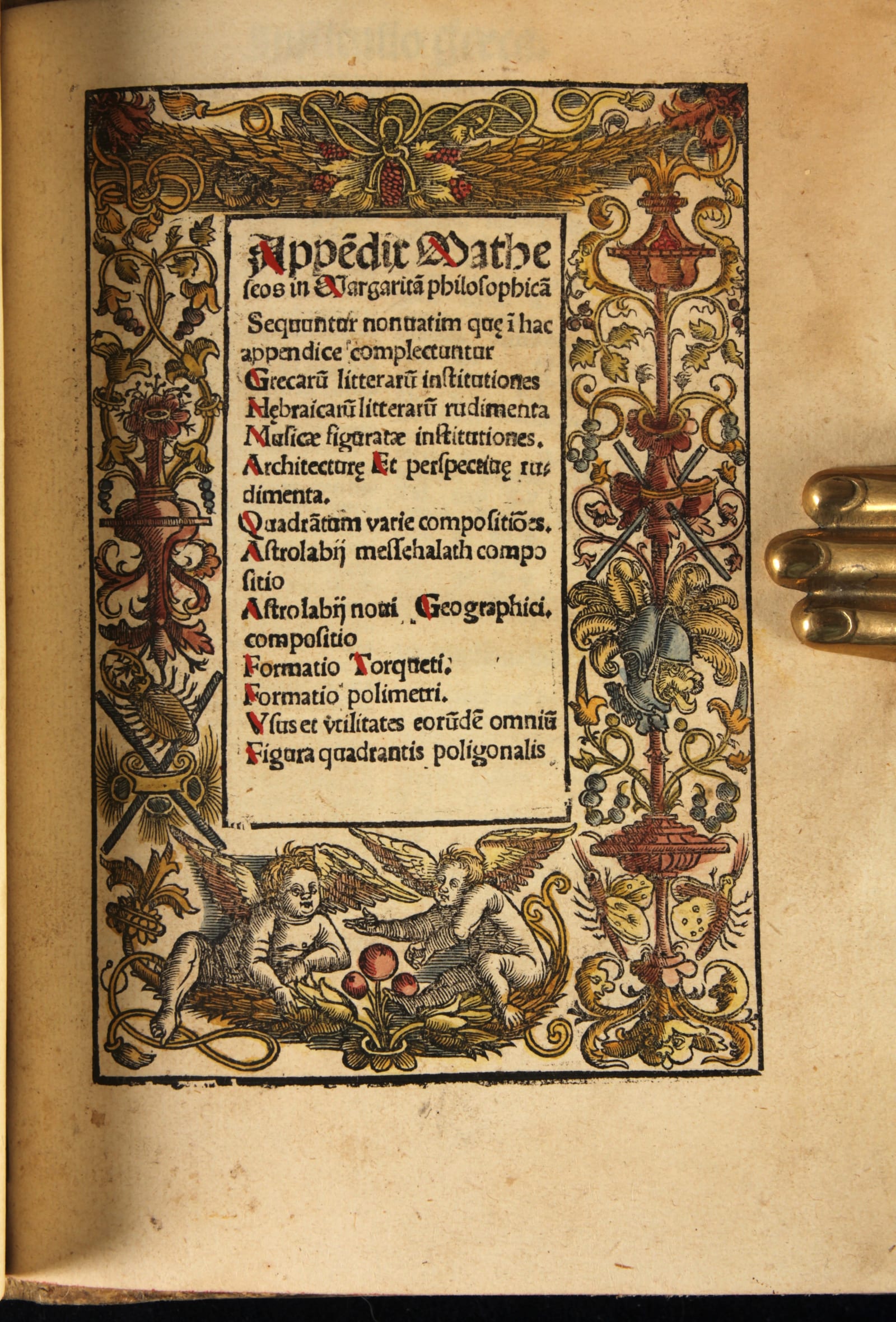
The 1512 Strasbourg edition of Reisch's illustrated encyclopaedia of the sciences, with the rare folding world map, in contemporary hand colour
FM-0072
Price on request
Key Properties
Format: Quarto
Binding: Contemporary blindstamped pigskin over wooden boards
Illustration: 2 engraved title-pages, 7 full-page chapter titles, a folding world map, a folding music table, and hundreds of woodcuts in contemporary hand colour
Text: Rubricated throughout
Language: Latin
References: Smith, Rara Arithmetica; Maggs (1929); Shirley 23
Collation & Technical Description
Quarto, in contemporary blindstamped pigskin over wooden boards, with a printed label on the spine and the title in manuscript on the fore-edge. The text is rubricated throughout. With 2 engraved title-pages, 7 full-page engraved chapter title-pages (Trivium and Quadrivium), one folding woodcut world map (bull's head watermark), one folding music table, and abundant woodcut text illustrations, all in contemporary hand colour.
Condition
A fine copy in its contemporary blindstamped pigskin binding, with the rare folding world map present and the woodcuts in contemporary hand colour throughout.
References & Bibliography
Smith, Rara Arithmetica, p. 82. Maggs, Science Catalogue (1929). Shirley, The Mapping of the World (1987), 23. Compare the 1504 Strasbourg edition in Smith and Maggs.
Description
Gregor Reisch's Margarita Philosophica, the celebrated illustrated encyclopaedia of the liberal arts, here in the Strasbourg edition printed by Johann Gruninger and dated 31 May 1512, with its Appendix. The text, first completed in 1496, offers a complete overview of the sciences at the dawn of the Renaissance, and Smith (Rara Arithmetica, 1908) called it the first modern encyclopaedia to appear in print.
The work is organised around the traditional framework of general education in twelve fields, grouped as the Trivium (grammar, dialectic and rhetoric), the Quadrivium (arithmetic, music, geometry and astronomy), the natural sciences and moral philosophy. Each of the Trivium and Quadrivium subjects is introduced by a full-page metaphorical woodcut, and this 1512 edition adds a detailed index after the twelve chapters. The volume is richly illustrated with two engraved title-pages, seven full-page engraved chapter titles, a folding woodcut world map, a folding music table, and hundreds of woodcut text illustrations, here all in contemporary hand colour.
Beyond its scope, the book is important in several fields. It is an early printed text on music (Leclerc) and on mathematics (Smith). In medicine it is regarded as a graphic incunable, containing the oldest printed depiction of the human eye and an image of the opened skull showing the centres of brain activity, which Maggs (1929) called one of the earliest representations of its kind.
The folding woodcut world map is almost always wanting, and is of such rarity that Harrisse never saw it. It is a variant of a Ptolemaic world map in which the great Southland encloses the Indian Ocean, inscribed hic non terra sed mare est (this is not land but sea, wherein a multitude of islands that were unknown to Ptolemy). It belongs to the Gruninger variant of the Schott world map, framed by four wind-heads rather than twelve, which appears from 1504 onward (Shirley, 1987, 32). In this copy the map corresponds to Shirley's variant 32 2A, but with the arctic wind-head turned correctly, as in the later editions.
The Margarita thus summarises classical learning as it stood around 1490, while this particular edition also documents the arrival of the new sciences of the age of exploration, set out in its Appendix.
Its author, Gregor Reisch (1467 to 1525), was no ordinary compiler: a Carthusian prior at Freiburg and confessor to the Emperor Maximilian I, he moved in the leading humanist circles of his day and was acquainted with Erasmus. The book's best-known image is the Typus Arithmeticae, in which the muse Arithmetica presides over a contest between Boethius, calculating confidently with pen and Hindu-Arabic numerals, and Pythagoras, still labouring at a counting board. It stages the triumph of the new pen-reckoning over the old abacus, and is gloriously anachronistic, since Pythagoras lived around 500 BC, Boethius around AD 500, and Hindu-Arabic numerals reached Europe only after 1200. It remains one of the most reproduced images in the history of mathematics.
Historical Significance
The Margarita Philosophica is one of the most important illustrated encyclopaedias of the early sixteenth century: a compendium of Renaissance learning, an early printed source for music and mathematics, and a landmark of medical illustration. Its folding woodcut world map, almost always lacking, is among the rarest features any copy can retain.