Antique Maps
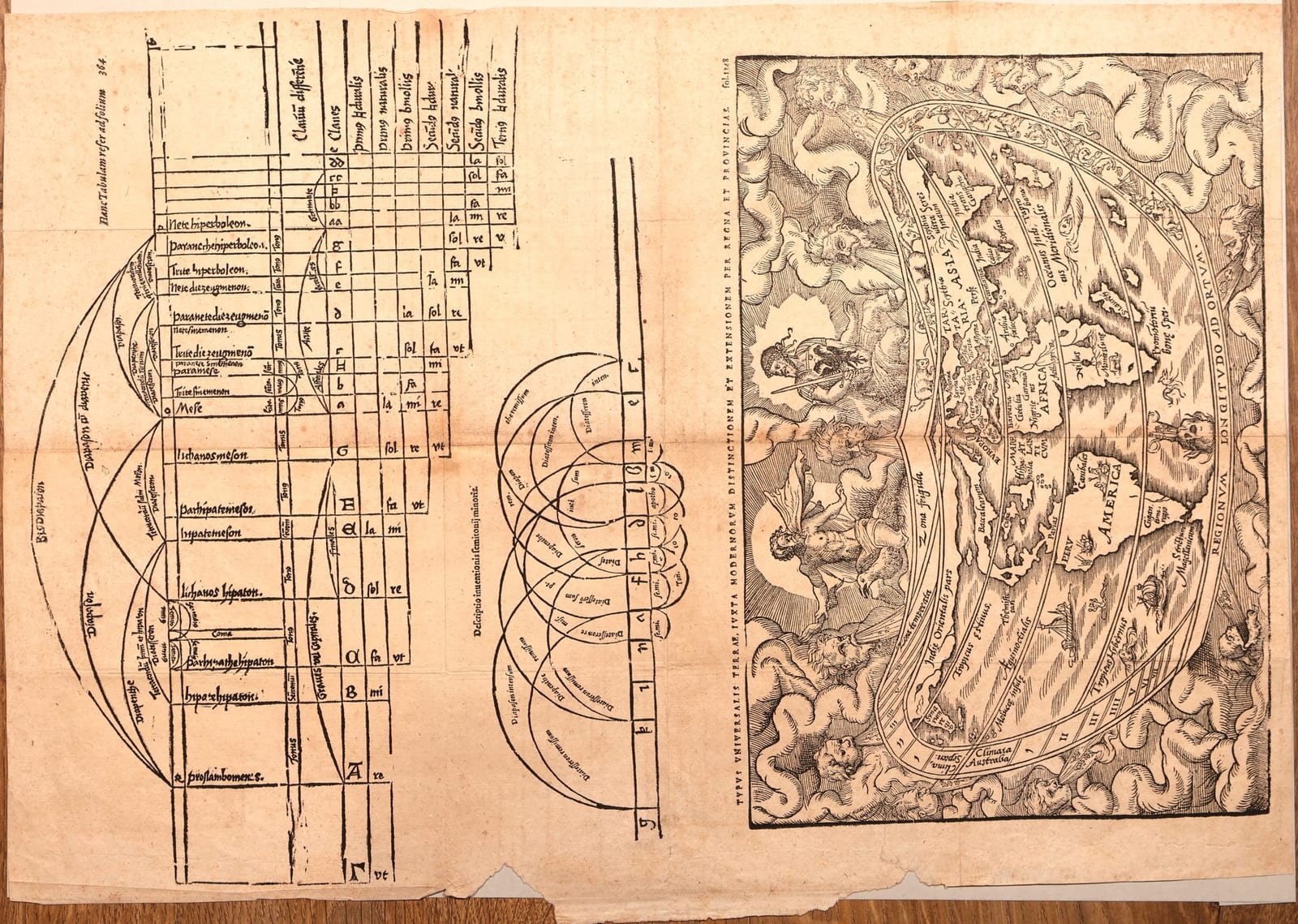
Typus universalis terrae, iuxta modernorum distinctionem et extensionem per regna et provincias, with the folding music table, on one uncut sheet
APIAN, Peter and GEMMA FRISIUS (world map); REISCH, Gregor, Margarita Philosophica (Basel, Sebastian Henricpetri, 1583) · Basel · Sebastian Henricpetri · 1583
The woodcut world map of the Apian and Gemma Frisius type and the large woodcut music table from the Basel 1583 edition of Reisch's Margarita Philosophica, printed together on a single uncut sheet.
FM-0097
€ 8.500 excl. VAT
Key Properties
Contents: world map "Typus universalis terrae, iuxta modernorum distinctionem et extensionem per regna et provincias", with windheads and America, Peru and the Strait of Magellan named; table of the Greek tone system with the hexachord syllables; diagram "Descriptio inventionis semitonii minoris"
Technique: woodcut, uncoloured
Instruction to the binder: "Hanc tabulam refer ad folium 364"
Size: 46.5 x 33 cm
Collation & Technical Description
Single sheet with two woodcut plates printed side by side, uncut and never bound: the world map (headed with a folio reference) and the music table with its diagram ("Hanc tabulam refer ad folium 364").
Size: 46.5 x 33 cm.
Condition
Toned, with folds; loss at the lower edge in the middle and a torn upper left corner.
References & Bibliography
Shirley, The Mapping of the World, 82
Description
Reisch's Margarita Philosophica, the encyclopaedia of the liberal arts first published in 1503, contained two large plates that folded out of the book: a world map and a table of music theory. On this sheet the two are printed together and were never separated for binding.
The world map shows the world on a cordiform (heart-shaped) projection, divided by climates and parallels, surrounded by wind heads, with Asia, Africa and Europe and, to the west, America, Peru, the Cannibales and the Strait of Magellan. The music table sets out the Greek tone system from proslambanomenos to nete hyperbolaeon against the hexachord syllables ut, re, mi, fa, sol, la, with arcs marking the consonances, and beside it a diagram of the minor semitone, Descriptio inventionis semitonii minoris. The instruction "Hanc tabulam refer ad folium 364" tells the binder where the table belongs.
Historical Significance
Gregor Reisch (c. 1467-1525), prior of the Carthusians at Freiburg im Breisgau, wrote the Margarita Philosophica as a complete course of the university arts, from grammar and logic to arithmetic, music, geometry and astronomy. For the Basel edition of 1583 the world map of the earlier editions was replaced by the cordiform world map of Peter Apian, as found in his Cosmographia, after the large world map of Gemma Frisius of 1540, of which no copy is known. It shows America, Peru and the Strait of Magellan. The Basel edition of the map is rarely seen on the market.
Related works
Science · FM-0072
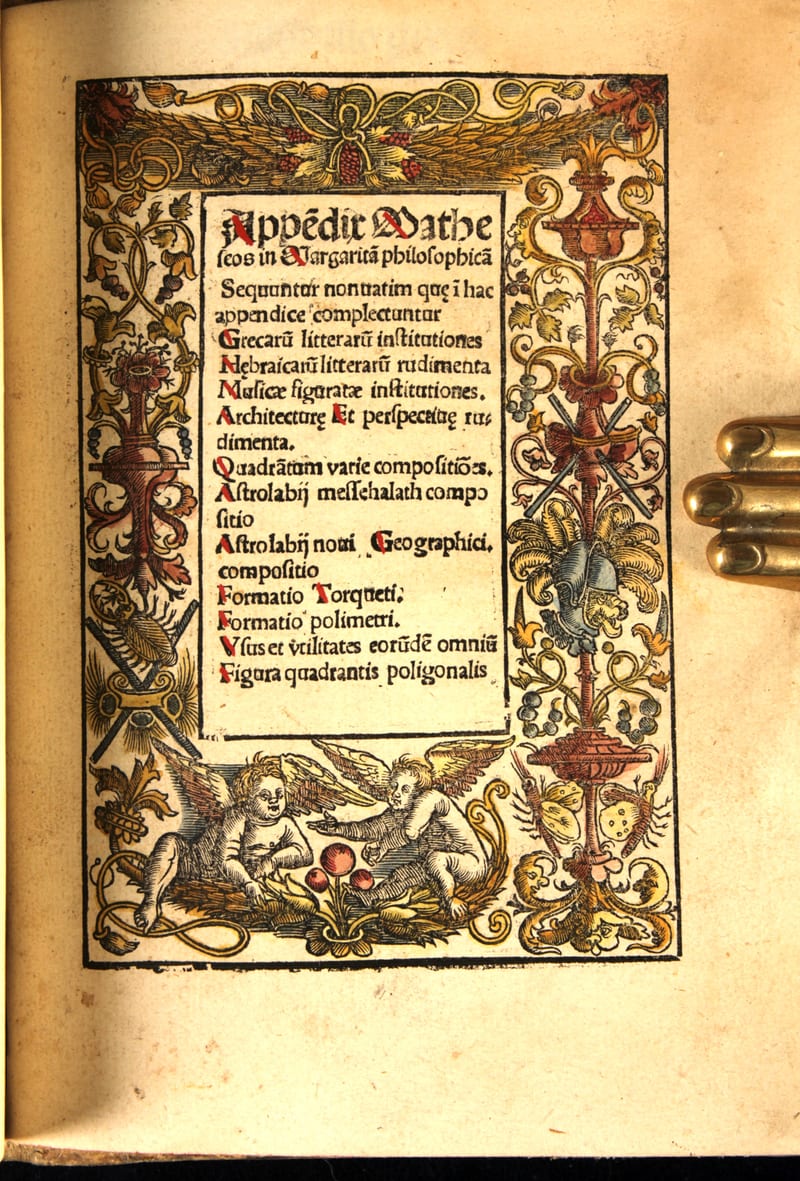
Margarita Philosophica Nova
Gregor Reisch · Strasbourg · 1512
Price on request
Voyages & Discovery · FM-0033
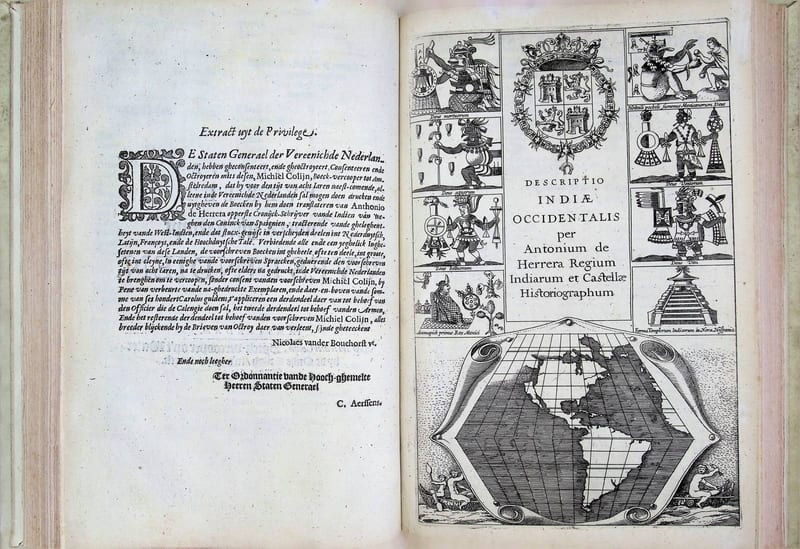
Spieghel der Australische navigatie
Jacob le Maire; Antonio de Herrera; Pedro Ordóñez de Ceballos · Amsterdam · 1621–1622
€ 35.000
Voyages & Discovery · FM-0041
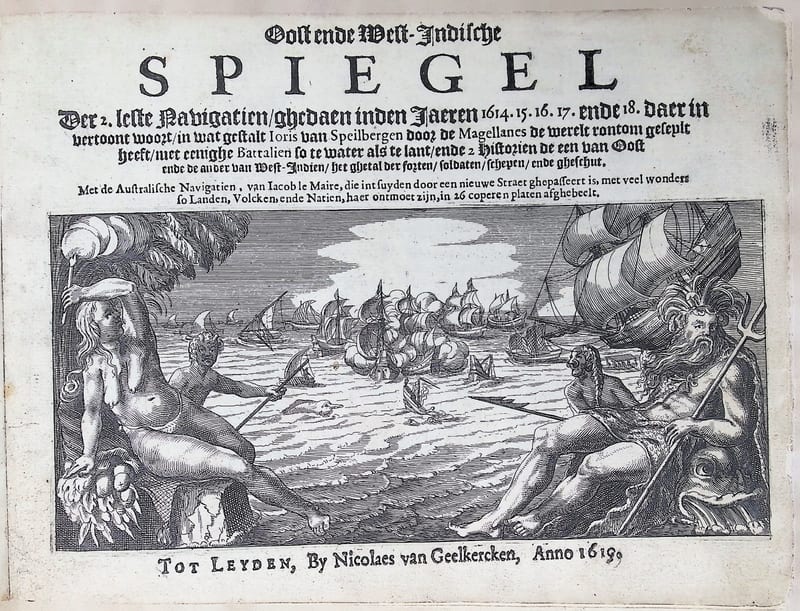
Oost ende West-Indische Spiegel
Joris van Spilbergen; with Jacob le Maire and Willem Schouten, Australische Navigatien · Leiden · 1619
Price on request
Voyages & Discovery · FM-0087
De Nieuwe en Onbekende Weereld: of Beschryving van America en 't Zuid-Land
MONTANUS, Arnoldus (Arnold van den Berg, c. 1625-1683) · Amsterdam · 1671
€ 18.500
All 2 works: Gregor Reisch → · Gregor Reisch · The Strait of Magellan and Cape Horn