Science
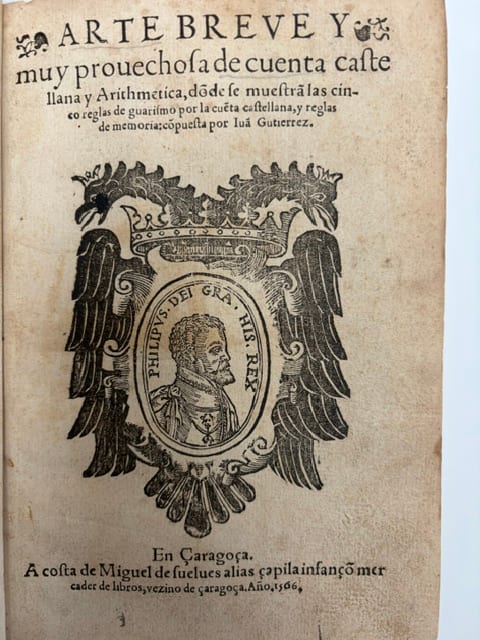
Arte breve y muy provechosa de cuenta castellana y Arithmetica
Gutierrez de Gualda, Juan · Zaragoza · Pedro Bernuz for Miguel de Suelves · 1566
Merchant's arithmetic teaching the five rules in both Roman and Arabic numerals, at the very moment Spain changed over; Philip II woodcut portrait on the title. Of the greatest rarity, as such booklets were used to destruction.
FM-0089
€ 18.000
Key Properties
Author: Juan Gutierrez de Gualda
Title: Arte breve y muy provechosa de cuenta castellana y Arithmetica, donde se muestran las cinco reglas de guarismo por la cuenta castellana, y reglas de memoria
Imprint: Zaragoza, Pedro Bernuz, at the cost of the bookseller Miguel de Suelves alias Zapila, 1566
Format: Quarto
Collation: 24 leaves
Illustration: Woodcut title with the crowned double-headed eagle enclosing a portrait medallion of King Philip II; woodcut illustrations in the text
Binding: Later goatskin, spine gilt with a red morocco lettering-piece (Arte de Cuenta)
Collation & Technical Description
Quarto. 24 leaves. Title page with a large woodcut of the crowned double-headed eagle enclosing an oval portrait medallion of King Philip II (PHILIPVS DEI GRA. HIS. REX); woodcut illustrations in the text, among them the division of one sheaf of wheat into four equal smaller sheaves, and woodcut diagrams of squared stones. Bound in later goatskin, the spine gilt in compartments with a red morocco lettering-piece.
Condition
In a later goatskin binding, the spine gilt with a red morocco lettering-piece. Some browning and marginal dampstaining, and a few early ink marks in the margins, the honest traces of period use; a complete copy of a booklet that was made to be worn out.
References & Bibliography
Cf. Palau 111617 and USTC 336761 (the closely similar Zaragoza 1564 quarto, of which USTC records only two copies in American libraries). First published Toledo, 1539.
Description
A pocket arithmetic for the world of trade. Juan Gutierrez de Gualda, a priest of Villarejo de Fuentes in the province of Cuenca, wrote this short and very profitable art of reckoning to teach the five rules of guarismo, the new Arabic numerals, through the cuenta castellana, the traditional Castilian reckoning in Roman numerals, together with rules of memory. The table of contents covers naming numbers, addition, subtraction, multiplication, halving and long division, the adding and subtracting of weights and measures, memory rules, the reduction of coinage and rules of progression. The worked examples are taken straight from daily commerce: pricing cloth and land by the vara, a stonemason cutting squared stones (with a nod to fray Juan de Ortega and his treatise), and travellers sharing the cost of their provisions in ducados. Throughout, every computation is shown twice, in Roman numerals beside their Arabic equivalents, so that a merchant raised on the old reckoning could teach himself the new. This Zaragoza quarto of 1566 differs from the later octavo edition of 1573 and contains its own illustrated material, such as the woodcut showing one sheaf of wheat divided into four equal smaller sheaves.
Historical Significance
In sixteenth-century Spain trade became more formalised and basic mathematics a necessity; instruction booklets like this one were printed in very limited editions in different parts of the country, often based on the same basic text but with regional examples, sometimes illustrated with woodcuts. Gutierrez de Gualda's Arte breve, first published in Toledo in 1539 and reprinted at least five times in the sixteenth century, is the classic of the genre, and it documents one of the great quiet revolutions of the age: the change-over from Roman to Arabic numerals in everyday commercial life. Its popularity grew further after the celebrated Zaragoza calligrapher Juan de Yciar appended it to his writing manual in 1564; the present Zaragoza edition of 1566 followed directly in that wake. Because these heavily used booklets were read to pieces, few copies survive: of the closely similar Zaragoza 1564 edition USTC records only two copies in American libraries. In 2018 we handled an example printed in Sevilla by Rodrigo de Cabrera in 1673 that was unknown to Palau, Goldsmith, Kress and others; the present copy, printed in Zaragoza by Bernuz in 1566, carries similar elements of basic mathematics but also material of its own.
Related works
Science · FM-0073
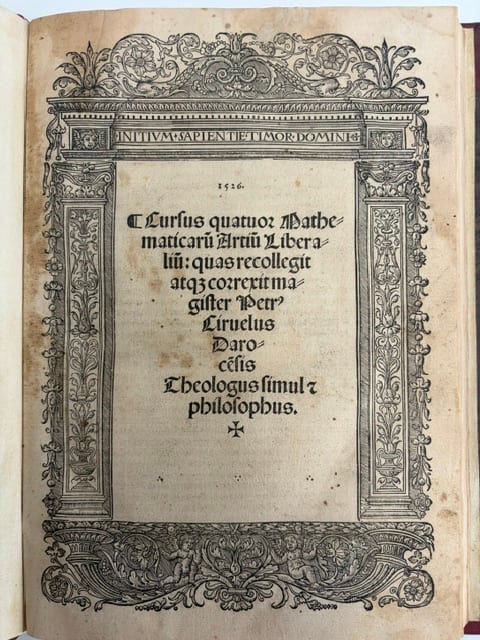
Cursus quattuor mathematicarum artium liberalium
CIRUELO, Pedro · Alcalá de Henares · 1516-1528
Price on request
Books · FM-0200
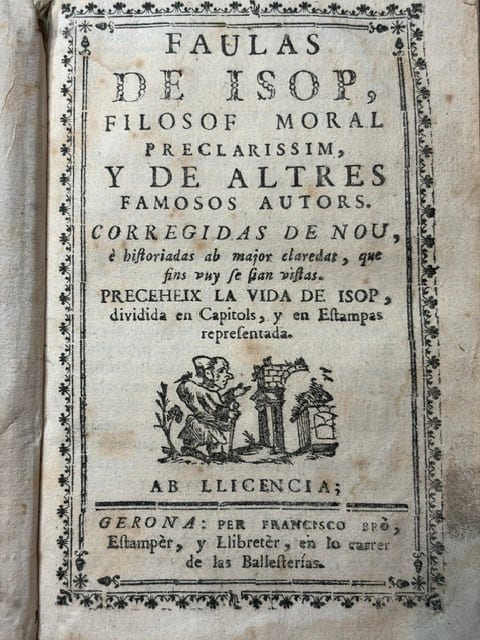
Faulas de Isop, filosof moral preclarissim, y de altres famosos autors. Corregidas de nou, e historiadas ab major claredat, que fins vuy se sian vistas. Preceheix la vida de Isop, dividida en capitols, y en estampas representada
Aesop (Isop) · Girona (Gerona) · n.d., c. 1790
€ 12.000
Voyages & Discovery · FM-0092
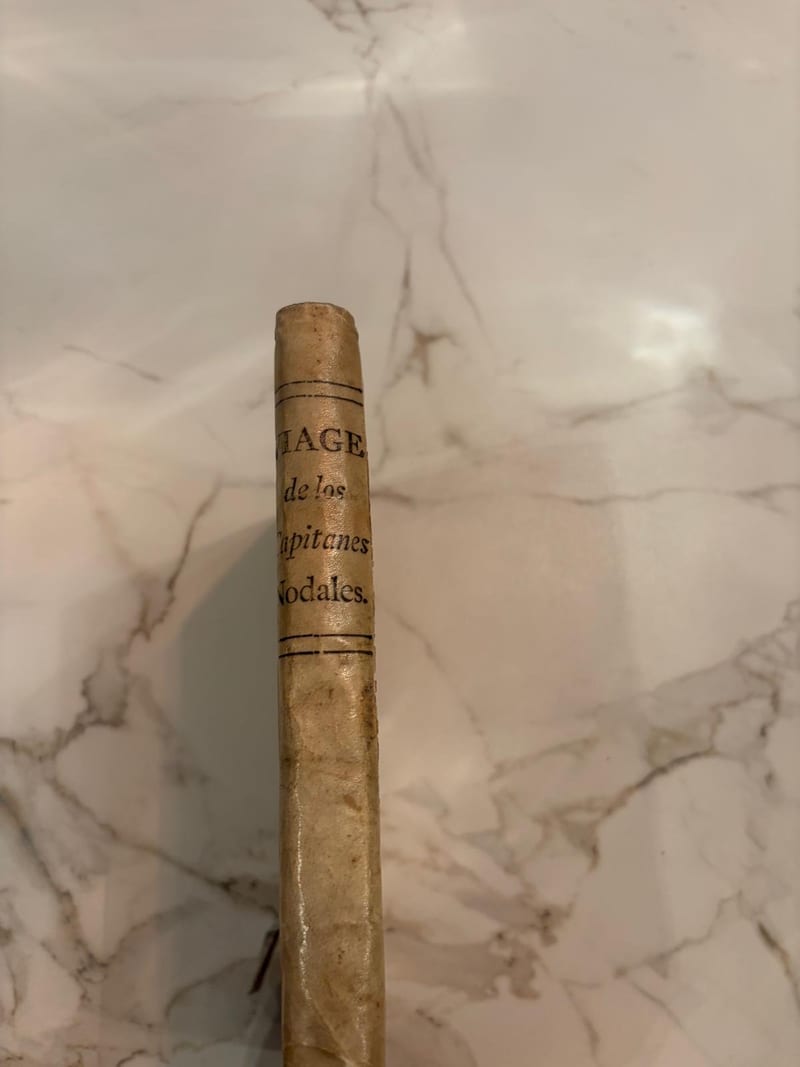
Relacion del viaje que por orden de su Magestad y acuerdo del Real Consejo de Indias hizieron los capitanes Bartolome Garcia de Nodal y Gonzalo de Nodal
Bartolomé García de Nodal and Gonzalo de Nodal · Cádiz · 1769
€ 8.400
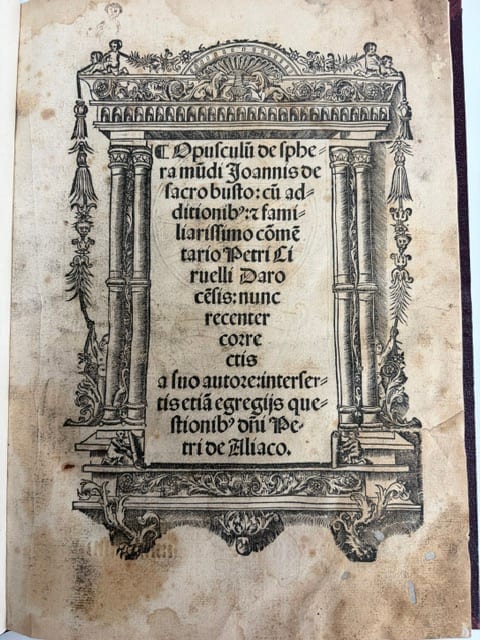
Science · FM-0112
Opusculum de sphera mundi, cum commentario Petri Ciruelli
SACROBOSCO, Johannes de; CIRUELO, Pedro · Alcala de Henares · 1526
€ 5.000
All 7 works: Spanish books of science and the Indies →