Science
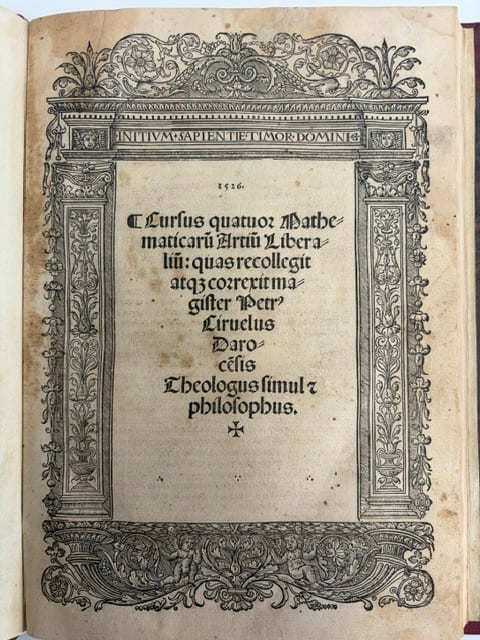
Cursus quattuor mathematicarum artium liberalium
CIRUELO, Pedro · Alcalá de Henares · Miguel de Eguía (parts printed by Arnao Guillén de Brocar) · 1516-1528
One of the first mathematical books printed in Spain: Ciruelo’s course of the four mathematical arts, a rare composite issue (1516-1528) from the presses of Brocar and Eguía at Alcalá.
FM-0073
Price on request
Key Properties
Author: Pedro Ciruelo (Daroca 1470 - Salamanca 1548)
Title: Cursus quattuor mathematicarum artium liberalium quas recollegit atque correxit Magister Petrus Ciruelus Darocensis theologus simul & philosophus
Place and printer: Alcalá de Henares, Miguel de Eguía; two parts from the press of Arnao Guillén de Brocar
Date: 1516-1528 (arithmetic 1526, geometry and perspective 1516, music 1528)
Format: Folio (29 x 20 cm), four parts in one volume
Language: Latin
Collation & Technical Description
Folio, 29 x 20 cm. Four parts in one volume, 92 leaves, with woodcut diagrams and illustrations throughout. A composite issue: the arithmetic in the second edition of 1526, the geometry and perspective still in the first editions of 1516, and the music in the second edition of 1528.
Condition
Later red half goatskin over marbled boards, spine with raised bands, gilt-lettered Pedro Ciruelo, Alcala 1526, with blind-tooled ornament. Some spotting and light dampstaining to margins in places; a clean, wide-margined copy overall.
References & Bibliography
Palau 54923; Martín Abad, La imprenta en Alcalá de Henares, 414. Cf. the Honeyman collection of scientific books (Sotheby’s, 1979) and a comparable copy at Sotheby’s London, 2002.
Description
Extremely rare composite issue of the four mathematical treatises of Pedro Ciruelo (1470-1548), the noted Spanish philosopher, theologian, mathematician, astrologer and astronomer: arithmetic, geometry, perspective and music, gathered in one folio volume and counted among the first books on mathematics printed in Spain (Palau).
The Cursus was first printed as a whole at Alcalá by Arnao Guillén de Brocar in 1516, for the newly founded university of Cardinal Cisneros where Ciruelo held the chair of Thomist theology and taught mathematics; Domingo de Soto was among his pupils. The four books were afterwards issued together in varying combinations, much as the Germans describe a Sammelband. In the present volume the arithmetic appears in the second edition printed by Miguel de Eguía in 1526, the geometry and the perspective remain in their first editions of 1516, and the music, the closing book, is the second edition of 1528.
The contents distil the Parisian university course Ciruelo had absorbed during his years at the Sorbonne, where from 1495 he edited and published mathematical texts: a paraphrase of Boethius’s Arithmetica, a compendium of Thomas Bradwardine’s geometry, John Peckham’s Perspectiva communis, and a treatise on music credited to Jacobus Faber Stapulensis (Jacques Lefèvre d’Étaples). Copies of Ciruelo’s mathematical works, including this Cursus, figured in the celebrated Honeyman collection of scientific books (Sotheby’s, 1979); a comparable composite copy was sold at Sotheby’s London in 2002.
This copy has features that bring the book vividly to life. The 1526 title is set within the splendid woodcut architectural border of the Alcalá press, its entablature carrying the motto INITIUM SAPIENTIE TIMOR DOMINI, the fear of the Lord is the beginning of wisdom. Ciruelo’s dedication addresses the rector and scholars of the University of Alcalá directly, and the printed shoulder notes flag the positions of the Reales, Thomistae, Scotistae and Nominales in the dispute over the nature of number, a snapshot of live scholastic debate. An early reader has left traces of actual use: small arithmetical workings in ink beside the opening chapters on number, and in the music part a drawn pointing hand with the note cromatico beside the woodcut monochord diagram, where the intervals of the chromatic genus are traced in arcs. The geometry is illustrated throughout with woodcut figures in the margins, from Euclid’s postulates to the theorems on circles.
Historical Significance
With this course of the quadrivium Ciruelo carried the mathematical learning of Paris to the new university of Alcalá, laying a foundation for scientific teaching in Renaissance Spain. The volume unites the four mathematical arts of the medieval curriculum, arithmetic, geometry, perspective and music, in Spanish print for the first time, at the very start of scientific publishing in Spain.
Related works
Science · FM-0112
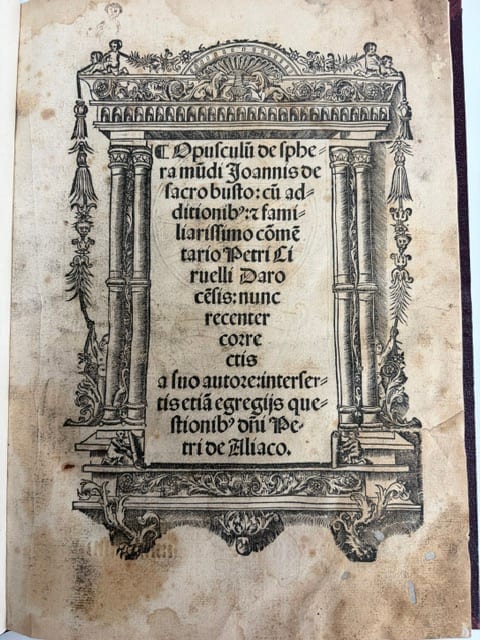
Opusculum de sphera mundi, cum commentario Petri Ciruelli
SACROBOSCO, Johannes de; CIRUELO, Pedro · Alcala de Henares · 1526
€ 5.000
Science · FM-0089
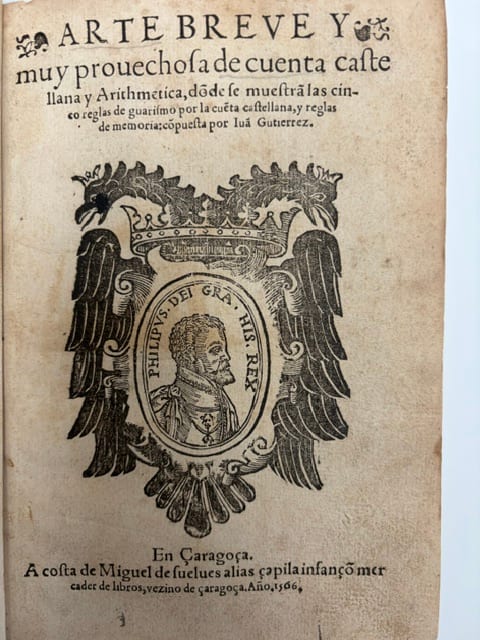
Arte breve y muy provechosa de cuenta castellana y Arithmetica
Gutierrez de Gualda, Juan · Zaragoza · 1566
€ 18.000
Books · FM-0200
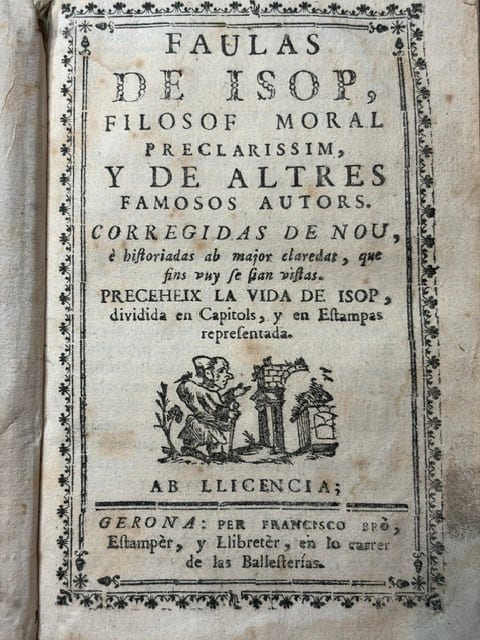
Faulas de Isop, filosof moral preclarissim, y de altres famosos autors. Corregidas de nou, e historiadas ab major claredat, que fins vuy se sian vistas. Preceheix la vida de Isop, dividida en capitols, y en estampas representada
Aesop (Isop) · Girona (Gerona) · n.d., c. 1790
€ 12.000
Voyages & Discovery · FM-0092
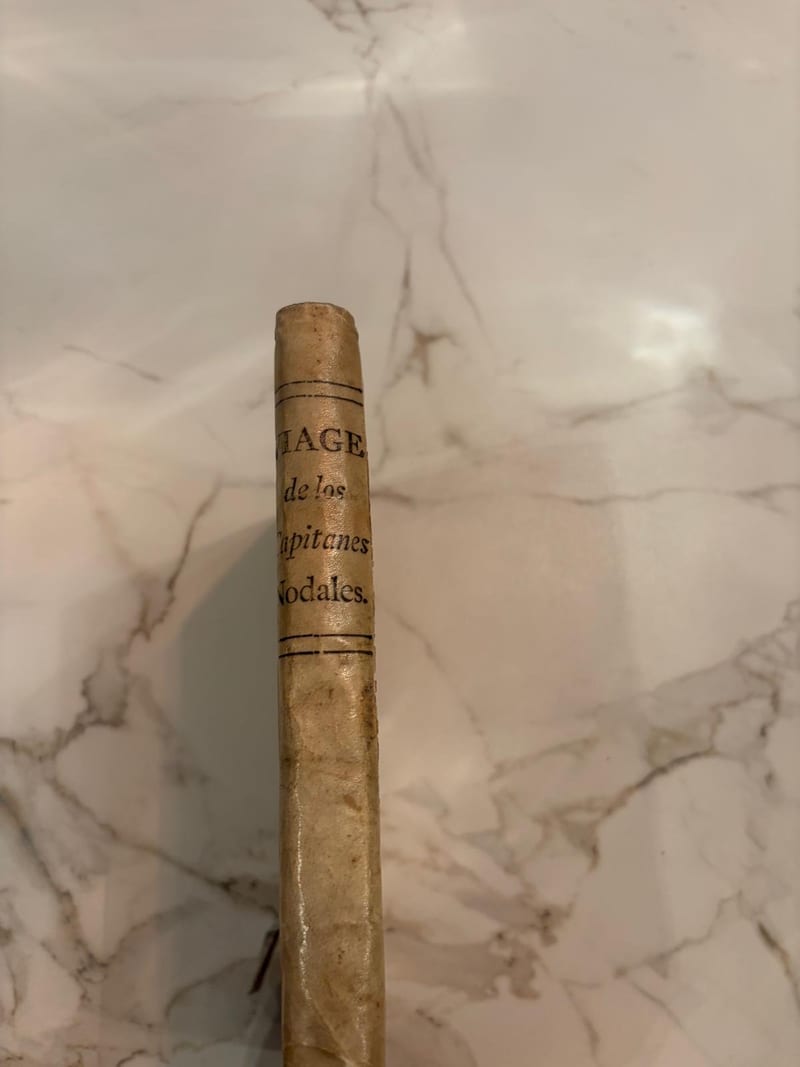
Relacion del viaje que por orden de su Magestad y acuerdo del Real Consejo de Indias hizieron los capitanes Bartolome Garcia de Nodal y Gonzalo de Nodal
Bartolomé García de Nodal and Gonzalo de Nodal · Cádiz · 1769
€ 8.400
All 2 works: Pedro Ciruelo → · Pedro Ciruelo · Spanish books of science and the Indies