Science
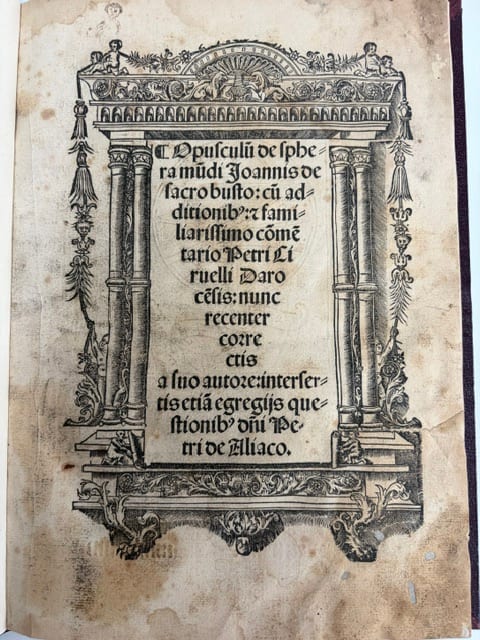
Opusculum de sphera mundi, cum commentario Petri Ciruelli
SACROBOSCO, Johannes de; CIRUELO, Pedro · Alcala de Henares · Miguel de Eguia · 1526
The Alcala 1526 edition of Sacrobosco's Sphaera mundi with Ciruelo's commentary and the questions of Pierre d'Ailly, from the same press and year as our Ciruelo Cursus (FM-0073). Incomplete copy, lacking six leaves.
FM-0112
€ 5.000
Key Properties
Author: SACROBOSCO, Johannes de; with the commentary of Pedro Ciruelo and the questions of Pierre d'Ailly
Title: Opusculum de sphera mundi Ioannis de Sacro Busto: cum additionibus & familiarissimo commentario Petri Ciruelli Darocensis: nunc recenter correctis a suo autore: intersertis etiam egregiis questionibus domini Petri de Aliaco
Place and printer: Alcala de Henares (Compluti), Miguel de Eguia
Date: 15 December 1526
Format: 4to
Language: Latin, gothic type, mainly in two columns
Collation & Technical Description
4to: a-l6, m8 (the letter j omitted from the sequence), 74 leaves in a complete copy; printed foliation to LXXIII with several known errors in the Roman numeration. Numerous woodcut astronomical and geometrical diagrams throughout, integral to the text. THIS COPY INCOMPLETE: lacking the six leaves f5-g4 (twelve pages), within the discussion of the celestial circles, horizon and meridian, latitude and longitude, and the associated tables.
Condition
Later half dark morocco over boards, spine with raised bands; sides sunned along the spine edge, extremities rubbed. Title somewhat soiled, scattered spotting and foxing, dampstaining to the final leaves including the colophon; early ink manicule beside the earth-measurement table. Incomplete: lacking f5-g4 (six leaves), sold as such.
References & Bibliography
Cf. the complete digitised copy, Biblioteca de la Universidad de Sevilla; a copy in the Rosenwald Collection, Library of Congress. First edition of Ciruelo's commentary: Paris 1498.
Description
The Alcala edition of the most famous astronomy textbook of the medieval and early modern university: Sacrobosco's thirteenth-century Sphaera mundi, here wrapped in the extensive commentary of Pedro Ciruelo of Daroca and interleaved with the celebrated questions of Pierre d'Ailly. Ciruelo first published this commentary at Paris in 1498; the present edition, printed at Alcala by Miguel de Eguia on 15 December 1526, is revised by the author himself, as the title proudly states (nunc recenter correctis a suo autore). The concise text of Sacrobosco is expanded into a full course on the structure of the cosmos: the celestial spheres, the astronomical circles, horizon and meridian, geographical latitude and longitude, and the motions of the heavenly bodies, all illustrated with woodcut diagrams that form an integral part of the printed page.
The interpolated questions of Pierre d'Ailly connect this schoolbook of the heavens directly to the age of discovery: it was d'Ailly's cosmography that Columbus read and annotated when he formed his picture of the width of the ocean. And the volume has a close companion in our own catalogue: in the very same year, 1526, the same Miguel de Eguia at Alcala printed the second edition of Ciruelo's Cursus quattuor mathematicarum artium liberalium (FM-0073). The two books belong together, the mathematical course and the astronomy, the teaching programme of Cardinal Cisneros's young university in print from a single press in a single year.
This copy is incomplete, lacking the six leaves f5-g4 within the astronomical discussion, and is offered as such; the edition has been collated against the complete digitised copy in the Biblioteca de la Universidad de Sevilla.
The photographs show what a handsome production this was. The title is set within a woodcut architectural border of columns and putti, and its verso carries a fine full-page woodcut of an armillary sphere held aloft by a hand, on a banderole inscribed Sphera mundi, within a border of foliage. A verse epigram in praise of Ciruelo’s commentary by Petrus de Lerma of Burgos opens the book. The text is thick with working material: tables of the longitude and latitude of the principal places of Europe, a table of the size of the earth iuxta Ptholemeum & experientiam, according to Ptolemy and to experience, that quiet nod to the new discoveries, ascension tables for the climates, and woodcut eclipse diagrams of sun and moon in the fourth book. An early reader has drawn a pointing hand in ink beside the calculation of the earth’s circumference. The colophon, set in the shape of a chalice and dated 15 December 1526, states that the book was printed in the Alma Complutensis Universitas by Miguel de Eguia, dwelling opposite San Eugenio, where the book was also sold, and notes that the work was newly rearranged from four chapters into four books.
Historical Significance
Sacrobosco's Sphaera was the standard introduction to astronomy in European universities for four centuries. In Ciruelo's Alcala edition it became the vehicle by which Parisian cosmology reached Renaissance Spain, in the years when Spanish pilots and cosmographers were redrawing the map of the world. The d'Ailly questions bound into the text tie it to the intellectual equipment of Columbus himself.
Related works
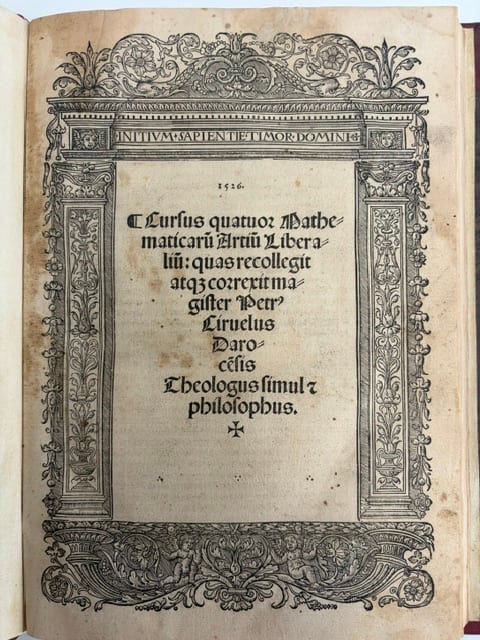
Science · FM-0073
Cursus quattuor mathematicarum artium liberalium
CIRUELO, Pedro · Alcalá de Henares · 1516-1528
Price on request
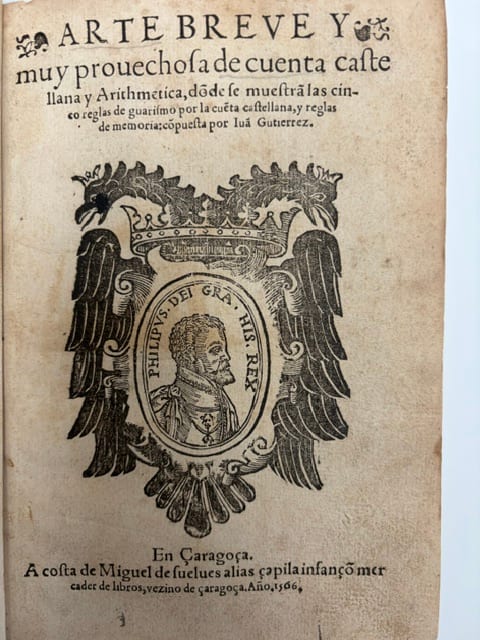
Science · FM-0089
Arte breve y muy provechosa de cuenta castellana y Arithmetica
Gutierrez de Gualda, Juan · Zaragoza · 1566
€ 18.000
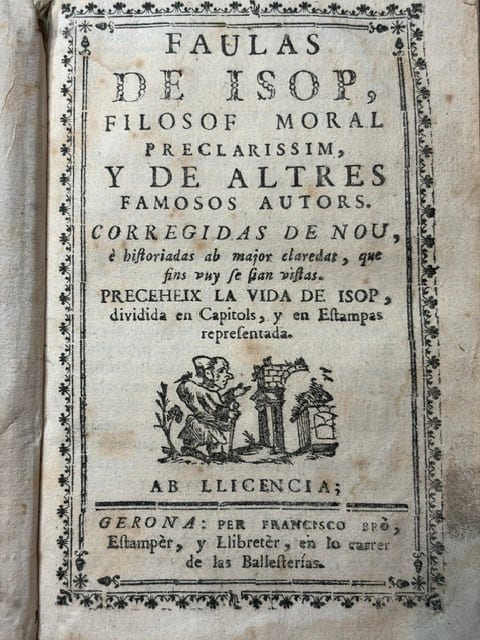
Books · FM-0200
Faulas de Isop, filosof moral preclarissim, y de altres famosos autors. Corregidas de nou, e historiadas ab major claredat, que fins vuy se sian vistas. Preceheix la vida de Isop, dividida en capitols, y en estampas representada
Aesop (Isop) · Girona (Gerona) · n.d., c. 1790
€ 12.000
Voyages & Discovery · FM-0092
Relacion del viaje que por orden de su Magestad y acuerdo del Real Consejo de Indias hizieron los capitanes Bartolome Garcia de Nodal y Gonzalo de Nodal
Bartolomé García de Nodal and Gonzalo de Nodal · Cádiz · 1769
€ 8.400
All 2 works: Pedro Ciruelo → · Pedro Ciruelo · Spanish books of science and the Indies