Voyages & Discovery
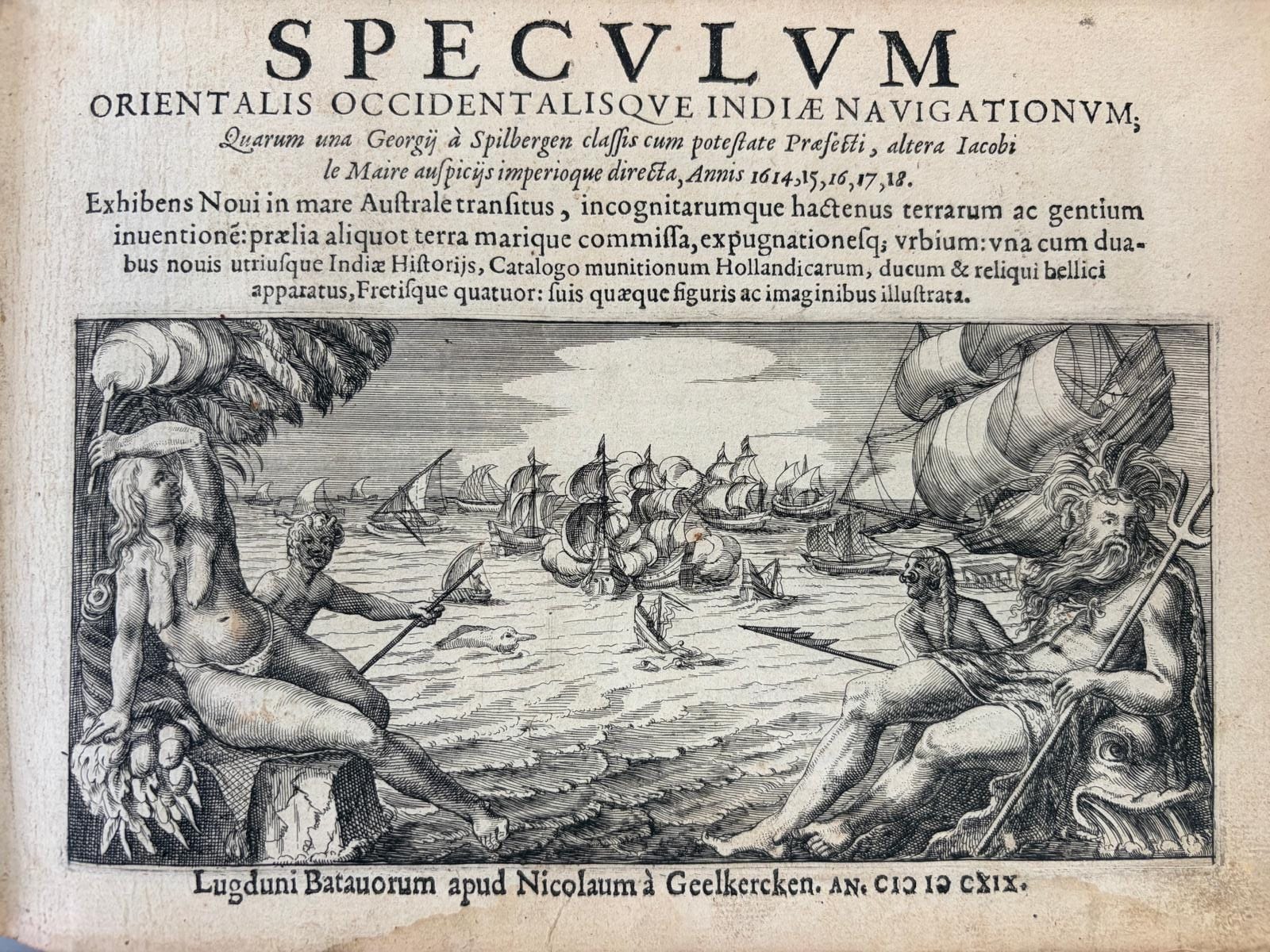
Speculum orientalis occidentalisque Indiae navigationum
Joris van Spilbergen; with Jacob le Maire, Navigationes Australes · Leiden · Nicolaes van Geelkercken · 1619
The first Latin edition of the fifth circumnavigation, with Le Maire on the discovery of Cape Horn, in its original vellum and wanting only the world map
FM-0105
€ 15.000
Key Properties
Edition: First Latin edition, issued in the same year as the first Dutch edition, bound with Le Maire's Navigationes Australes
Language: Latin
Format: Oblong quarto
Binding: Contemporary vellum over boards, title in faded manuscript on the spine
Illustration: Engraved title-page and 23 of 25 plates, including two double-page plates
Collation & Technical Description
Oblong quarto: A to Y in fours; 87 leaves, the last (Y5) blank. Four preliminary leaves including the engraved title-page. 166 pp., including a genuine blank (P4). The plates are inserted without signature or page number.
23 of the 25 plates present, including two double-page plates. Wanting the folding world map; the map of South-East Asia is supplied from another and later copy.
The plates include detailed maps of the Strait of Magellan and of the Manila channel, and views of Manila, Sao Vicente, Mocha, Callao and Acapulco among others.
Condition
In its original vellum binding, on strong paper. Slight overall browning, more pronounced on most of the plates. A small water stain to the lower margin, hardly affecting the text. A sound working copy, wanting the world map as noted above.
References & Bibliography
Sabin 89450. Tiele, Journaux, 66C.
J. C. M. Warnsinck, De reis om de wereld van Joris van Spilbergen, 2 vols. (The Hague, Nijhoff, 1943). W. A. Engelbrecht and others, De ontdekkingsreis van Jacob le Maire en Willem Corneliszoon Schouten, 2 vols. with 7 folding maps (The Hague, Nijhoff, 1945).
Description
The first Latin edition of Joris van Spilbergen's voyage around the world, published at Leiden by Nicolaes van Geelkercken in 1619, in the same year as the first Dutch edition. This was the fifth circumnavigation ever made, after Magellan, Drake, Cavendish and Van Noort, and the second by the Dutch. The voyage lasted from 1614 to 1618.
Spilbergen was an experienced admiral who had already sailed for the VOC to the Indies. He was sent out again to find new territory, to chart the Strait of Magellan, and to do the Spanish as much harm as he could in South America and the Philippines. He landed in Brazil, surveyed the Strait, fought the Spanish settlements in Chile, Peru and Mexico, and crossed to the Philippines.
Bound with it is the Navigationes Australes of Jacob le Maire, the account of the voyage on which Le Maire and Willem Schouten found the strait that carries Le Maire's name and rounded the cape that Schouten named after Hoorn, in 1616. The two men parted company during the voyage and each claimed the discovery, and each kept his own journal. Schouten's was printed first, by Blaeu at Amsterdam in 1618. Le Maire died on the way home and his own account did not appear until 1622.
The two stories meet in this volume for a reason. When Spilbergen reached Batavia he took on board Le Maire and what was left of his crew, who had been arrested there for sailing to the Indies without VOC consent. Le Maire's defence was a good one: the VOC charter forbade the route through the Strait of Magellan, and he had not used it. He had gone round Cape Horn.
Historical Significance
Spilbergen's Speculum is the official record of a voyage that was as much a naval campaign as a circumnavigation, and its plates are the reason collectors want it. The maps of the Strait of Magellan and of the Manila channel and the views of the Spanish Pacific ports are among the earliest printed images of those places to reach northern Europe, drawn by men who had just fought there.
The Le Maire text bound with it records the discovery that ended the Strait of Magellan's monopoly on the passage to the Pacific and gave the world Cape Horn. To have the two together in one contemporary volume, in the Latin issue that carried them to a European readership, is to have the whole of the Dutch challenge to Spain in the South Sea in a single binding.
This copy wants the folding world map and has the South-East Asia map supplied from a later copy, which places it below a complete example and prices it accordingly. Everything else is present, including both double-page plates, and it is untouched in its original vellum.
Provenance
Manuscript ex libris of Matheus Regalus on the first free endleaf.
Related works
Voyages & Discovery · FM-0041
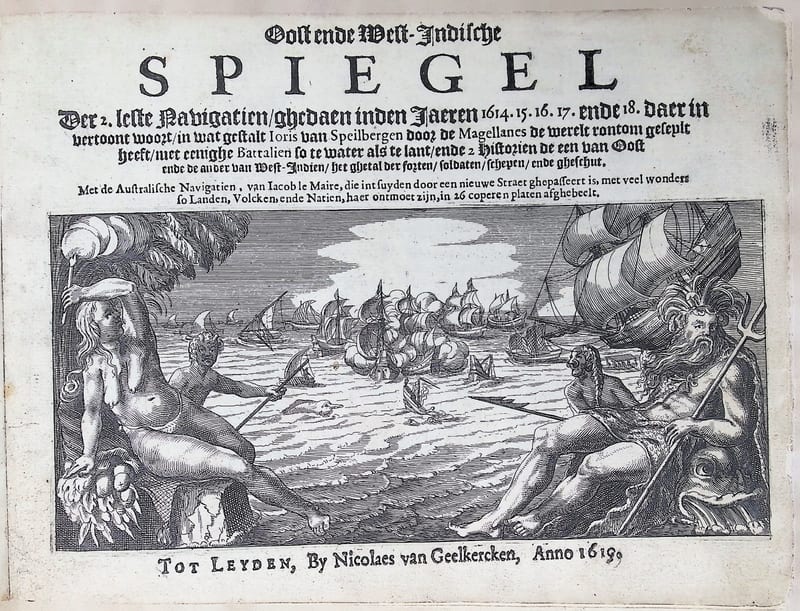
Oost ende West-Indische Spiegel
Joris van Spilbergen; with Jacob le Maire and Willem Schouten, Australische Navigatien · Leiden · 1619
Price on request
Voyages & Discovery · FM-0043
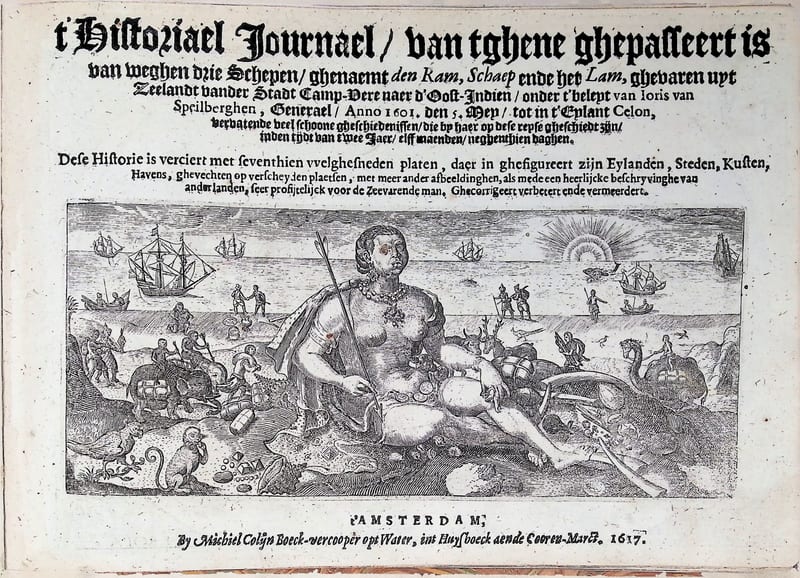
’t Historiael Journael van Joris van Spilbergen naer Oost-Indien (Ceylon)
Joris van Spilbergen · Amsterdam · 1617
€ 9.000
Voyages & Discovery · FM-0035
Oost ende West Indische Spieghel
Joris van Spilbergen (text by Jan Cornelisz May) · Amsterdam · circa 1663
€ 7.000
Voyages & Discovery · FM-0057
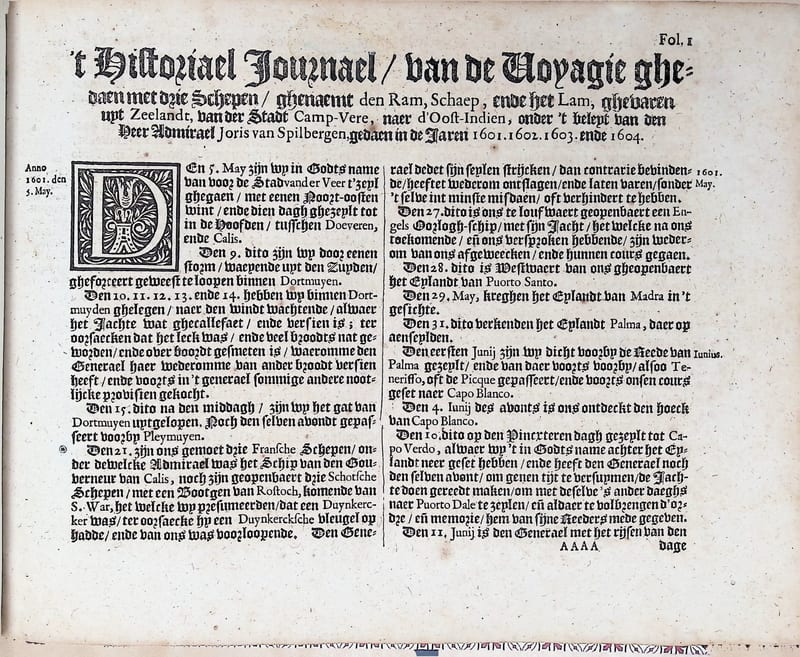
Historisch Journael, Spilbergen's Voyagie naar Oost-Indien (1601–1604)
Joris van Spilbergen (with Wolfhart Harmanszoon & Cornelis van Veen) · Amsterdam · 1646
€ 3.500
All 8 works: Joris van Spilbergen → · Joris van Spilbergen · The Dutch East India Company (VOC) · The Strait of Magellan and Cape Horn