Voyages & Discovery
Begin ende Voortgangh van de Vereenighde Nederlantsche Geoctroyeerde Oost-Indische Compagnie
Isaac Commelin (compiler and editor) · Amsterdam · Johannes Janssonius · 1646
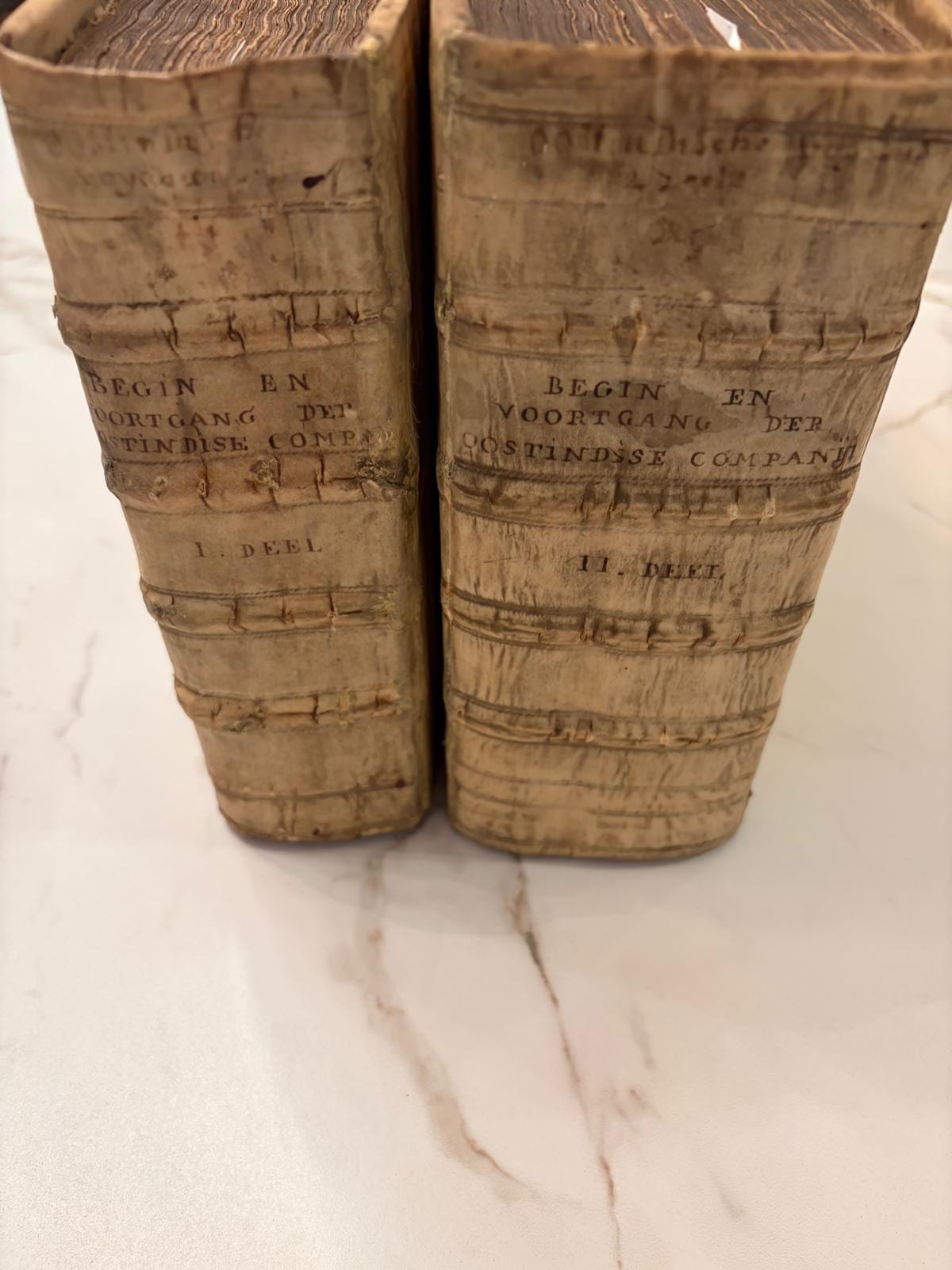
The third collection of early Dutch voyages, two volumes in contemporary vellum, never restored.
FM-0044
Price on request
Key Properties
Author: Isaac Commelin, compiler and editor
Title: Begin ende Voortgangh van de Vereenighde Nederlantsche Geoctroyeerde Oost-Indische Compagnie
Imprint: Amsterdam, 1646, Johannes Janssonius
Format: 2 volumes, oblong quarto, 18.7 x 24 cm
Binding: contemporary vellum over boards, front and back plates embossed, spine with raised bands
Ties: contemporary ties present (3 of 4, and 0 of 4)
Spine titles in faded early manuscript and in a clearer, more recent hand
Collation & Technical Description
Volume I: 12 unnumbered leaves, letterpress and engraved title pages, followed by an introduction to the voyages of the Dutch. 5 unnumbered leaves of index at the end.
Volume II: 2 unnumbered leaves, letterpress and engraved title pages, with 8 unnumbered leaves of index at the end.
The collection comprises 21 books covering 26 voyages, with 75 inserts: summarised voyages, country descriptions, instructions and letters.
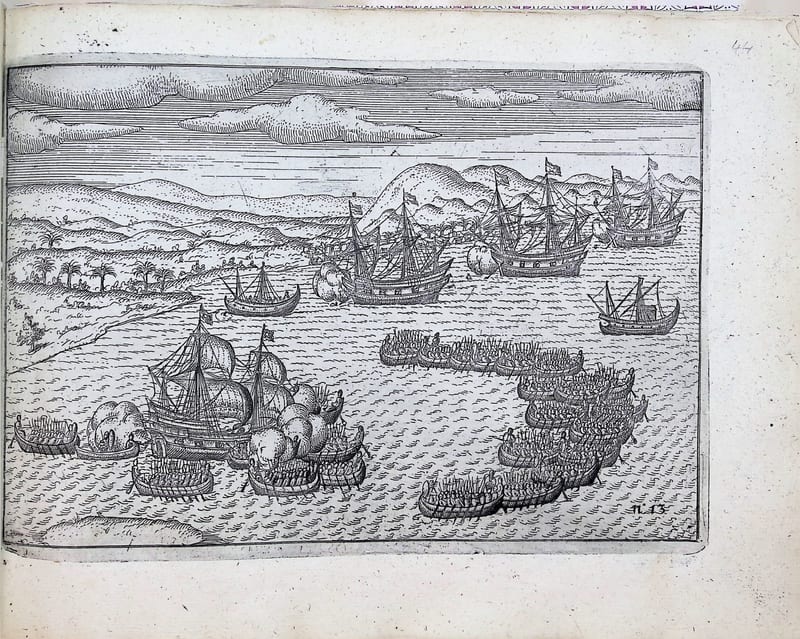
Richly illustrated with 230 plates, including 31 maps (6 of them double-page and folding) and 199 plans, views and other prints.
Condition
One map supplied from another copy, otherwise complete. A never restored example. Slight toning here and there, but good impressions throughout, particularly of the plates and maps.
References & Bibliography
Tiele, Memoire, nos. 4 and 5
Muller 1872, no. 1871
For individual voyages: Tiele, Memoires nos. 93, 119 and 130; Hakluyt Society no. 54, 1876; Rouffaer and IJzerman, 1925; Ginsberg, map 46
Description
This is the third collection of early Dutch voyages. The first was a set of eight separate booklets printed by Cornelis Claeszoon in Amsterdam between 1598 and 1608. They had no shared title page, yet their design makes them read as a series. They are rare and expensive. Michiel Colijn re-edited that series under a shared title, Oost-Indische ende West-Indische voyagien (1617 to 1619), bringing together ten voyages with 166 maps, plans and plates.
Isaac Commelin gathered the texts and plates from original journals, printed and unprinted. Five voyages appear here for the first time: Both (no. 8), Van Hagen (no. 10), Harmansen (no. 11), Van Caerden (no. 16) and Schram (no. 22).
The collection opens with Gerrit de Veer's account of the voyages by the north, with Willem Barentszoon at its centre. Jan Huygen van Linschoten sailed on the first two. The third ended in disaster, with the wintering on Nova Zembla in the Behouden Huys, a story that became an immediate emblem of polar voyaging and endurance. There follow, among others, the first Dutch voyage to the East under Cornelis de Houtman and the second under Van Neck and Van Warwijck, the latter including a Dutch to Malay dictionary.
Historical Significance
The Commelin belongs to the European tradition of edited collections of voyages of discovery, which began with Montalboddo in 1507 and continued through Grynaeus and Huttich (1532), Ramusio (1556), De Bry (from 1590) and Hulsius (from 1598). Some of these collections confine themselves to a single nation: Peter Martyr to Spain, De Barros to Portugal, Commelin to Holland. They preserved many original sources that would otherwise have been lost. They should not, however, be read as the whole history of discovery and colonisation: editors frequently shortened and altered the original journals.
What distinguishes the Dutch published journals from those of other countries is the richness of their illustrations and maps. These were copied from original drawings, many of them now lost, and they tell a story of their own alongside the text.
The collection matters first of all as a source and a testimony of the early Dutch voyages to the East and the West, roughly 1590 to 1631. The Dutch came late to a field occupied by Portugal for 150 years in Africa and Asia, and by Spain for a century in the Americas and the Far East. Their purpose was trade and profit; there is little sign of Christianisation in these first forty years. Discoveries were limited: the exploration of the north-east passage, the discovery of Australia from 1606, Cape Horn in 1616 and a new crossing of the Indian Ocean.
Reading Commelin also documents the birth of the VOC in 1602 as a distinctly Dutch model of a seaborne empire. Extensive as Dutch control of the seas became, an empire it never was: it was a large, multinational company set up to trade and to control trade routes, which could not be done without politics and military power against the sultans of Ceylon, Atjeh and Java, the emperors of Japan and China, and the European enemies of the day.
Provenance
An old Maggs description pasted in.
Related works
Voyages & Discovery · FM-0057
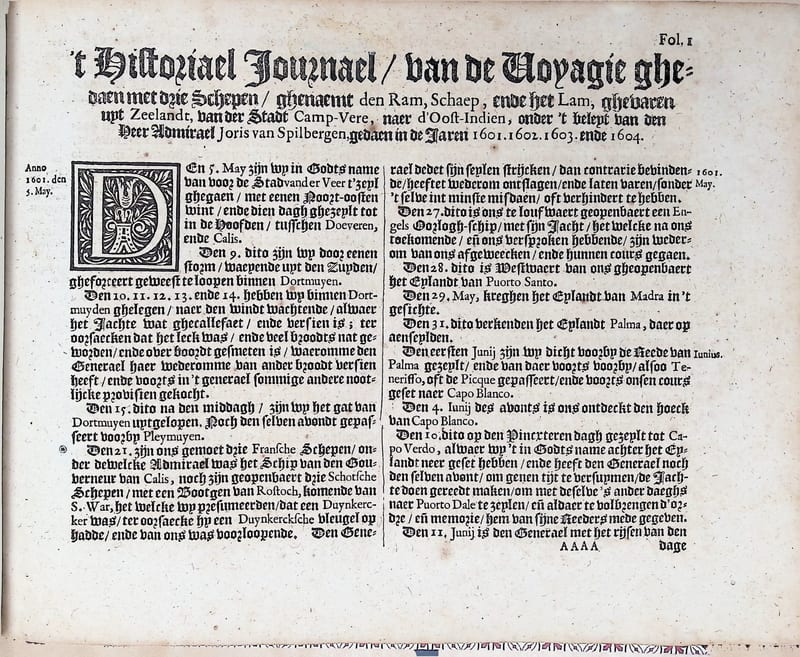
Historisch Journael, Spilbergen's Voyagie naar Oost-Indien (1601–1604)
Joris van Spilbergen (with Wolfhart Harmanszoon & Cornelis van Veen) · Amsterdam · 1646
€ 3.500
Voyages & Discovery · FM-0047
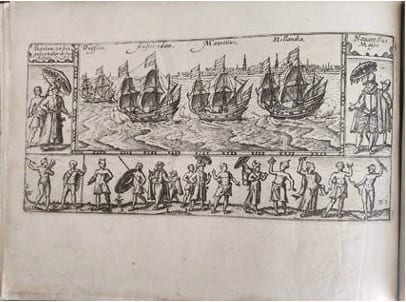
Waerachtigh verhael van de tweede Schipvaerd op Oost-Indien (van Neck & van Warwijck)
Jacob van Neck & Wijbrant van Warwijck · Amsterdam · 1646
€ 3.200
Voyages & Discovery · FM-0063
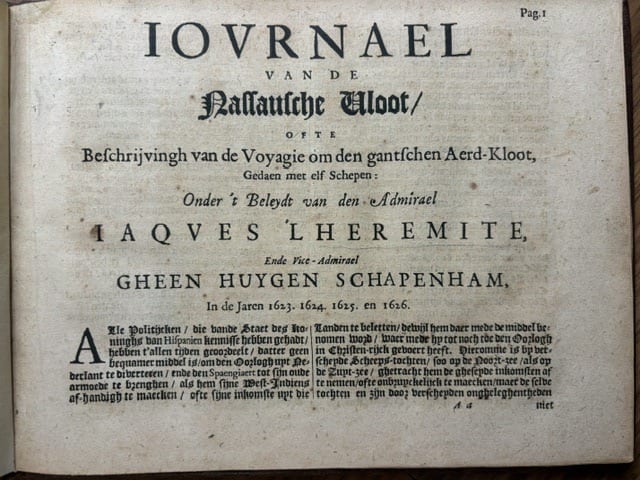
Journael van de Nassausche vloot, ofte beschrijvingh van de voyagie om den gantschen aerd-kloot, gedaen met elf schepen onder 't beleyt van admirael Jacques L'Hermite
Jacques L'Hermite · Amsterdam · 1646
€ 2.500
Voyages & Discovery · FM-0070
Eerste schipvaerd der Hollandsche Natie naar Oost-Indien
Willem Lodewijckszoon · Amsterdam · 1646
€ 2.400
All 8 works: Isaac Commelin, Begin ende Voortgangh → · Isaac Commelin, Begin ende Voortgangh · The Dutch East India Company (VOC)