Voyages & Discovery
Waerachtigh verhael van de tweede Schipvaerd op Oost-Indien (van Neck & van Warwijck)
Jacob van Neck & Wijbrant van Warwijck · Amsterdam · Isaac Commelin, Begin ende Voortgangh, 1646 (Joannes Janssonius) · 1646
Van Neck & Van Warwijck - the second Dutch voyage to the Indies (1598-1600), complete with all plates and the Dodo
FM-0047
€ 3.200
Key Properties
Edition: In the Commelin/Janssonius collection
Language: Dutch
Format: Oblong quarto
Binding: Recased in contemporary full calf
Collation & Technical Description
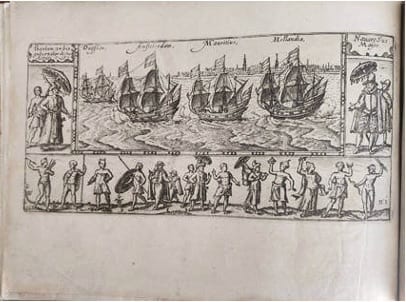
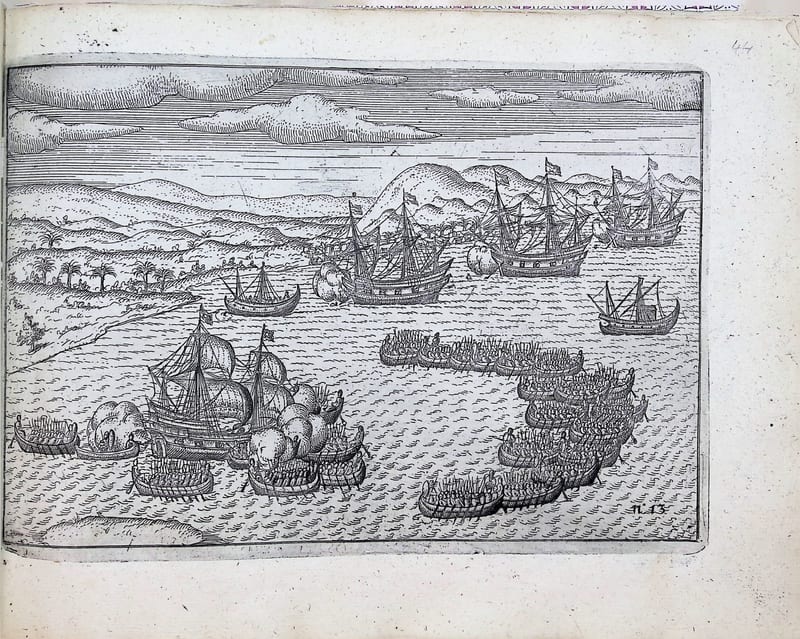
56 pp. of text (including a Dutch-Malay-Javanese dictionary, pp. 43-56). Engraved title-page plus 25 plates (of which 2 are maps); 26 interleaved plates in all, complete. Plate 1 shows the departure of De Houtman's earlier voyage; plates 2 and 3 are among the earliest of Mauritius and show the Dodo (de Walgvogel); with images of Java, Amboina, Banda and the Moluccas, an early image of nutmeg, and a mosque.
Condition
In very fine condition. A near flawless copy, complete and without restorations or imperfections, in its original contemporary calf binding. Complete with all 26 interleaved plates.
References & Bibliography
Tiele, Mémoire no. 130, p. 145. Keuning, De tweede schipvaart der Nederlanders naar Oost-Indië (The Hague, Nijhoff, 1938-47).
Description
As a follow-up to De Houtman's first voyage, the Dutch sent two great expeditions to the Indies in 1598: one by the east, this one under Van Neck and Van Warwijck, and one by the west under Cordes and Mahu. Van Neck's ships returned by mid-1599, the voyage proving both a navigational and a commercial triumph, with all ships returning at a profit to the investors of some 400 per cent.
It is one of the landmark books of the early Dutch expansion into Asia. It contains the earliest printed depictions of the Dodo and some of the first maps and views of the legendary Spice Islands. The engraved title-page shows the departure from Amsterdam of the 1595 to 1597 Dutch first fleet, including the yacht Duyfken, the very vessel that would make the first recorded European sighting of Australia in 1606.
The volume is further notable for its early plates of Mauritius and for its Dutch, Malay and Javanese dictionary of some 650 words, including a short list of trade terms such as nutmeg, cloves and silver in Moluccan Malay and Javanese. The journal ends with this vocabulary.
Van Neck's was the first Dutch fleet to reach the eastern archipelago around the Moluccas. By establishing lodges there it laid the foundation for Dutch trade and settlement in the region, hastening the end of the Portuguese monopoly on the spice trade and the rise of the United Dutch East India Company (VOC).
Historical Significance
The Van Neck voyage marks the decisive moment when the Dutch broke into the Asian spice trade. The first fleet under De Houtman (1595 to 1597) had shown that the Spanish and Portuguese monopoly on overseas trade was vulnerable and could be circumvented. The second fleet, much larger and better organised, reached the Moluccas to buy spices directly and to establish trade relations, returning with rich cargoes of pepper, cloves, mace, nutmeg and cinnamon. From the first and second fleets onward the Dutch would dominate the East Indies and its trade for more than three centuries, and the detailed maps and views in this account make the voyage of seminal importance to the exploration and cartography of the region.
Provenance
Available on request.
Accompanied by a certificate of authentication from Leen Helmink Antique Maps & Atlases (stock no. 19415).
Related works
Voyages & Discovery · FM-0044
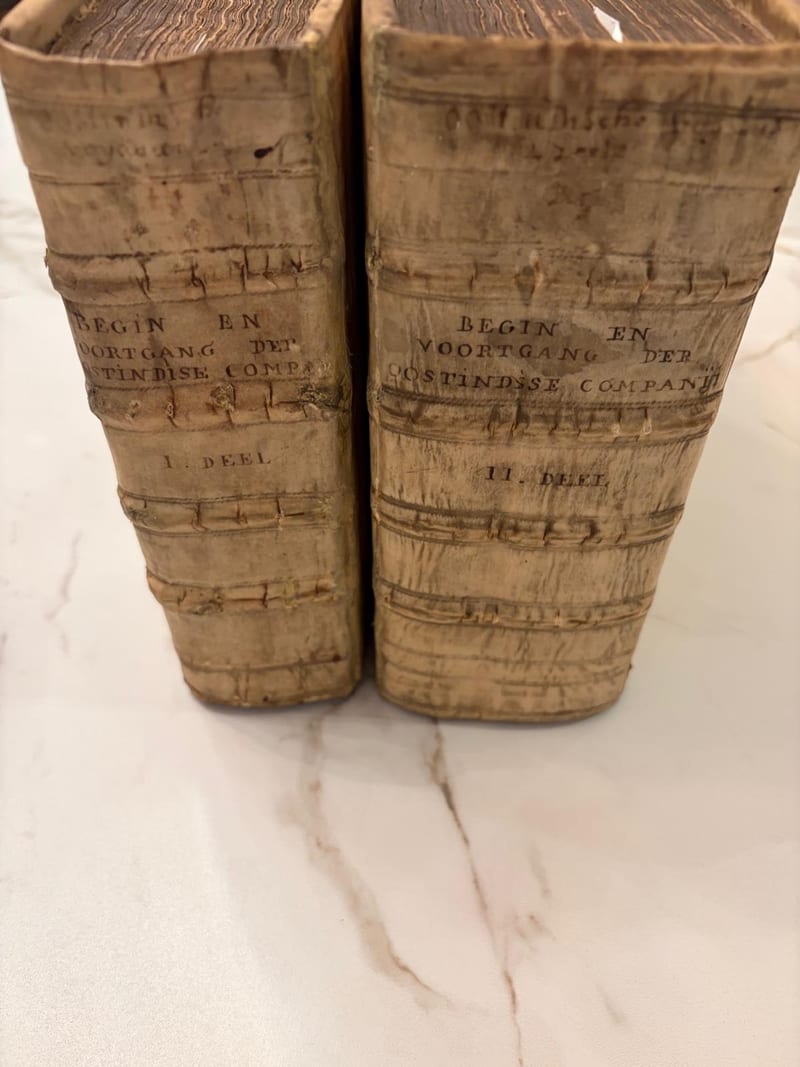
Begin ende Voortgangh van de Vereenighde Nederlantsche Geoctroyeerde Oost-Indische Compagnie
Isaac Commelin (compiler and editor) · Amsterdam · 1646
Price on request
Voyages & Discovery · FM-0057
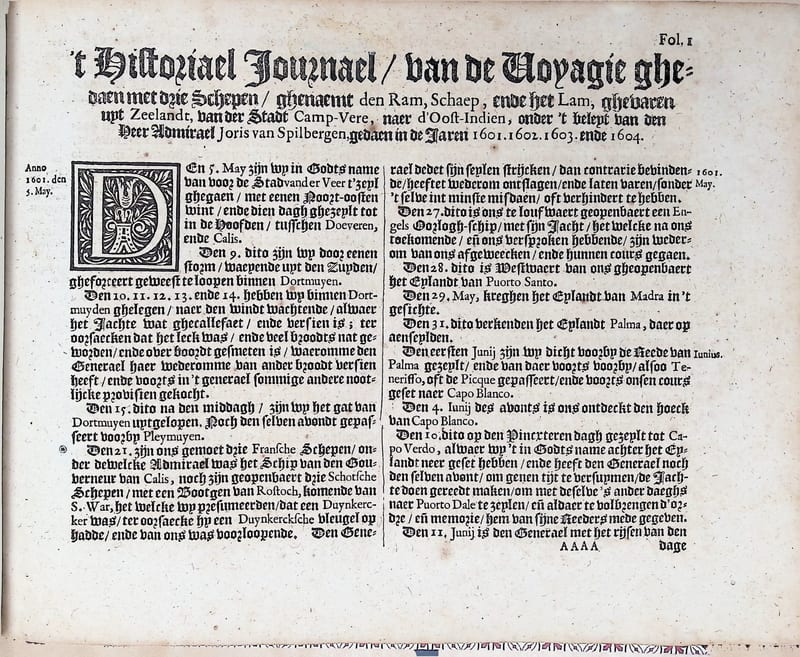
Historisch Journael, Spilbergen's Voyagie naar Oost-Indien (1601–1604)
Joris van Spilbergen (with Wolfhart Harmanszoon & Cornelis van Veen) · Amsterdam · 1646
€ 3.500
Voyages & Discovery · FM-0063
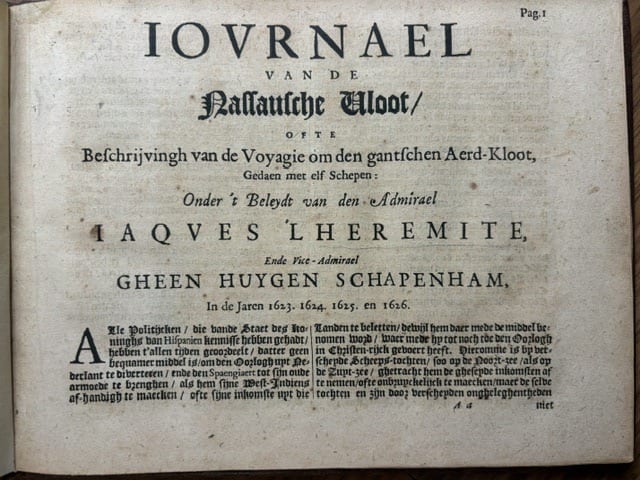
Journael van de Nassausche vloot, ofte beschrijvingh van de voyagie om den gantschen aerd-kloot, gedaen met elf schepen onder 't beleyt van admirael Jacques L'Hermite
Jacques L'Hermite · Amsterdam · 1646
€ 2.500
Voyages & Discovery · FM-0070
Eerste schipvaerd der Hollandsche Natie naar Oost-Indien
Willem Lodewijckszoon · Amsterdam · 1646
€ 2.400
All 8 works: Isaac Commelin, Begin ende Voortgangh → · Isaac Commelin, Begin ende Voortgangh · The Dutch East India Company (VOC)