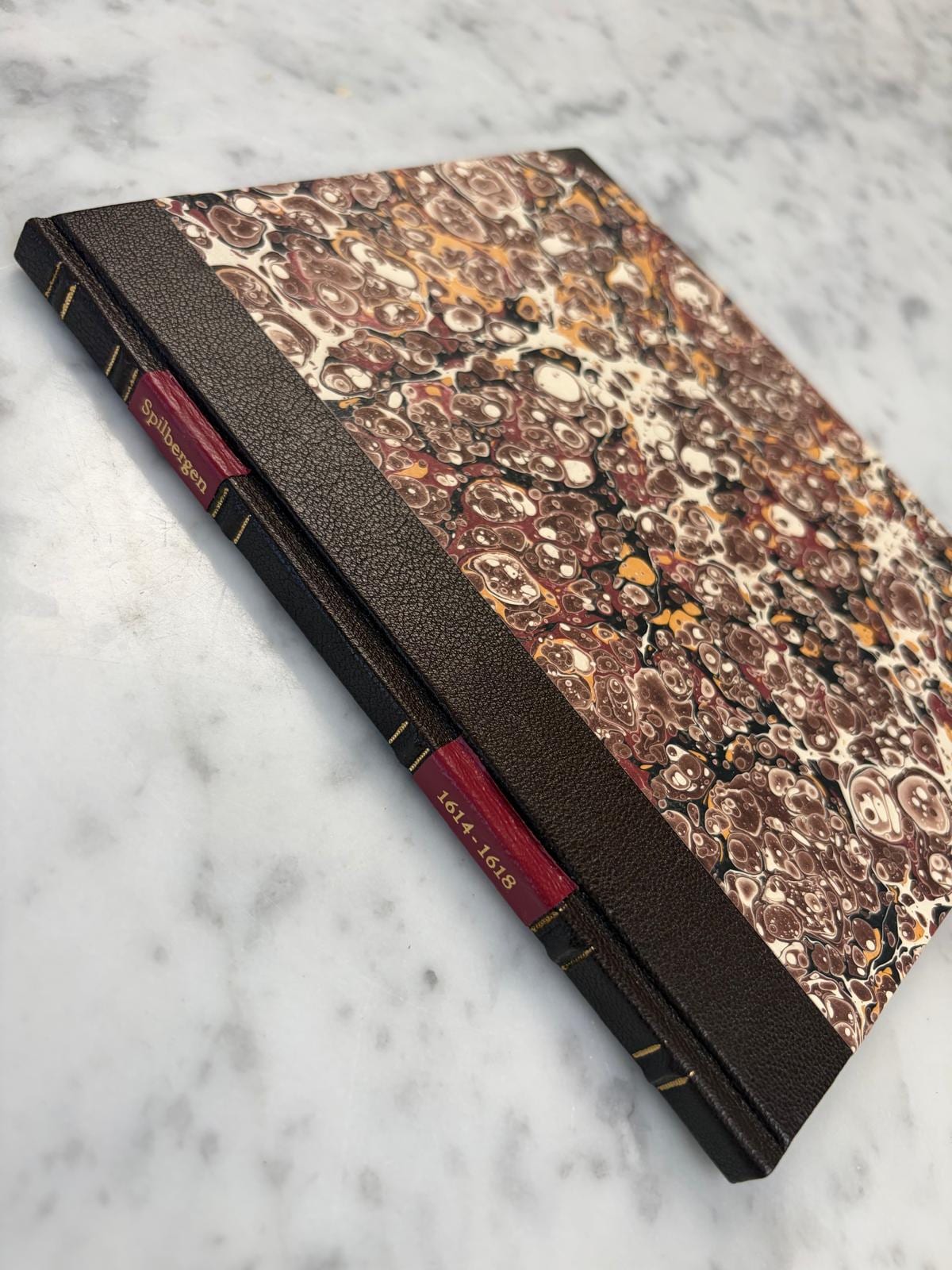
Voyages & Discovery
Oost en West Indische Voyagie
Joris van Spilbergen · Amsterdam · Gilles Saegman · c. 1663
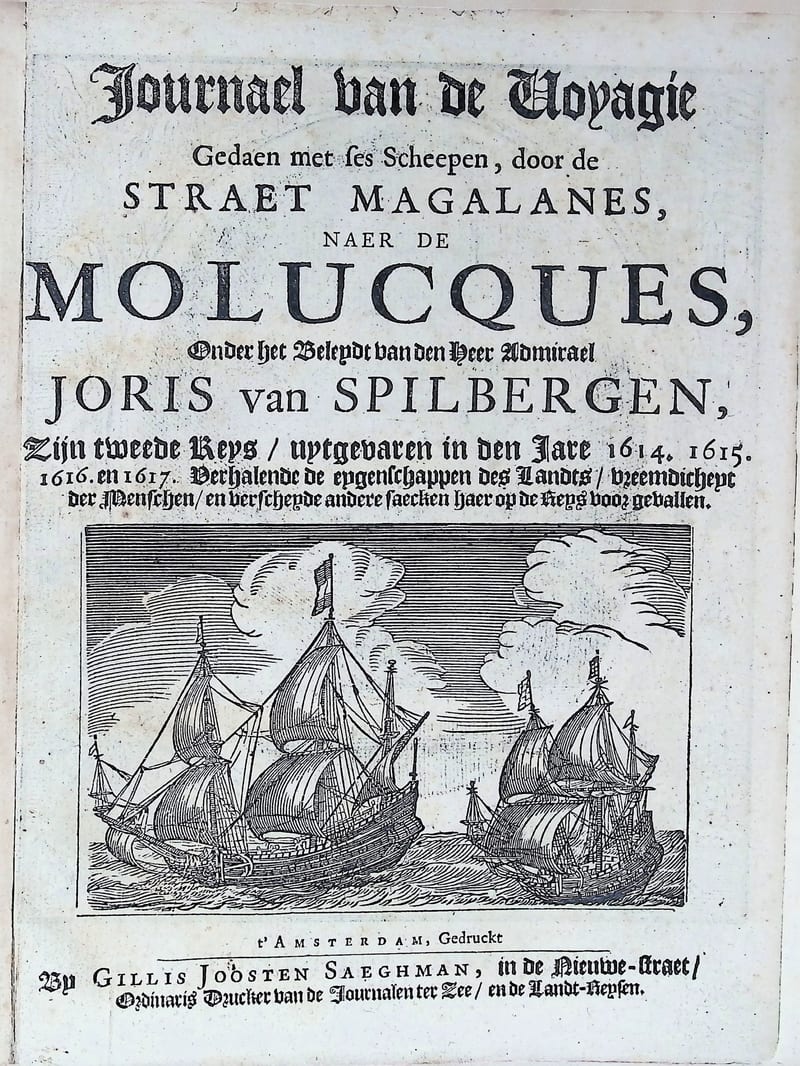
A Saeghman popular edition (Amsterdam, Gilles Saegman, c. 1663) of the account of Joris van Spilbergen's circumnavigation, the fifth ever, illustrated with seven woodcuts (including a dodo) and a copperplate engraving. Small quarto; lacking the title-leaf, but the circumnavigation text itself complete.
FM-0059
€ 1.400
Key Properties
A Saeghman popular edition of the text of Joris van Spilbergen's circumnavigation of 1614–1617. The edition carries the six woodcuts belonging to the voyage together with two others borrowed from the account of Van Neck's second voyage to the Indies (1600–1602).
Collation & Technical Description
Small quarto. Pp. 3–62 (of 64), with 7 woodcuts and one copperplate engraving in the text.
Condition
Modern quarter calf. Lacking the first leaf (title-page and portrait) and the last leaf (an unrelated annex). Cut a little short at the foot; the sides of the first ten leaves strengthened. Some staining. The text of the Spilbergen circumnavigation itself is complete.
References & Bibliography
Tiele, Mémoire bibliographique sur les journaux des navigateurs néerlandais, no. 72.
Description
This is a Saeghman popular edition (Amsterdam, Gilles Saegman, c. 1663) of the account of Joris van Spilbergen's circumnavigation of the globe, the fifth ever accomplished, after those of Magellan, Drake, Cavendish and Van Noort. The voyage took place between 1614 and 1617.
Spilbergen was an accomplished admiral who had already sailed for the VOC to the Indies (Ceylon). He was sent out again by the Company to discover new territories, to chart the Strait of Magellan, and to damage Spanish interests in South America and the Philippines wherever possible. He landed in Brazil, mapped the Strait of Magellan, attacked Spanish settlements in Chile, Peru and Mexico, and sailed on to the Philippines. At Batavia he took aboard Jacob le Maire and the remainder of his crew, including Willem Schouten, who had been arrested there for breaching VOC law by sailing to the Indies without the Company's consent. Le Maire's defence was ingenious: he had not sailed through the Strait of Magellan (as the monopoly specified) but had rounded Cape Horn, the passage he and Schouten had just discovered.
The present edition carries the full text of Spilbergen's circumnavigation, but illustrates it with the six woodcuts belonging to the voyage together with two others borrowed from the account of Van Neck's second voyage to the Indies (1600–1602). The illustrations are: p. 12, living conditions on Mauritius (after Van Neck's first voyage); p. 22, the 'Walgvogel' or dodo (Van Neck's first voyage); p. 25, a llama (Spilbergen's circumnavigation); p. 27, the island of Santa María, Chile, at 37° S (the copperplate engraving); p. 36, Spilbergen's battle with Admiral Rodrigo de Mendoza off Callao de Lima; p. 44, off Payta (Peru), Dutch ships attacked by Indian rafts ('balsas'), one of them carrying a great bird (August 1615); p. 52, the Islas de los Ladrones ('Islands of Thieves', the Marianas); and p. 53, Luzon and Manila, an attack on a house built in a tree (January 1616).
Historical Significance
Joris van Spilbergen's was the fifth circumnavigation of the globe, after Magellan, Drake, Cavendish and Van Noort (1614–1617). Dispatched by the VOC to chart the Strait of Magellan and strike at Spanish interests in the Pacific, the voyage is also bound up with the discovery of Cape Horn: at Batavia Spilbergen took aboard Jacob le Maire and Willem Schouten, who had just rounded the Horn.
Provenance
Available on request.
Related works
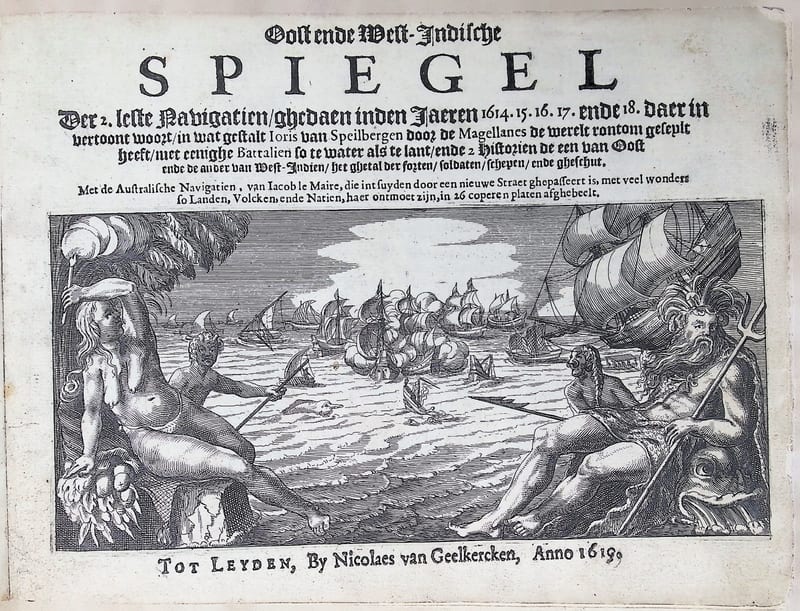
Voyages & Discovery · FM-0041
Oost ende West-Indische Spiegel
Joris van Spilbergen; with Jacob le Maire and Willem Schouten, Australische Navigatien · Leiden · 1619
Price on request
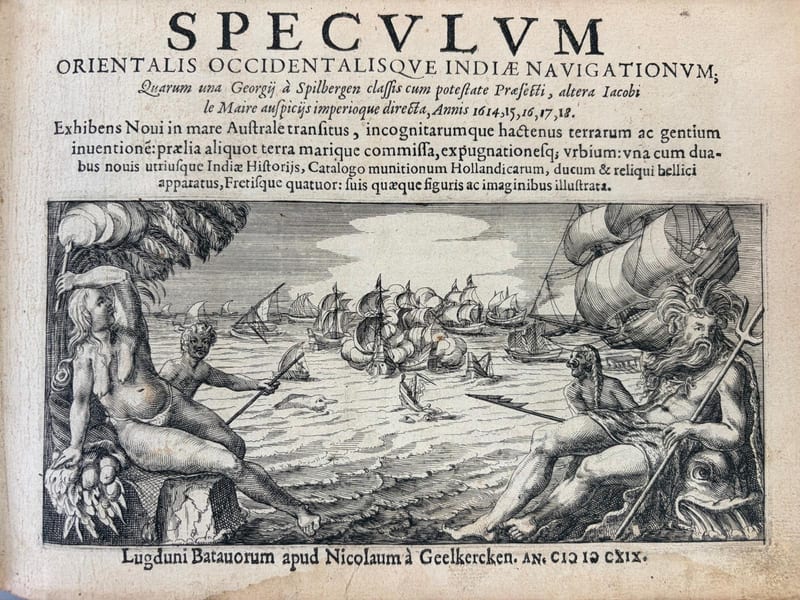
Voyages & Discovery · FM-0105
Speculum orientalis occidentalisque Indiae navigationum
Joris van Spilbergen; with Jacob le Maire, Navigationes Australes · Leiden · 1619
€ 15.000
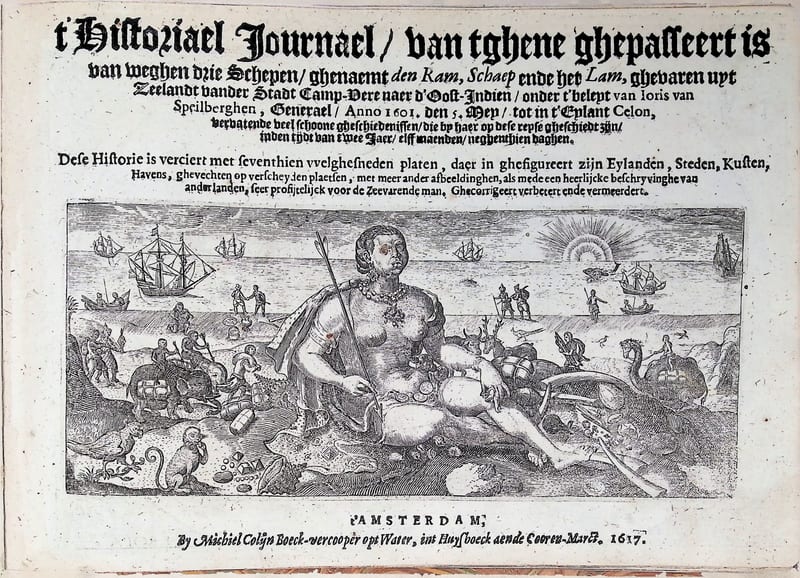
Voyages & Discovery · FM-0043
’t Historiael Journael van Joris van Spilbergen naer Oost-Indien (Ceylon)
Joris van Spilbergen · Amsterdam · 1617
€ 9.000
Voyages & Discovery · FM-0035
Oost ende West Indische Spieghel
Joris van Spilbergen (text by Jan Cornelisz May) · Amsterdam · circa 1663
€ 7.000
All 8 works: Joris van Spilbergen → · Joris van Spilbergen · The Dutch East India Company (VOC) · The Strait of Magellan and Cape Horn