Voyages & Discovery
L'Ambassade de la Compagnie Orientale des Provinces Unies vers l'Empereur de la Chine, ou Grand Cam de Tartarie, faite par les Srs. Pierre de Goyer, & Jacob de Keyser
NIEUHOF, Johan (Jean Nieuhoff); translated by Jean LE CARPENTIER · Leiden · Jacob de Meurs (for Jacob van Meurs, bookseller and engraver of Amsterdam) · 1665
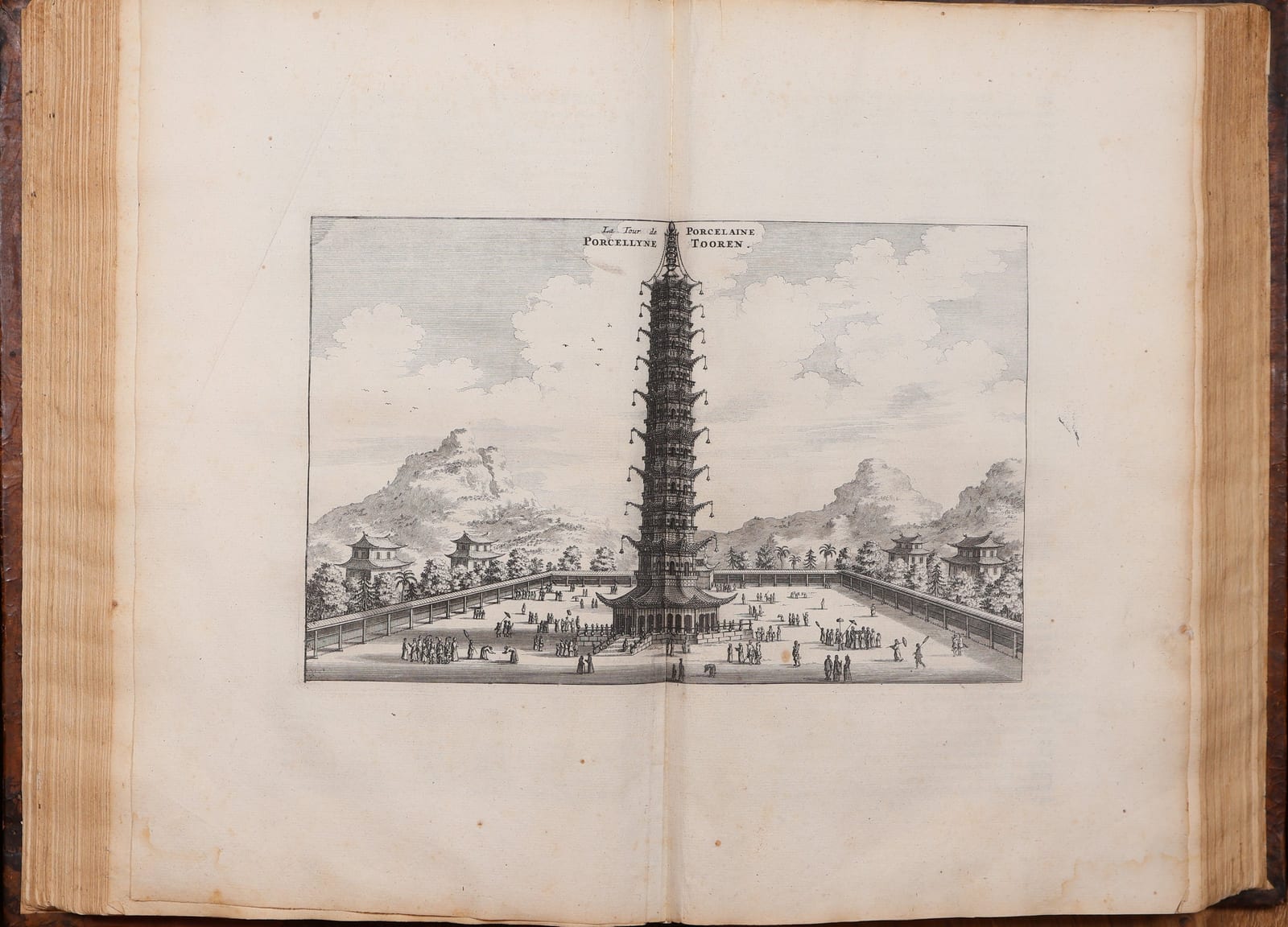
First French edition, published in the same year as the Dutch original, of the most influential illustrated book on China of the seventeenth century: the Dutch East India Company's embassy to the court of the Shunzhi Emperor in Peking, 1655 to 1657, with the engraved title, the portrait of Nieuhof, the large folding map of China, 34 double-page plates of Chinese cities, the Porcelain Pagoda of Nanking and the Imperial court, and some 110 engravings in the text; a complete copy in its contemporary French calf binding with the gilt arms of a monastery of St Martin, from the libraries of the painter Jules-Romain Joyant and the painter and lithographer Louis Thiénon.
FM-0216
€ 15.000
Key Properties
Edition: first edition in French, translated and enlarged by Jean Le Carpentier, 'historiographe', printed for Jacob de Meurs, Leiden 1665, with the royal privilege; the Dutch original (Het Gezantschap) appeared at Amsterdam in the same year with the same copperplates; German 1666, Latin 1668 and English 1669 editions followed.
Contents: two parts in one volume. Part I: the journey of the ambassadors Pieter de Goyer and Jacob de Keyser from Batavia by way of Canton, the rivers of Kiangsi and the Grand Canal to Peking, the audience with the Emperor and the return, with the 'Avis aux curieux', a letter from Batavia of 1659. Part II: Description generale de l'Empire de la Chine, on the government, religion, sciences, manners, animals, plants and the wars against the Tartars.
Illustration: engraved title (the Emperor enthroned with a globe, captives at his feet), engraved portrait of Joan Nieuhoff in an oval, large folding map of China, 34 double-page engraved plates (31 in Part I, 3 in Part II) of Batavia, Macao, Canton with its plan and the banquet of the viceroys, the cities of the route to Nanking and Peking, the Porcelain Pagoda, the Imperial city and palace, a temple interior, the banana tree and the march of the army, and about 110 half-page engravings in the text; woodcut head- and tailpieces and initials; the title of Part I printed in red and black.
Format: folio, 37 x 23.5 cm.
Binding: contemporary French brown calf, spine with raised bands richly gilt in compartments, the boards with a triple blind fillet and the gilt supralibros of a monastery of St Martin at the centre, gilt roll on the edges of the boards.
Language: French.
Collation & Technical Description
Folio in fours. Engraved title; *2-4 (letterpress title in red and black with engraved vignet, verso blank; dedication to Colbert signed by Jacob de Meurs); engraved portrait; **4 (preface, table of chapters of both parts, privilege, verso blank); folding map; A-Z, Aa-Oo4 (Oo2 the title of Part II): pp. [16], 1-290, [2], with the 31 double-page plates of Part I; A-R4: pp. 1-134, [2] (R4 the 'Advertissement' to the binders listing the 34 plates, verso blank), with the 3 double-page plates of Part II. Complete, collated leaf by leaf against the printed binder's list; the pagination of Part I irregular as in all copies.
Condition
Very good. A complete, wide-margined copy in its first binding. The calf with old restorations to the corners, headcaps and joints, the upper joint split along four compartments but firm, some rubbing; the gilding of the spine and the supralibros bright. Internally clean and fresh with only scattered light foxing; one plate with a short tear in the corner, without loss; the map and the plates in strong impression. Front flyleaf with the early ownership inscriptions and notes described under Provenance.
References & Bibliography
Cordier, Bibliotheca Sinica, col. 2345-2346. Landwehr, VOC, 539 ff. Tiele 800. Lust, Western Books on China, 543 ff. Löwendahl, Sino-Western Cultural Relations, I p. 65. Brunet IV, 77. STCN 840054262. Cf. Cat. NHSM I, p. 499; Sabin 55286 (the Latin and English editions).
Description
Johan Nieuhof (1618-1672) travelled as steward of the embassy that the Dutch East India Company sent from Batavia to the young Manchu Emperor of China in 1655, hoping to obtain the right to trade in the ports of the empire that the Portuguese held from Macao. Pieter de Goyer and Jacob de Keyser and their suite landed at Canton in July 1655, were kept waiting for eight months, and then travelled for five months by river and by the Grand Canal through the provinces of Kwangtung, Kiangsi, Nanking and Shantung to Peking, where on 1 October 1656 they were admitted to the presence of the Shunzhi Emperor. The Jesuits at court, above all Adam Schall, worked against the heretical Hollanders, and the embassy came home in 1657 with presents and a tributary status but without the trade it had asked for. Nieuhof had been instructed to draw everything he saw, 'in its true form', and his sketches, worked up by the Amsterdam publisher and engraver Jacob van Meurs into the plates of this book, gave Europe its first eyewitness picture of the interior of China: the walled cities on the rivers, the pagodas and bridges, the boats, the costumes of mandarins, soldiers, bonzes and beggars, the plants and animals, the feasts and the executions, and the Porcelain Pagoda of Nanking, which through this book became the most famous building of Asia in the European imagination.
The book was published at Amsterdam in Dutch in 1665 and, from the same plates and in the same year, in this French translation by Jean Le Carpentier, printed for Van Meurs at Leiden and dedicated to Colbert, who was then founding the French Compagnie des Indes orientales. It was the French text that carried the book across Europe; German, Latin and English editions followed within four years, and Nieuhof's images were copied by Kircher, Dapper and Montanus and by the decorators of porcelain, lacquer and tapestry for a century. Together with Martini's atlas and Kircher's China illustrata it is the foundation of the European image of China before the Enlightenment, and the source of the chinoiserie of the age of Louis XIV.
Nieuhof's own drawings survive. The manuscript with his eighty-odd sketches in pencil, chalk, pen and watercolour, which he handed to the East India Company in Amsterdam on 3 August 1658 and from which Van Meurs's engravers worked, disappeared from view after the seventeenth century. In the 1890s it passed through the hands of Frederik Muller and Co., the Amsterdam house of which the present firm is the continuation, and was bought there by Prince Roland Bonaparte, the geographer and collector, who left it with his library to the Société de Géographie in Paris; it is now in the Bibliothèque nationale de France, where it was recognised in 1984 and published by Leonard Blussé and Reindert Falkenburg in 1987. Set beside the printed plates, the drawings show how much the engravers added, palm trees, figures and exotic staffage that Nieuhof had never drawn, and how much of the picture of China that Europe took from this book was made in an Amsterdam workshop. That the same firm which handled the manuscript a century and a quarter ago should now offer this copy of the book is a coincidence we are glad to record.
This copy is complete, with the engraved title, the portrait of the author, the folding map and all thirty-four double-page plates in strong impression, and it has never left its first binding: a French binding of brown calf of the time of publication, the spine richly gilt, the boards stamped in gilt with the supralibros of a monastery of St Martin, so that the book was probably acquired for a French or Flemish Benedictine library within a few years of its appearance. On the flyleaf it carries the later signatures of Renard Virlet and a nineteenth-century note recording that it came from the library of Joyant père, sold at the sale of the painter Jules-Romain Joyant (1803-1854), the painter of Venetian views, and passed into the collection of the painter and lithographer Louis-Désiré Thiénon (1812-c. 1884): a copy of the greatest picture book of China that spent its second century among Parisian painters.
Historical Significance
Nieuhof's embassy is the first European account of the interior of China illustrated from life, and the plates of this book fixed the image of the country in the European mind for a hundred years. For the history of the Dutch East India Company it is the record of the first Dutch mission to the Chinese court; for the history of art it is the source of European chinoiserie; for the history of cartography it carries the first printed plans of Canton and of the Imperial city of Peking made by a Western eyewitness. The French edition of 1665 is the version in which the book was read at the court of Louis XIV and in the rest of Europe, and copies in contemporary bindings with all the plates have become rare.
Provenance
A monastery of St Martin (gilt supralibros 'Mon. S. T. Martin' on the boards, French or Flemish, late seventeenth or eighteenth century, not yet identified). Renard Virlet, two ink signatures on the front flyleaf, late eighteenth or early nineteenth century, with a note of price. Simon Joyant, father of the painter Jules-Romain Joyant (1803-1854), and sold at the painter's sale (pencil note: 'provenant de la Bibliothèque Joyant père, vente du peintre Joyant'). Louis-Désiré Thiénon (1812-c. 1884), painter and lithographer, Paris ('collection Louis Thiénon, L.T.'). A later bookseller's number in pencil.
Related works
Voyages & Discovery · FM-0022
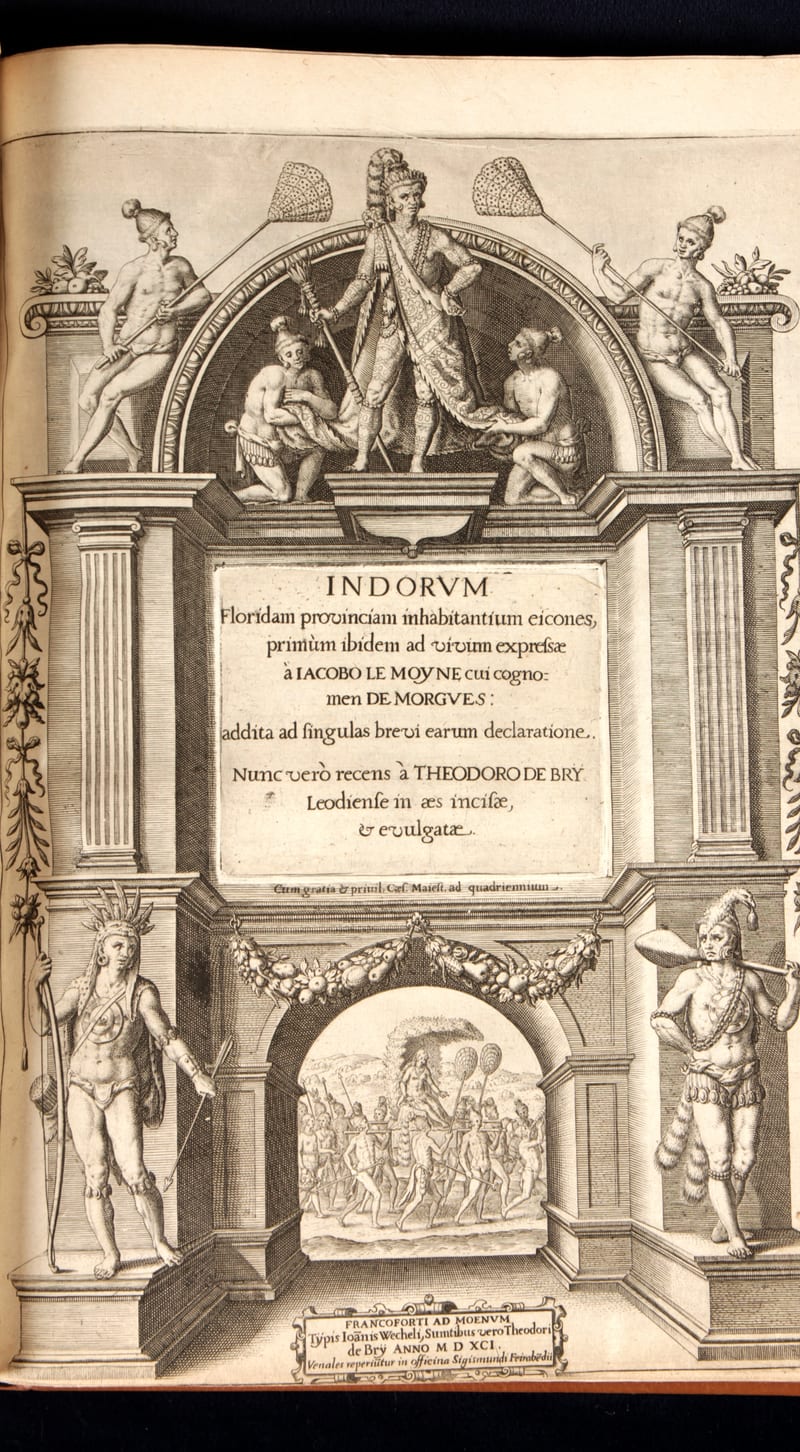
Grands Voyages & Petits Voyages, The Complete De Bry
Theodor de Bry (1528–1598) and sons Johann Theodor & Johann Israel de Bry · Frankfurt · 1590–1634
Price on request
Voyages & Discovery · FM-0026
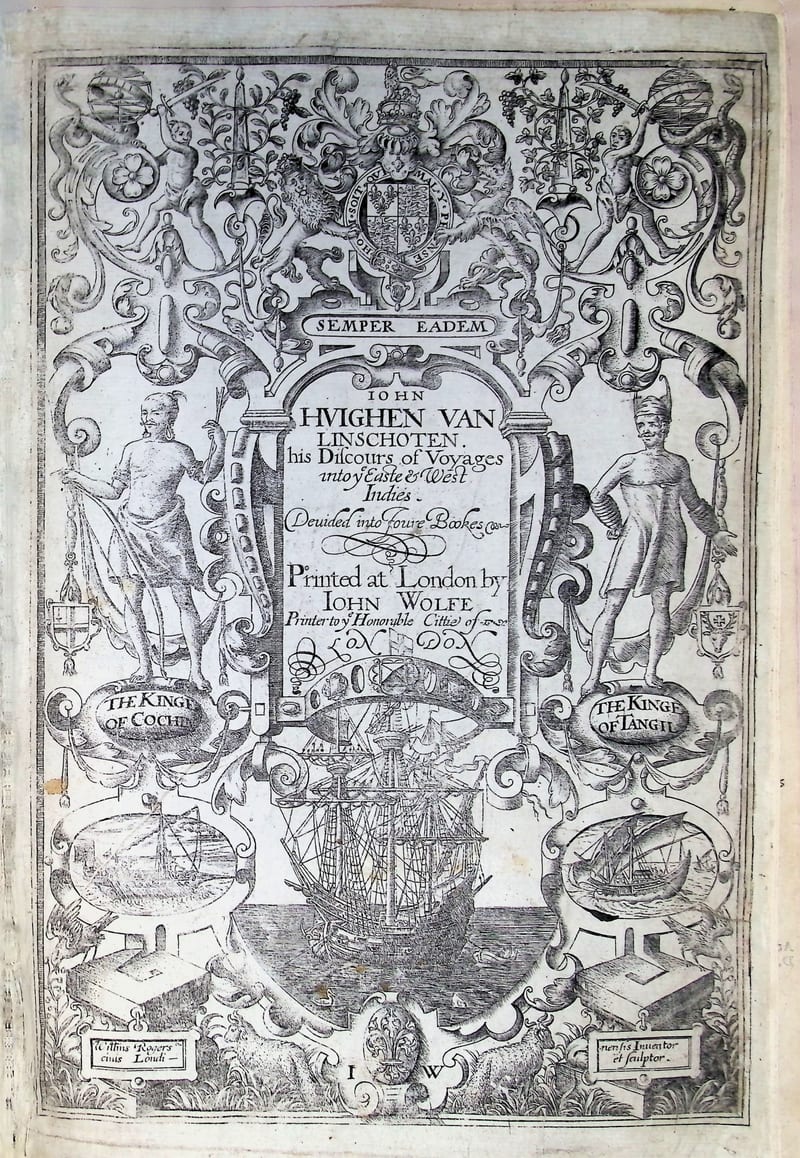
John Huighen van Linschoten his Discours of Voyages into ye Easte & West Indies
Jan Huygen van Linschoten (translated by William Phillip) · London · 1598
Price on request
Voyages & Discovery · FM-0044
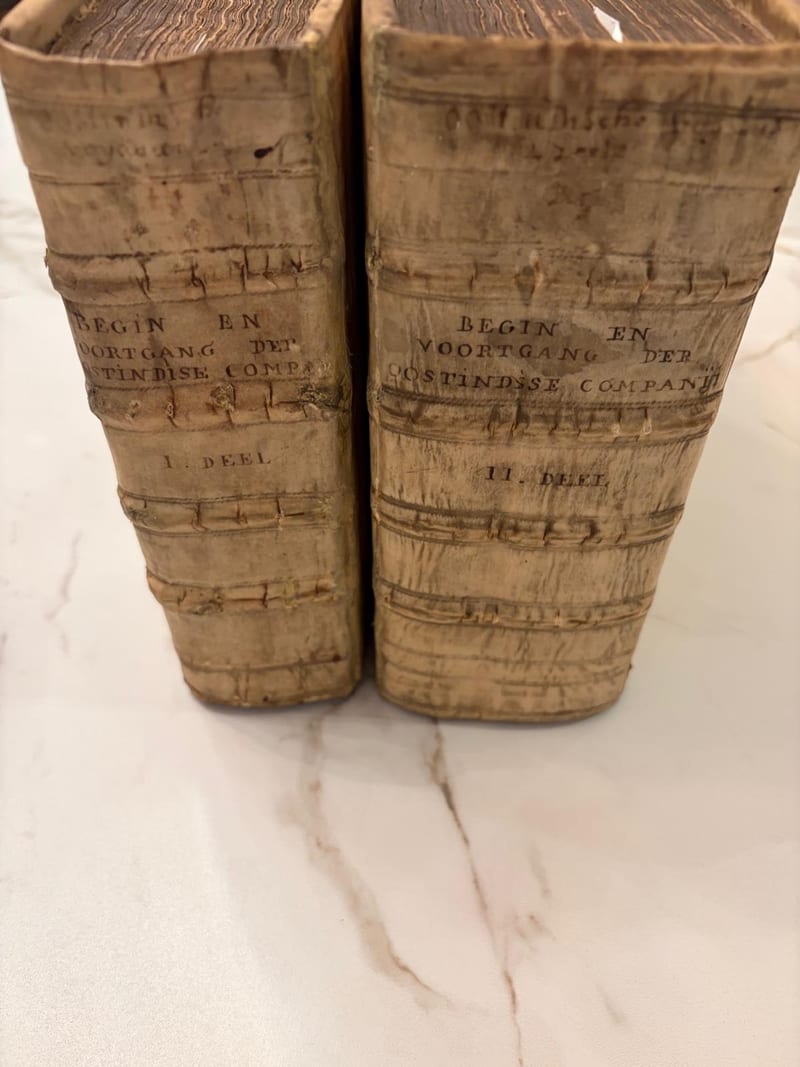
Begin ende Voortgangh van de Vereenighde Nederlantsche Geoctroyeerde Oost-Indische Compagnie
Isaac Commelin (compiler and editor) · Amsterdam · 1646
Price on request
Voyages & Discovery · FM-0030
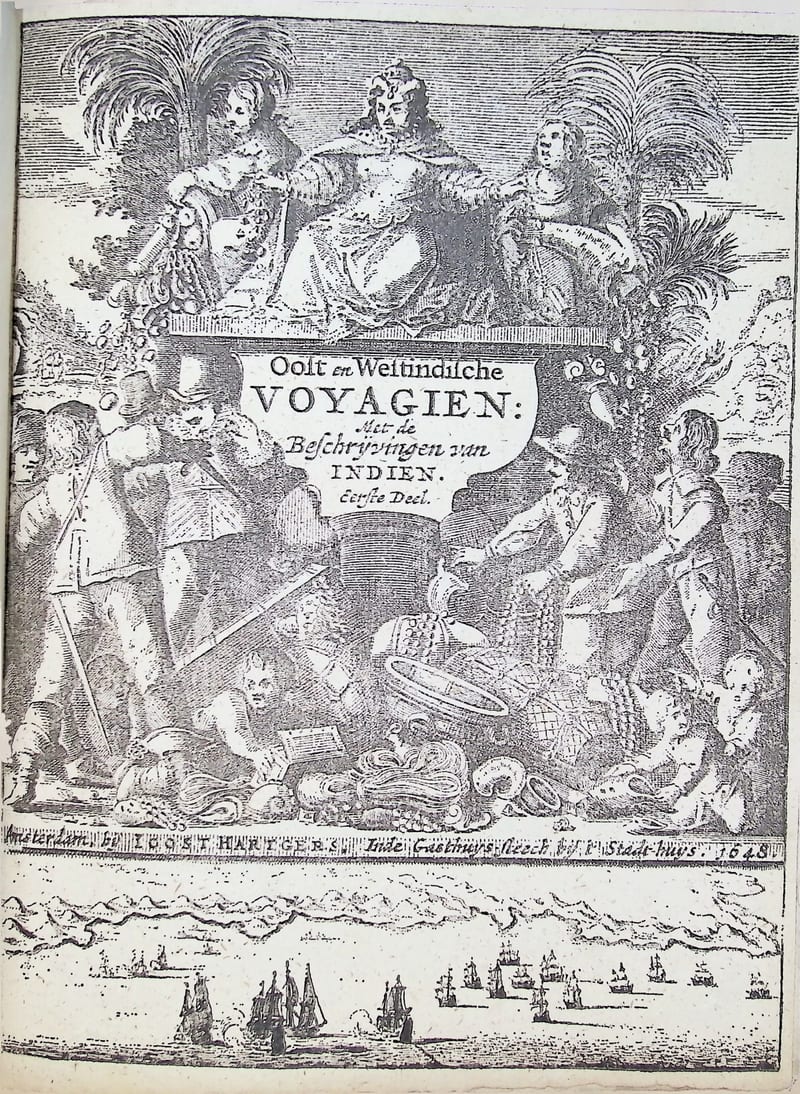
Oost-Indische voyagien
Joost Hartgers (collector & printer); various authors · Amsterdam · 1648
Price on request
All 28 works: The Dutch East India Company (VOC) →