Voyages & Discovery
Grands Voyages & Petits Voyages, The Complete De Bry
Theodor de Bry (1528–1598) and sons Johann Theodor & Johann Israel de Bry · Frankfurt · Family de Bry and Matthäus Merian · 1590–1634
The complete De Bry: Grands Voyages and Petits Voyages, the illustrated collection of voyages to the Americas and the East Indies, Frankfurt 1590 to 1634
FM-0022
Price on request
Key Properties
Language: Latin
Binding: Expertly bound in fine brown calf by Sam Ellenport, Boston
Collation & Technical Description
Parts
I–XIII complete, in six volumes
Leaves
1,378
Plates
305 engraved plates with text
Maps
34 folding maps
Title pages
18 engraved (two incorporating maps)
Additional prints
7 (including folding view of Cusco)
Parts
I–XII + Appendix Africae, complete in five volumes
Edition
All first editions in Latin
Leaves
1,030
Plates
273 engraved plates
Maps
18 mostly double-page and folding maps
Completeness
Complete; one incorrect title page (1625 Appendix)
Volume structure: Vol. 1: Book I (1598) and Book XIII / Appendix Africae (1625); Vol. 2: Books II–III; Vol. 3: Books IV–VI; Vol. 4: Books VII–IX; Vol. 5: Books X–XII. Volume 1, which includes the often-missing Appendix Africae, is slightly smaller than the rest (29.5 x 19.5 cm).
Total leaves
2,408
Total plates
578 engraved plates
Total maps
52 folding and double-page maps
Total volumes
11 (6 Grands + 5 Petits)
FORMAT & BINDING
Condition
Condition: very good. The entire set has been uniformly and expertly rebound in fine brown calf, modestly decorated in gilt, by Sam Ellenport of Boston, one of the most respected fine binders and conservators in the United States. The uniform binding gives this large set a commanding physical presence.
All volumes have been mildly washed and de-acified, ensuring the long-term preservation of the paper. The Grands Voyages have an old restoration of a worm gang in 20 leaves in book XI. The Petits Voyages have no restorations. The engraved plates and maps show strong, well-printed impressions throughout. The Petits Voyages are all first editions in Latin, a distinction that underscores the quality and integrity of this set.
References & Bibliography
Grands Voyages: Church 140–174. Petits Voyages: Church 205; 207; 208; 211; 212; 213; 216; 218; 220; 222; 223; 224 and 225.
Church quotes Stevens as saying: "No man ever yet made up his de Bry perfect if one may count on the three great de Bry witnesses: Grenville; Sobolewski and Lenox..."
The three legendary 'perfect' De Bry sets referred to by Stevens are those of the Grenville collection (now British Library), the Sobolewski collection, and the Lenox collection (now New York Public Library). The present set joins that rarefied company.
Brunet I, 1341–1345. Sabin 8784 et seq. Borba de Moraes I, 130–135. European Americana (individual parts). JCB (3) I, passim.
Description
The thirteen parts of the Grands Voyages, published between 1590 and 1634, constitute the most influential visual record of the European encounter with the Americas ever produced. Conceived by Theodor de Bry, a Liège-born Protestant engraver who had settled in Frankfurt, and continued after his death by his sons Johann Theodor and Johann Israel, the series translated the raw accounts of explorers and colonists into over three hundred finely engraved copperplates that defined European perceptions of the New World for generations.
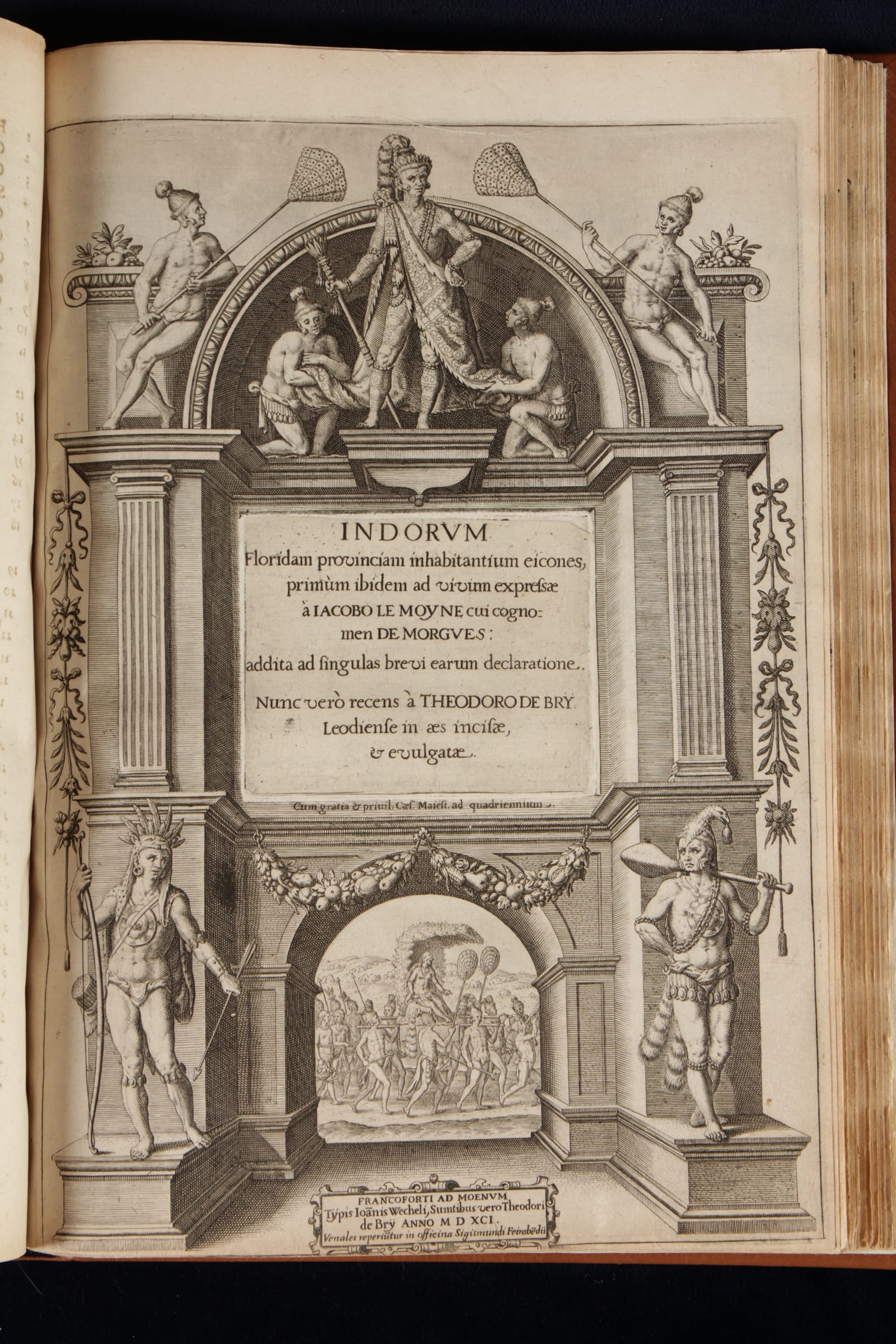
The series opens with Thomas Hariot's account of Virginia (Part I, 1590), illustrated after the watercolours of John White, images that remain the primary visual record of Algonquian life before sustained European contact. Jacques Le Moyne's Florida follows in Part II, with engravings of Timucua ceremonies that have become icons of early American ethnography.
Subsequent parts document the full sweep of European expansion across the continent: Columbus's Caribbean, Pizarro's conquest of Peru, Ulrich Schmidel's account of the Río de la Plata, Raleigh's Guyana, the circumnavigations of Drake, Cavendish, Schouten and Spilbergen, and the early English settlements at Jamestown and New England through Hamor and John Smith.
Also included is an edition of Antonio de Herrera's Atlas of the Americas, a set of fourteen maps that provided the most comprehensive cartographic survey of Spanish colonial geography available to a European audience.
The 305 engraved plates have been reproduced and copied continuously for over four centuries. De Bry's images of native Americans, whether depicting feasts, warfare, rituals or daily life, shaped and in many cases distorted European understanding of indigenous cultures. They remain essential primary sources for the study of colonialism, visual culture and the history of the book.
The companion series of Petits Voyages, published between 1598 and 1628, extends the De Bry enterprise eastward, documenting European voyages to Africa, the Indian Ocean, Southeast Asia, the Arctic and the Pacific. Where the Grands Voyages charted the Atlantic world, the Petits Voyages recorded the opening of the sea routes that would reshape global trade.
The series preserves the earliest published accounts of the Dutch East India Company's expansion into Asia, including the voyages of Jan Huygen van Linschoten (whose Itinerario broke the Portuguese monopoly on Eastern navigation), Cornelis de Houtman's first Dutch voyage to Java, and the expeditions of Van Neck, Spilbergen, Verhoeff and Van der Hagen across the Indonesian archipelago.
The African voyages, including those of Lopez to the Congo, De Marees to Guinea, and Samuel Braun, provide some of the earliest European visual records of West and Central African societies. The Arctic voyages of Willem Barents and Henry Hudson, illustrated with dramatic scenes of ice-locked ships and polar bears, document the perilous search for a Northeast Passage.
The later parts of the Petits Voyages, Parts 11, 12 and the Appendix Congo, are exceptionally rare and absent from the majority of surviving sets. Their presence in this collection is a mark of its extraordinary completeness.
Historical Significance
The De Bry voyages occupy a position in the history of the printed book that is without parallel. No other publication of the sixteenth or seventeenth century attempted so ambitious a visual survey of the non-European world. The project spanned three generations of the De Bry family and over four decades of continuous production, from 1590, two years after the Spanish Armada, to 1634, in the midst of the Thirty Years' War.
The De Bry workshop operated from Frankfurt, a Protestant free city with access to the great book fairs that served as the distribution network of European publishing. This was no accident: the De Brys were Calvinist refugees from the Spanish Netherlands, and their publications carried an unmistakable Protestant perspective. The Spanish conquest of the Americas is depicted with particular ferocity, drawing on Bartolomé de las Casas's accounts of colonial atrocities. These images fuelled the 'Black Legend' of Spanish cruelty that shaped northern European attitudes for centuries.
Yet the significance of the De Bry collection extends far beyond polemic. The engravings constitute the largest and most systematic visual archive of early contact between Europeans and non-European peoples assembled before the age of photography. Ethnographers, art historians and scholars of colonialism continue to draw on them as primary sources.
Complete sets of both series are of the utmost rarity. The individual parts were published over decades, sold separately, and assembled by collectors over lifetimes. Church's famous observation, via Stevens, that no collector had ever assembled a perfect De Bry underscores the difficulty. The three benchmark sets (Grenville, Sobolewski, Lenox) are all in institutional hands. A complete set in private ownership represents a collecting achievement of the highest order.
Provenance
Frits Muller / Frederik Muller Rare Books. This set represents the life's work of Frits Muller, who assembled the complete De Bry across both series over many years of dedicated collecting and dealing. The set carries the weight of its association with one of the most respected names in the European antiquarian book trade.
Binding by Sam Ellenport, Boston. The complete set was uniformly bound in fine brown calf, modestly decorated in gilt, by Sam Ellenport, a master binder whose work is held in the collections of major American libraries and private collectors. Ellenport's binding unifies the disparate parts, acquired over time from different sources, into a coherent and handsome whole.
The provenance of a complete De Bry is itself a testament to the collector's persistence and expertise. Each part had to be sourced individually, verified against the notoriously complex collation requirements, and matched for condition and completeness. That this was achieved by a figure of Frits Muller's standing in the trade lends the set an authority that few private collections can match.,
Related works
Antique Maps · FM-0102
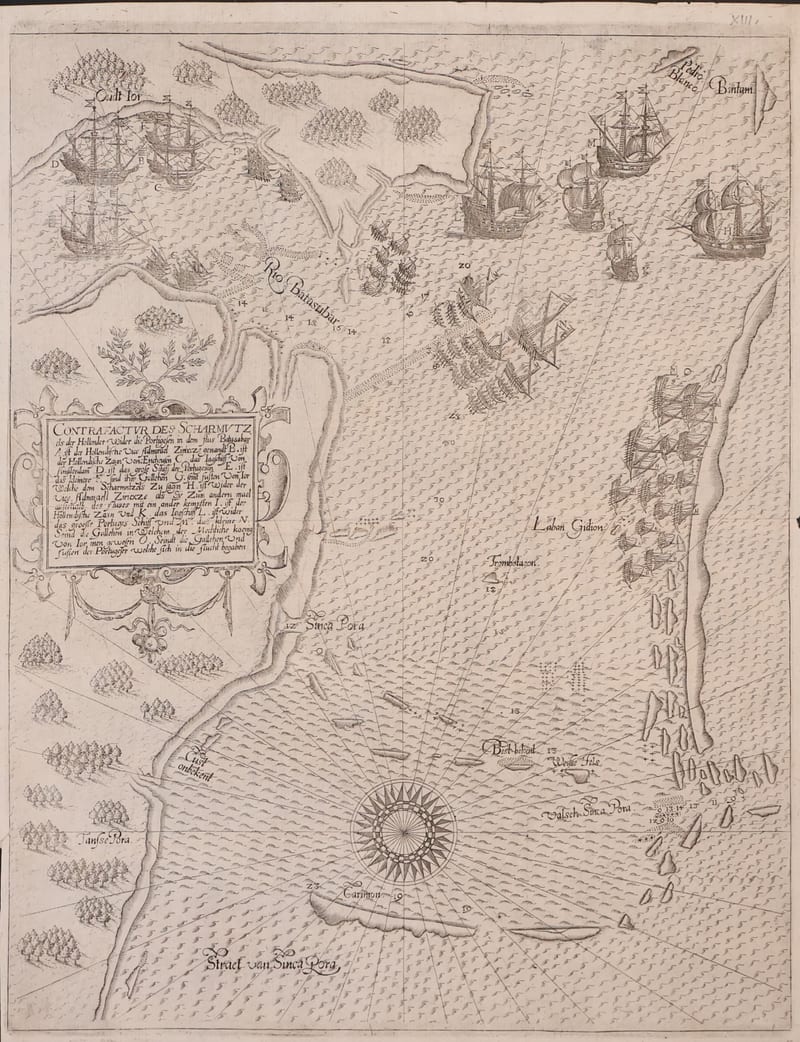
Contrafactur des Scharmutzels der Hollender wider die Portugesen in dem Flus Balusabar (Singapore and the Singapore Strait)
DE BRY, Johann Theodor and Johann Israel · Frankfurt am Main · 1606
€ 10.000
Antique Maps · FM-0136
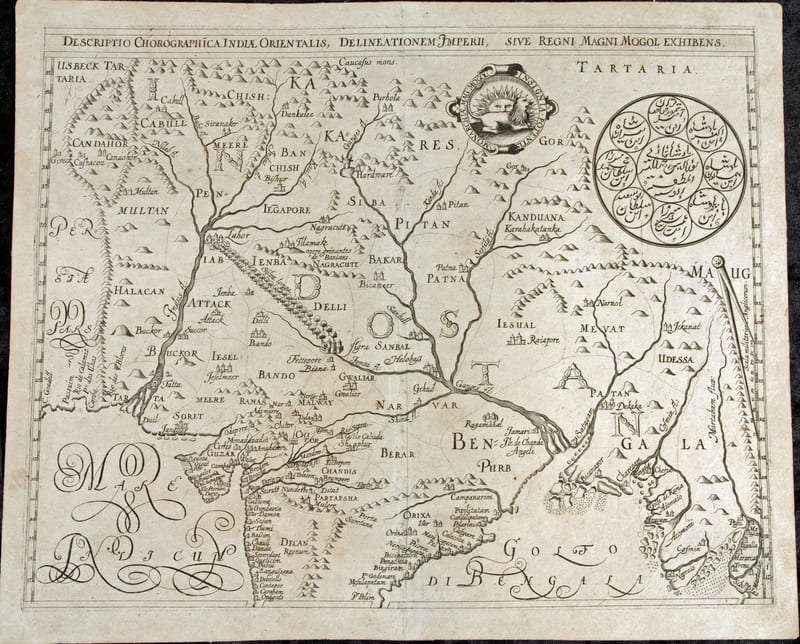
Descriptio Chorographica Indiae Orientalis, Delineationem Imperii, sive Regni Magni Mogol Exhibens (The Mughal Empire)
DE BRY, Johann Theodor and Johann Israel, after William Baffin · Frankfurt am Main · 1628
€ 5.500
Antique Views · FM-0100
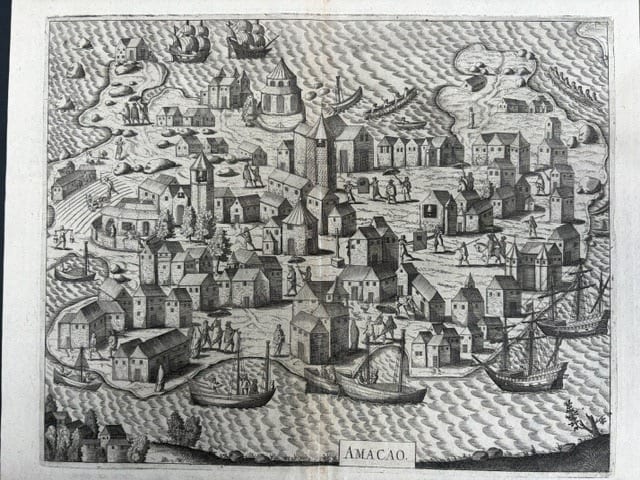
Amacao (Macao): the first printed view of Macao
DE BRY, Johann Theodor and Johann Israel · Frankfurt am Main · 1607
€ 4.000
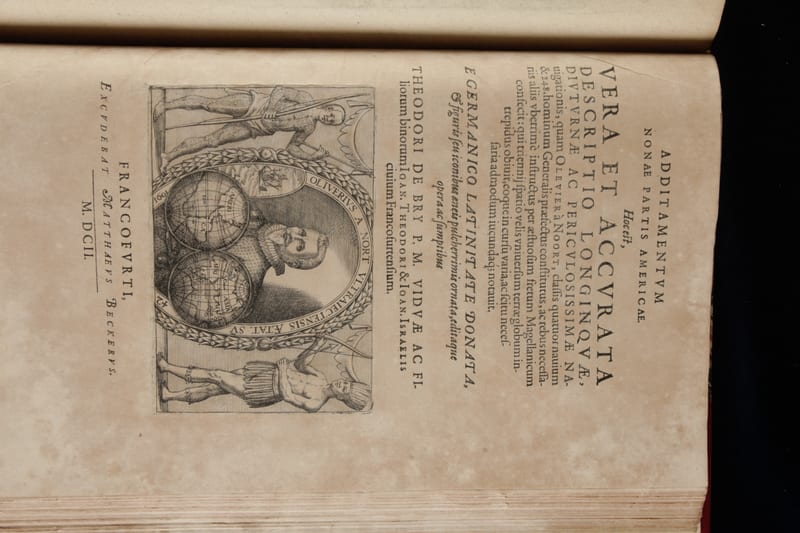
Voyages & Discovery · FM-0114
Americae nona & postrema pars
Theodor de Bry (issued by his sons Johann Theodor and Johann Israel de Bry); José de Acosta, Bernard Janszoon on Sebald de Weert, and Olivier van Noort · Frankfurt am Main · 1602
Price on request
All 5 works: Theodor de Bry and his sons → · Theodor de Bry and his sons · The Dutch East India Company (VOC)