Voyages & Discovery
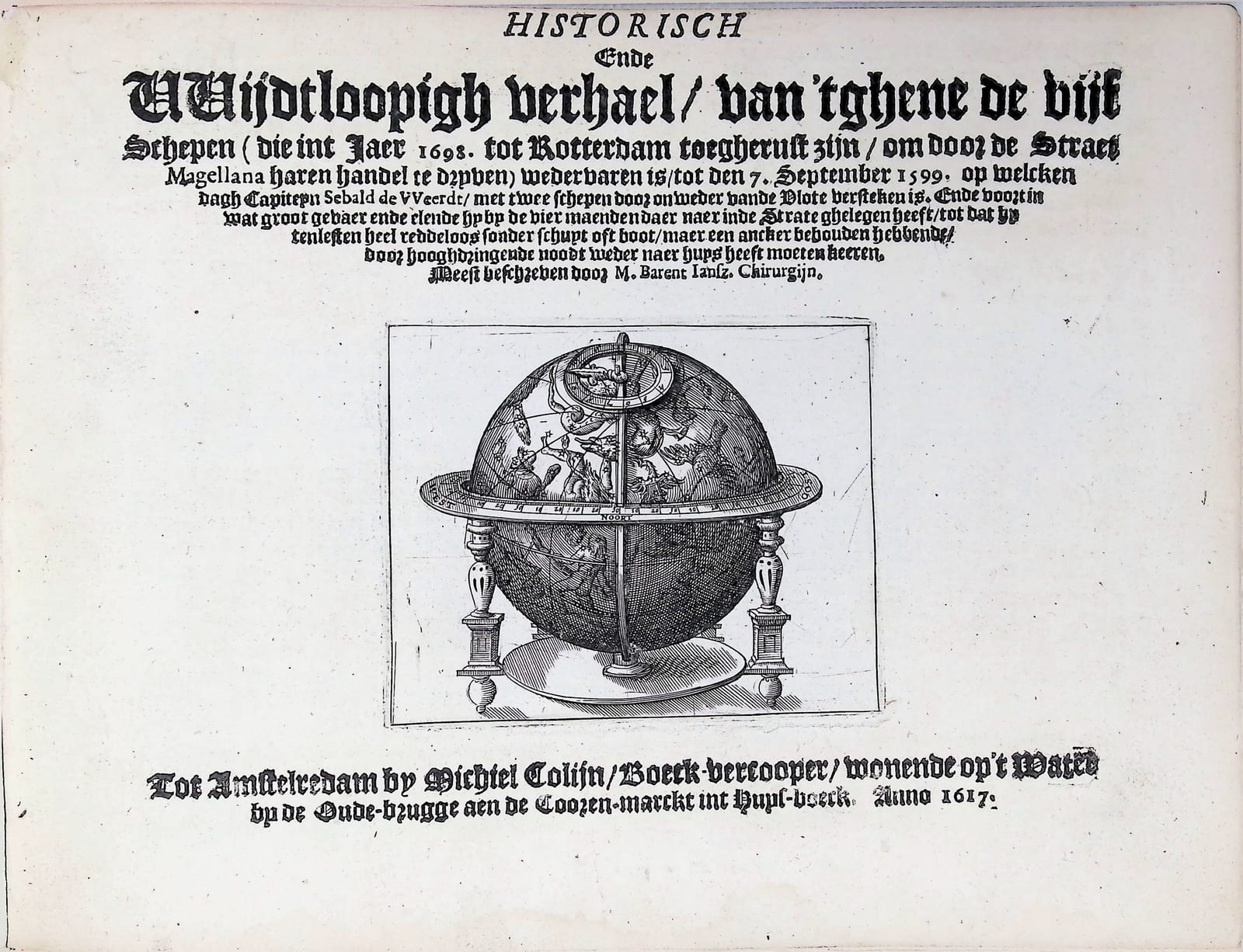
Historisch ende wijdtloopigh verhael van 'tghene de vijf schepen … door de Straet Magellana … wedervaren is; Sebalt de Weert
Barent Jansz Potgieter · Amsterdam · Michiel Colijn · 1617
Second edition (Amsterdam, Michiel Colijn, 1617) of Potgieter's richly illustrated account of the five-ship Dutch expedition through the Strait of Magellan (De Weert, 1598–99). Oblong quarto, with engraved celestial-globe title vignette and 8 full-page etchings. Of great rarity.
FM-0058
€ 6.000
Key Properties
Second imprint of the first edition of 1600, with a new and improved set of etchings. Bound in 20th-century vellum over three raised bands, with gilt title on a leather label, two sets of differently-coloured marbled endpapers, gilt top edge and a bookmark ribbon.
Collation & Technical Description
Oblong quarto (Quer-4°). 1 leaf (title) + 77 (1) pp. With an engraved title vignette (celestial globe), 8 full-page copper etchings, and a closing woodcut vignette.
Condition
Pagination errors (as issued): 43 for 34, 60 and 61 transposed, 72 lacking, 77 for 73, 27 for 76, and 73 for 77. Top edge trimmed a little close but without loss of text; the last five leaves slightly stained at the upper fore-edge; some early marginalia in pencil; paper with slight browning. Overall a well-preserved copy of this very rare edition, of particular rarity in commerce, with only two copies traceable at auction in the last fifty years.
References & Bibliography
Sabin 64582 (vol. XV); Tiele, Mémoire bibliographique sur les journaux des navigateurs néerlandais, pp. 24–26.
Description
A detailed and richly illustrated first-hand account of the calamitous voyage of the five ships fitted out at Rotterdam in 1598 by the Magellanic Company (Magelhaensche Compagnie), one of the earliest Dutch attempts to reach the East Indies and the Pacific by way of the Strait of Magellan, both to open the spice trade and to strike at the Spanish settlements on the coast of Chile. It was, in effect, the expedition of Jacques Mahu and Simon de Cordes, with Sebald de Weert one of the captains; this is his narrative of it.
The voyage was a disaster for its commanders. Admiral Jacques Mahu died of fever off Cape Verde in September 1598, only months out, and command passed to Simon de Cordes. De Cordes brought the fleet through the strait into the Pacific, only to be killed in November 1599, he and some twenty-seven of his men were cut down by Araucanians (Mapuche) on Mocha Island off the Chilean coast. The fleet was scattered by storms; of the five ships only one, the Liefde, ever reached its destination, drifting into Japan in 1600 with the Englishman William Adams aboard, the beginning of European (and soon Dutch) contact with Japan.
This narrative follows the ships under Sebald de Weert, which were separated from the fleet in a storm and forced to winter four months in the Strait of Magellan, where the crews endured a catalogue of "dangers and sufferings" (Tiele, p. 24) before de Weert turned for home, sighting on the return the islands that still bear his name, the Sebald (Sebaldine) Islands off the Falklands.
Its importance is considerable. It is one of the principal printed sources for the early Dutch voyages of discovery; a vivid record of the perils of the Magellan route, which would soon drive the Dutch to seek the alternative passage round Cape Horn (found by Schouten and Le Maire in 1616); and a foundational document of Dutch overseas expansion on the very eve of the founding of the VOC in 1602. This is the second imprint, with a new and improved set of etchings, of the first edition of 1600; of the plates Tiele remarked that "Les planches sont des imitations beaucoup plus exactes que celles qui se trouvent dans la collection des De Bry" (Tiele, p. 25). South America.
Historical Significance
Records one of the first Dutch attempts to reach the East Indies by way of the Strait of Magellan, the Magellanic Company's fleet of 1598, the same expedition whose sole surviving ship, the Liefde, carried William Adams to Japan. Sebald de Weert's account is also the source for the sighting of the Sebald Islands (now the Jason Islands, near the Falklands). Its etchings are notably more accurate than those in the celebrated De Bry collection (Tiele).
Related works
Voyages & Discovery · FM-0022
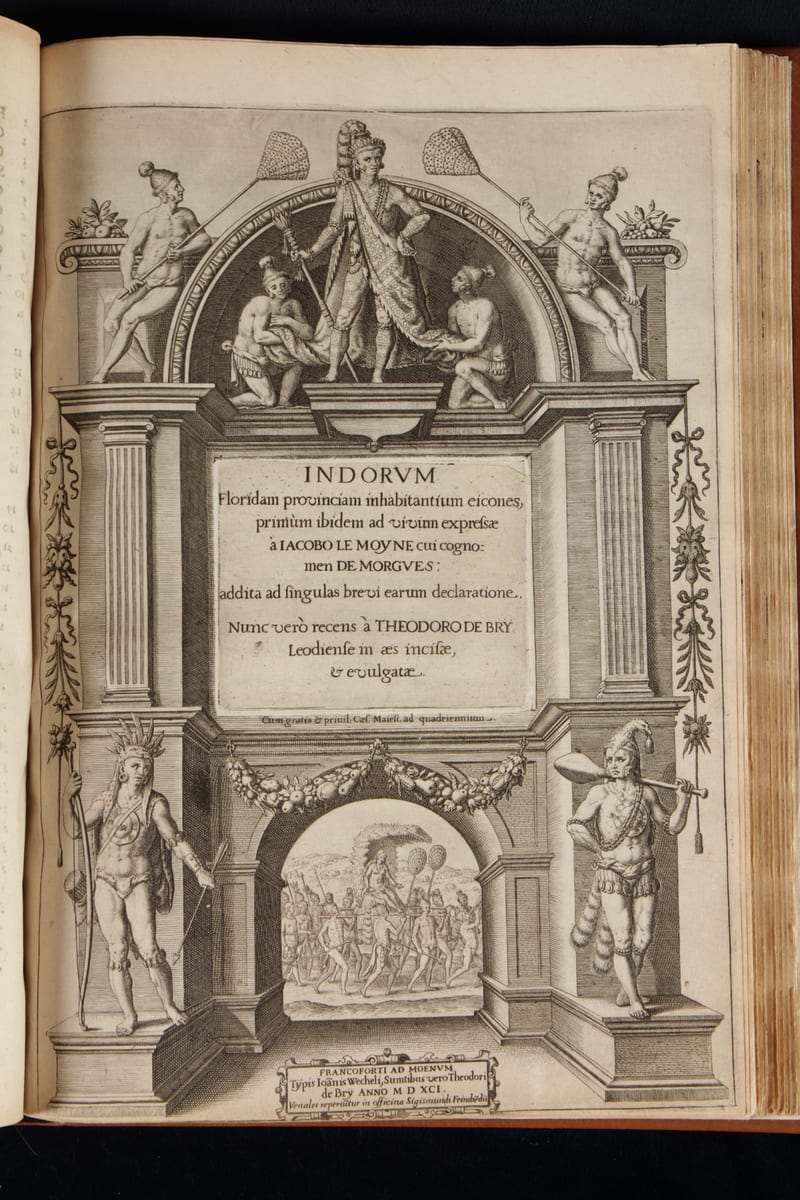
Grands Voyages & Petits Voyages, The Complete De Bry
Theodor de Bry (1528–1598) and sons Johann Theodor & Johann Israel de Bry · Frankfurt · 1590–1634
Price on request
Voyages & Discovery · FM-0026
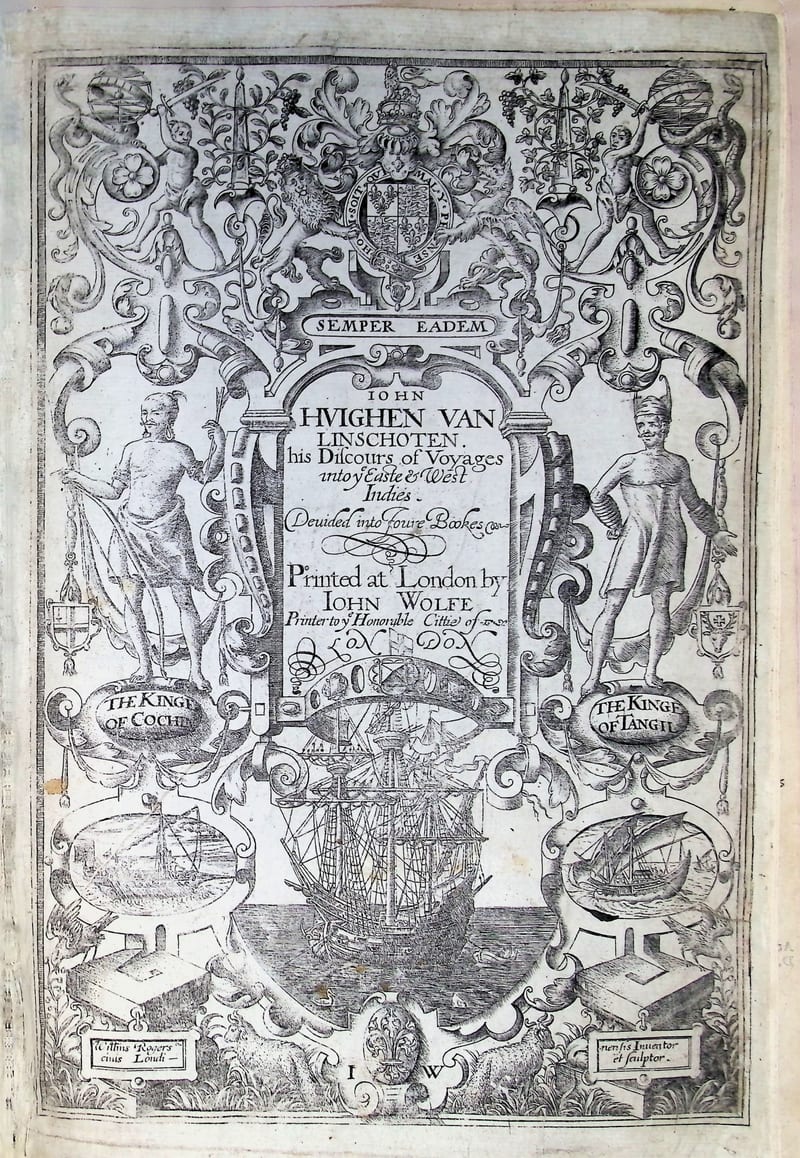
John Huighen van Linschoten his Discours of Voyages into ye Easte & West Indies
Jan Huygen van Linschoten (translated by William Phillip) · London · 1598
Price on request
Voyages & Discovery · FM-0044
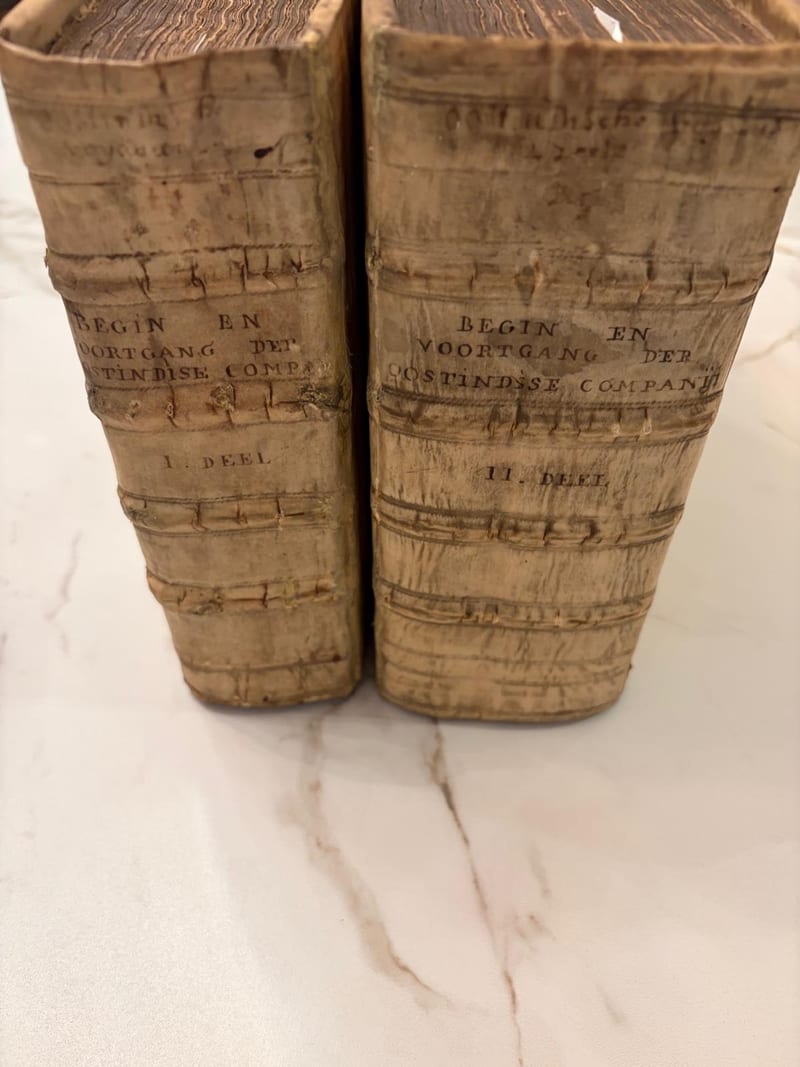
Begin ende Voortgangh van de Vereenighde Nederlantsche Geoctroyeerde Oost-Indische Compagnie
Isaac Commelin (compiler and editor) · Amsterdam · 1646
Price on request
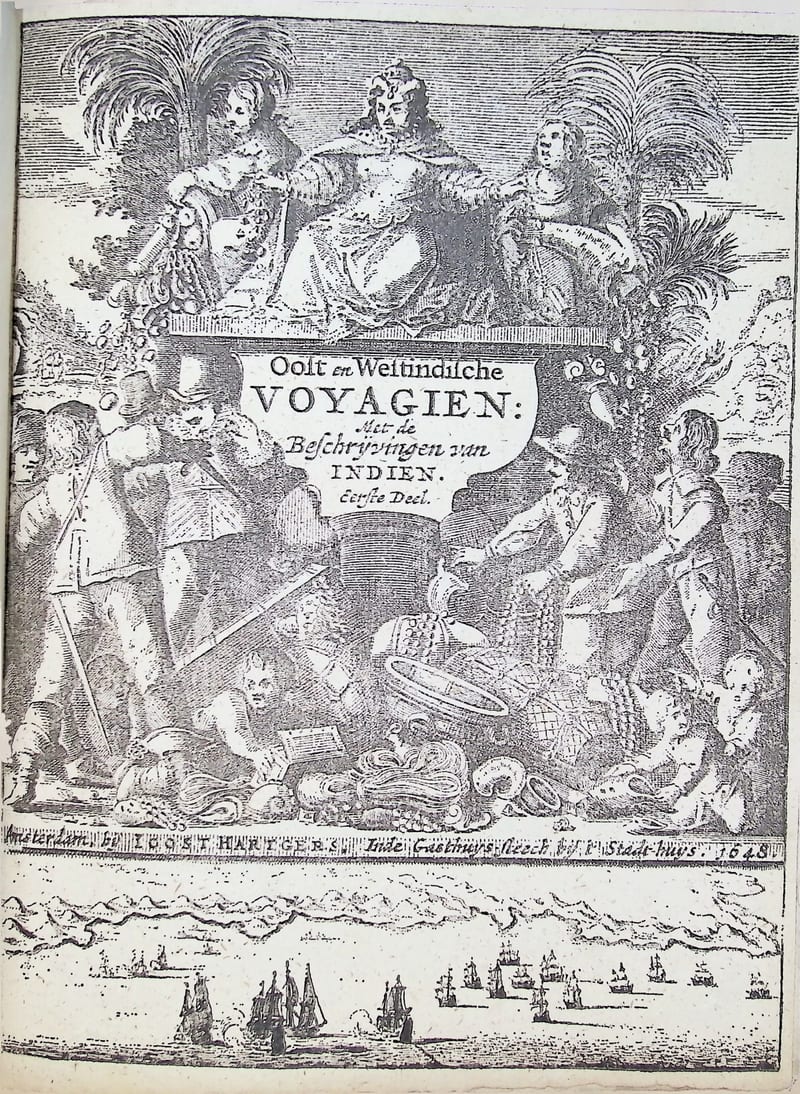
Voyages & Discovery · FM-0030
Oost-Indische voyagien
Joost Hartgers (collector & printer); various authors · Amsterdam · 1648
Price on request
All 26 works: The Dutch East India Company (VOC) → · The Dutch East India Company (VOC) · The Strait of Magellan and Cape Horn